|
FM
Boosters Topic at NAB Radio Show Session
Boosters
have been in use since the 1980s to provide same-frequency "fill-in"
service for FM stations. A session at the upcoming NAB Radio Show
(September 17-19, 2008, Austin, TX, www.nabradioshow.com)
called “FM Boosters—Opportunities and Challenges”
will explore the theory behind booster usage and provide practical
information on when and how broadcasters can use boosters to provide
better coverage within their service area. Stan Salek, a registered
Professional Engineer with the engineering consulting firm of
Hammett & Edison (San Francisco, CA, www.h-e.com)
will be conducting this session, and has provided some introductory
material on this topic for this week’s Radio TechCheck.
The
concept of FM boosters is quite simple: extend coverage into areas
that are not served or well-served by the main transmitter. The
FCC does not permit boosters to exist outside of an FM station's
projected service contour, so from a regulatory standpoint, there
is no service gain. In the real world, however, FCC contours,
which only take an average of terrain conditions out to 16 kilometers
from the main transmitter site, do not always provide a realistic
assurance of coverage, potentially leaving areas without adequate
service.
Mountainous
regions of the U.S. provide excellent sites for FM transmitting
facilities without the need for tall towers. Those same mountains,
though, can create a great deal of blockage to FM signal propagation,
and hence blockage to communities potentially located on the other
side of neighboring ridgelines. The opportunity to serve such
communities is sometimes offset by considerable challenge. Establishing
a booster in a signal-shadowed area involves (1) locating an optimum
booster site, (2) delivering a clean program signal to the booster,
and (3) controlling areas of potential self-interference where
main and booster signals are both receivable.
Over
the years, finding a suitable site for an FM booster has been
subject to much experimentation, but more recent terrain-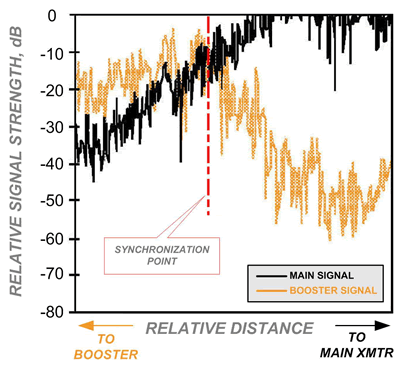 sensitive
propagation analysis has been applied to add a degree of science
to the process. Delivering a program signal to a booster is often
a challenge in itself, because the same terrain that blocks the
FM signal also blocks direct microwave STL signals. Creative ways
often need to be developed to provide programming to a booster.
Finally, and often most challenging, controlling the overlap between
main and booster signals is paramount in determining whether a
booster implementation is a success. Arguably the most common
reason that a booster fails in implementation is when it causes
greater lost service than the new service it creates. sensitive
propagation analysis has been applied to add a degree of science
to the process. Delivering a program signal to a booster is often
a challenge in itself, because the same terrain that blocks the
FM signal also blocks direct microwave STL signals. Creative ways
often need to be developed to provide programming to a booster.
Finally, and often most challenging, controlling the overlap between
main and booster signals is paramount in determining whether a
booster implementation is a success. Arguably the most common
reason that a booster fails in implementation is when it causes
greater lost service than the new service it creates.
Methods
of signal synchronization have improved over the years to the
point where it is possible to provide a nearly seamless transition
between main and booster service on FM receivers moving between
the service areas. However, because the main and booster transmitters
are located at separate sites, perfect synchronization occurs
only in an elliptical band between the sites. The time delay of
one transmitted signal can be adjusted to steer the "seam"
to a populated area, but self-interference still occurs as the
receiver moves farther away from the seam. The goal is to place
the inevitable self-interference zones to unpopulated areas, and
to make sure that the booster service area is well contained outside
the main service area.
The
figure above illustrates a real example of successful main/booster
synchronization. In this case, a large east-west mountainous ridge
exists with the main FM transmitter on the north face and the
booster transmitter on the south face. Just to the west of the
ridge is a major north-south roadway. The figure shows actual
measured relative signal levels of the main and booster facilities,
taken separately, when traveling on the roadway. As can be seen,
the main transmitter signal is dramatically stronger to the north
(i.e. towards the transmitter), but begins to fade as the ridge
creates blockage in the south. At one point, the main and booster
signals are essentially equal (the “synchronization point”
in the figure), with the booster signal more dominant in the south
(i.e. towards the booster). The timing synchronization point was
adjusted to place it on the roadway at the equal signal strength
point. As a further result, the interference areas were placed
on the unpopulated mountain ridge and in other lesser populated
areas.
FM
booster implementation is further complicated by the new need
to preserve in-band, on-channel (IBOC) digital signals that could
exist on main and booster signals of a station. Due to the nature
of the analog and digital decoders used in receivers, synchronization
of digital signals is a much more mathematical process. Recent
studies have been conducted to quantify the behavior of networked
IBOC transmitters, called Single Frequency Networks (SFNs). The
predicted performance of these networks can be directly applied
to IBOC booster implementations.
The
FM boosters engineering session will be held Wednesday, September
17, 2008 from 10AM-11AM in room 17A (on level 4) of the Austin
Convention Center. Additional information about The NAB Radio
Show engineering sessions is available online at http://www.nabradioshow.com/2008/conferences/EngineeringProgram.asp.
 NAB
AM Antenna NAB
AM Antenna 
Computer Modeling Seminar
November 20-21, 2008
NAB Headquarters
Washington, DC
Don’t miss this opportunity for broadcast engineers to learn
the basics needed to utilize modeling software such as MININEC
and nodal analysis for designing performance-optimized AM directional
antenna phasing and coupling systems and proving the performance
of directional antenna patterns.
You
will learn about:
- Moment
Method Modeling Basics
- DA Proofing
Using Moment Method Modeling
- Overcoming
Limitations of Using Field Strength Measurements for DA Proofs
- State
of the Art in Phasing System Design Nodal Analysis of AM DA
Phasing and Coupling Systems
- Pattern
Design Considerations for Optimum Performance
AM
antenna experts Ron Rackley and Ben Dawson, along with antenna
modeling software specialist Jerry Westberg, will lead the seminar
demonstrating how moment method modeling makes analysis of actual
tower current distributions possible and how a model can be used
to proof an array provided the proper criteria are considered.
All instructors are well known in the radio industry as experts
in the field of directional antenna design and maintenance. Their
decades of experience offer station engineers an opportunity to
learn techniques, tips and tricks that can be immediately useful.
Seminar
fee: $395.00 (NAB members) and $495.00 (non-members). For
more information on the curriculum, how to register or housing
go to AM
Antenna Computer Modeling Seminar on the NAB Web site or call
Sharon Devine at (202)-429-5338. Register now for the NAB AM Antenna
Computer Modeling Seminar!

The August 18, 2008 Radio
TechCheck is also available in an Adobe Acrobat file.
Please
click
here to read the Adobe Acrobat version of Radio TechCheck.
|
