|
FM
Radios in Cell Phones
According
to the latest figures, nearly 85% of the people in the U.S. have
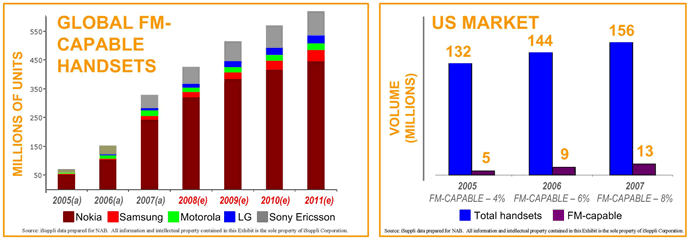
a cell phone, but while outside the U.S. about 34% of all cell
phones have a built-in FM radio receiver, in the U.S. that number
is only about 8% (see chart below, at right). A new report commissioned
by the NAB technology advocacy program NAB FASTROAD (Flexible
Advanced Services for Television & Radio On All Devices) outlines
the potential benefits that could result from an increase in the
penetration of FM radio receivers in cell phone handsets. This
study concludes that cell phone service providers, radio broadcasters,
and handset manufacturers all stand to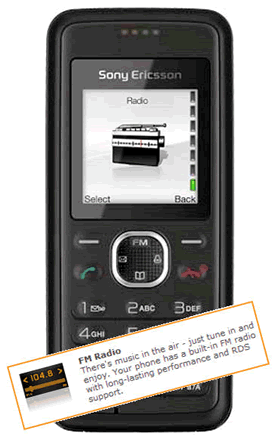 benefit from the expansion of FM-capable cell phones.
The
report, entitled "Study of the Potential for FM Radio to
be a Universal Feature on Cellular Handsets," was authored
by Dr. Joseph Kraemer of the Law and Economics Consulting Group
(LECG) and Richard O. Levine of Constantine Cannon LLP. Some of
the key facts contained in this study include the following:
-
Cellular systems outside of the U.S. are more
“open” and customers typically purchase their handset
first and select a carrier second. Consequently, for these
markets, cellular phone manufacturers include features such
as FM receivers to differentiate their phones from others
and attract customers to their products.
- In the
U.S., the distribution of handsets is largely controlled by
the cellular carriers themselves, who offer subsidized handsets
in return for agreement to one- or two-year contracts. Last
year, U.S. consumers purchased approximately 156 million handsets,
which means that the embedded base of U.S. handsets turns
over in less than two years and further, that if FM-capable
cell phones became more readily available in the U.S., they
could reach significant penetration in a similar period of
time.
- Worldwide
the Global System for Mobile Communications (GSM) cell phone
standard is predominant, while in the U.S. the market is nearly
evenly split between two incompatible systems, GSM (used by
AT&T and T-Mobile) and Code Division Multiple Access (CDMA)
technology (used by Verizon and Sprint). Further, most of
the FM-capable cell phones in the U.S. are GSM phones, which
is a consequence of the global GSM predominance and the fact
that the demand for FM-capable cell phones is greater outside
the U.S.
- Most
of the FM-capable handsets are made by Nokia and Sony Ericsson
(see chart at left) but in the U.S., Nokia is only fourth
in terms of total handset sales (but number one globally)
and Sony Ericsson is not in the top five, which helps to explain
why there are fewer FM-capable cell phones in the U.S. Nokia
offers 47 different cell phone models (out of 67, or 70%)
in the U.S. which include FM receivers.
Benefits
to be obtained by inclusion of FM receivers in cell phones include
increased cellular service subscriber satisfaction, ad-sharing
opportunities, and reduced-cost on-air cellular promotions. The
report also notes that cellular operators are increasingly dependent
on revenue from non-voice services, including music downloads.
The implementation of FM receivers on cell phones could provide
a boost to music downloads, the report suggests, by facilitating
"tagging" of songs heard on the FM receiver for later
purchase. FM receivers would also give cell phone users access
to the
Emergency Alert System (EAS) announcements that are relied upon
as a lifeline for Americans during emergencies.
A
potential catalyst for broadcaster/cellular network provider partnerships
identified in the report is the pending implementation of the
Commercial Mobile Alert System (CMAS) as recently defined by the
FCC in a Report and Order adopted by the Commission in April of
this year. A number of commenters in that proceeding have suggested
an FM radio-based solution to the CMAS requirements, which would
require the inclusion of FM receivers in cell phone handsets.
The
full text of the report and information on the NAB FASTROAD technology
advocacy program are available at www.nabfastroad.org.
 NAB
AM Antenna NAB
AM Antenna
Computer Modeling Seminar
November 20-21, 2008
NAB Headquarters
Washington, DC
Don’t miss this opportunity for broadcast engineers to learn
the basics needed to utilize modeling software such as MININEC
and nodal analysis for designing performance-optimized AM directional
antenna phasing and coupling systems and proving the performance
of directional antenna patterns.
You
will learn about:
- Moment
Method Modeling Basics
- DA Proofing
Using Moment Method Modeling
- Overcoming
Limitations of Using Field Strength Measurements for DA Proofs
- State
of the Art in Phasing System Design Nodal Analysis of AM DA
Phasing and Coupling Systems
- Pattern
Design Considerations for Optimum Performance
AM
antenna experts Ron Rackley and Ben Dawson, along with antenna
modeling software specialist Jerry Westberg, will lead the seminar
demonstrating how moment method modeling makes analysis of actual
tower current distributions possible and how a model can be used
to proof an array provided the proper criteria are considered.
All instructors are well known in the radio industry as experts
in the field of directional antenna design and maintenance. Their
decades of experience offer station engineers an opportunity to
learn techniques, tips and tricks that can be immediately useful.
Seminar
fee: $395.00 (NAB members) and $495.00 (non-members). For
more information on the curriculum, how to register or housing
go to AM
DA Seminar on the NAB Web site or call Sharon Devine at (202)-429-5338.
Register now for the NAB AM Antenna Computer Modeling Seminar!


The
June 23, 2008 Radio TechCheck is also available
in an Adobe Acrobat file.
Please
click
here to read the Adobe Acrobat version of Radio TechCheck.
|
