|
iBiquity
Submits Report on “High Power” FM IBOC to FCC
There
has been considerable discussion recently within the radio broadcasting
industry about the possibility of increasing the power of the
digital sidebands in a hybrid FM IBOC signal, so as to improve
the IBOC signal’s coverage and to provide for improved building
penetration. Last week, iBiquity Digital Corporation (Columbia,
MD, www.ibiquity.com) submitted
a comprehensive study to the FCC, detailing their investigation
of so-called “high power” FM IBOC operation and concluding
that raising the power of the digital portion of the hybrid FM
IBOC signal by 10 dB, from the current level of -20 dB below the
analog carrier (i.e., -20 dBc) to -10 dBc, will significantly
improve digital coverage and not “meaningfully increase”
potential interference to analog.
 The
iBiquity test program consisted of two principal parts. The first
part focused on establishing the extent of the digital coverage
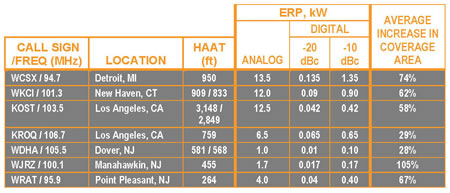
improvement with the 10 dB increase in digital power. To determine
this, coverage measurements were made for seven radio stations
(see first table) operating at -20 dBc (digital signal power)
and then at -10 dBc, and the results were compared. Note that
in the table, stations with two numbers listed for Height Above
Average Terrain (HAAT) use a dual-antenna IBOC configuration.
The stations used in this study were located in three different
areas of the country and represent a variety of RF environments: The
iBiquity test program consisted of two principal parts. The first
part focused on establishing the extent of the digital coverage
improvement with the 10 dB increase in digital power. To determine
this, coverage measurements were made for seven radio stations
(see first table) operating at -20 dBc (digital signal power)
and then at -10 dBc, and the results were compared. Note that
in the table, stations with two numbers listed for Height Above
Average Terrain (HAAT) use a dual-antenna IBOC configuration.
The stations used in this study were located in three different
areas of the country and represent a variety of RF environments:
NY/NJ/Connecticut/Rhode
Island – varied terrain (rolling hills, water, etc.),
multipath interference and closely spaced stations;
Detroit
– flat terrain and extensive analog coverage;
Los
Angeles/San
Diego/Santa Barbara – terrain obstructions and high
power analog operations.
For
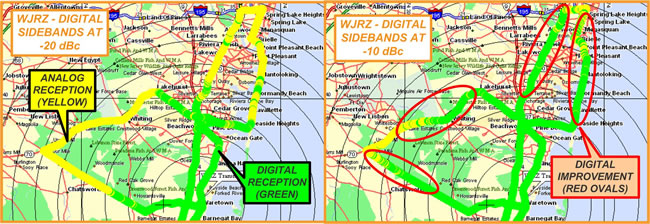
all cases, the increased digital power level significantly improved
digital coverage (see rightmost column in the first table). The
maps below show the extent of the improvement for one portion
of the WJRZ listening area. The green and yellow paths in the
maps represent the test routes that the iBiquity test vehicle
drove along, with yellow indicating analog reception and green
indicating digital reception. The left and right maps are for
the cases with -20 dBc and -10 dBc digital signal power, respectively,
with the improvement areas highlighted with red ovals in the right
map.
 |
In the second part of the study, analog audio was recorded from
stations 1st-adjacent to IBOC stations, operating first with -20
 dBc
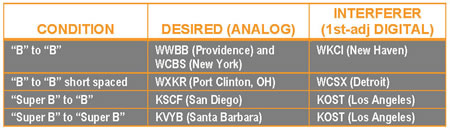
digital signal power, then with -10 dBc. Four specific scenarios
were tested and are shown in the second table, where “short
spaced” refers to the situation where the two stations (the
IBOC and 1st-adjacent channel analog) are spaced more closely
than current FCC allocation rules would allow. For each situation,
audio recordings were made using six commercially available radio
receivers: home hi-fi (1), tabletop (2), automotive OEM (1) and
automotive aftermarket (2). dBc
digital signal power, then with -10 dBc. Four specific scenarios
were tested and are shown in the second table, where “short
spaced” refers to the situation where the two stations (the
IBOC and 1st-adjacent channel analog) are spaced more closely
than current FCC allocation rules would allow. For each situation,
audio recordings were made using six commercially available radio
receivers: home hi-fi (1), tabletop (2), automotive OEM (1) and
automotive aftermarket (2).
These
recordings were sent to Salisbury University (Salisbury, MD, www.salisbury.edu)
for formal subjective evaluation using general population listeners.
Based on this analysis, iBiquity concluded that “...in the
vast majority of circumstances, the increase in digital power
will not result in a meaningful increase in the potential for
harmful digital to analog interference.” They further suggest
that any actual interference that may occur as a result of an
increase in power can be addressed by the stations or the FCC
on a case-by-case basis.
The
iBiquity report is entitled “Compatibility and Performance
Tests at Elevated FM Digital Power Levels” and includes four
appendices: a detailed test procedure, detailed system performance
results, a subjective evaluation report by Dr. Ellyn Sheffield
et.al. of Salisbury University, and information on class B and
super B stations, including an analysis of the number of short-spaced
B-to-B stations and the level of severity of the short spacing.
All of these documents can be obtained by going to the FCC’s
Electronic Comment Filing System (ECFS) Web page (http://gullfoss2.fcc.gov/prod/ecfs/comsrch_v2.cgi)
and entering “99-325” into BOX 1 on this page, then
clicking on “Retrieve Document List” at the bottom of
the page. On the resulting page, look for the 116 page report
filed on behalf of iBiquity Digital Corporation on 6/10/08 (the
report is contained in six separate documents).
Additional
information on operation of hybrid FM IBOC at elevated digital
power levels is available in technical papers presented at the
2008 NAB Broadcast Engineering Conference (BEC) this past April
in Las Vegas, NV: 
- FM
IBOC Building Penetration Tests at Elevated Digital Subcarrier
Levels by E. Glynn Walden, Senior VP of Engineeringwith
CBS Radio, discusses tests conducted by CBS Radio on HD Radio
signal building penetration in the Los Angeles radio market.
Ten buildings were tested, differing in construction type
and usage. These buildings ranged from a residential dwelling
to an office building in downtown Los Angeles;
- Implications
of IBOC Injection Levels above -20dB by Gary Liebisch,
Regional Sales Manager, Nautel, offers an assessment of the
impact of higher IBOC injection on the broadcast signal. The
implications of changing existing broadcast infrastructure
and an update on new installation recommendations are considered,
and information is provided on transmitter performance along
with possibilities for performance enhancement through peak-to-average
ratio reduction, precorrection and combining techniques.
These
papers are included in the 2008 BEC Proceedings which are available
online from the NAB Store at www.nabstore.com/20brencopr.html.
 NAB
AM Antenna NAB
AM Antenna
Computer Modeling Seminar
November 20-21, 2008
NAB Headquarters
Washington, DC
Don’t miss this opportunity for broadcast engineers to learn
the basics needed to utilize modeling software such as MININEC
and nodal analysis for designing performance-optimized AM directional
antenna phasing and coupling systems and proving the performance
of directional antenna patterns.
You
will learn about:
- Moment
Method Modeling Basics
- DA Proofing
Using Moment Method Modeling
- Overcoming
Limitations of Using Field Strength Measurements for DA Proofs
- State
of the Art in Phasing System Design Nodal Analysis of AM DA
Phasing and Coupling Systems
- Pattern
Design Considerations for Optimum Performance
AM
antenna experts Ron Rackley and Ben Dawson, along with antenna
modeling software specialist Jerry Westberg, will lead the seminar
demonstrating how moment method modeling makes analysis of actual
tower current distributions possible and how a model can be used
to proof an array provided the proper criteria are considered.
All instructors are well known in the radio industry as experts
in the field of directional antenna design and maintenance. Their
decades of experience offer station engineers an opportunity to
learn techniques, tips and tricks that can be immediately useful.
Seminar
fee: $395.00 (NAB members) and $495.00 (non-members). For
more information on the curriculum, how to register or housing
go to AM
DA Seminar on the NAB Web site or call Sharon Devine at (202)-429-5338.
Register now for the NAB AM Antenna Computer Modeling Seminar!


The
June 16, 2008 Radio TechCheck is also available
in an Adobe Acrobat file.
Please
click
here to read the Adobe Acrobat version of Radio TechCheck.
|
