|
FCC
Develops Class A FM Allotment Channel Finder Tool
The
first step in obtaining a license for a new FM station (i.e. one
for which no allotment currently exists) for operation in the
commercial band (92-108 MHz) is to petition the FCC to add a new
allotment to the FM Table of Allotments, 47 CFR § 73.202(b).
Late last month, the FCC announced the availability of a new Internet-based
tool at www.fcc.gov/mb/audio/allotmentfinder.html
designed to help identify, by community, those Class A FM channels
which are potentially available for new allotments. Class A FM
stations may have a maximum effective radiated power (ERP) of
6 kW at an antenna height above average terrain (HAAT) of 100m
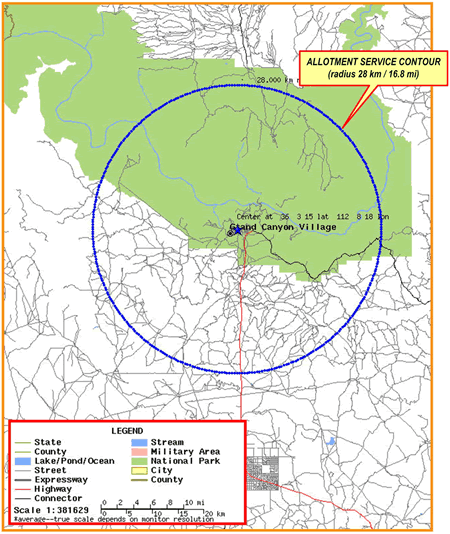
(328 ft), with a service contour of radius 28 km (16.8 mi).
 According
to the FCC, this tool is restricted to searches for Class A channels
because,as the smallest commercial station class, a search for
a Class A allotment will have the highest likelihood of success.
As explained in more detail on the Channel Finder tool Web page,
a successful search does not guarantee the availability of a channel
at a specific location. Radio spectrum rights are established
on a “first-come, first-served” basis. Thus, an application
could be filed at any time to preclude a new allotment proposal.
The tool also does not take into account many other factors that
can limit radio station transmitter site location options, for
example, environmental restrictions, land use regulations, and
Federal Aviation Administration air hazard issues. According
to the FCC, this tool is restricted to searches for Class A channels
because,as the smallest commercial station class, a search for
a Class A allotment will have the highest likelihood of success.
As explained in more detail on the Channel Finder tool Web page,
a successful search does not guarantee the availability of a channel
at a specific location. Radio spectrum rights are established
on a “first-come, first-served” basis. Thus, an application
could be filed at any time to preclude a new allotment proposal.
The tool also does not take into account many other factors that
can limit radio station transmitter site location options, for
example, environmental restrictions, land use regulations, and
Federal Aviation Administration air hazard issues.
A search conducted using the Channel Finder tool
will provide information on two key technical issues that determine
the acceptability of an allotment petition:
whether
a channel is available at the proposed transmitter site; and
whether
a Class A station could place a premium strength (city-grade)
70 dBµ signal over the community of license from the proposed
transmitter site.
The first step is to establish the latitude and longitude coordinates
of the community for which the allotment is sought. This can be
done using the FCC’s “Atlas” program (www.fcc.gov/mb/audio/bickel/atlas2.html).
Using Grand Canyon, AZ as an example, the coordinates for this
community according to the Atlas program are latitude 36°
3’ 5”, longitude W 112° 8’ 18.”
Next,
these coordinates are entered into the Channel Finder tool (note:
do not enter a minus sign on the longitude coordinates, as is
typically done for west longitude coordinates) which then performs
a channel search based on data derived from the FCC Media Bureau's
Consolidated Database System (CDBS). Again, using Grand Canyon,
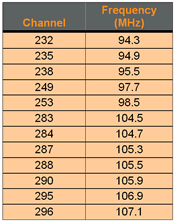
AZ as an example, twelve available channels are identified (listed
in the table), and a map can be drawn (from the Channel Finder
tool Web page), shown here, indicating the channel center coordinates
and allotment service contour.
The
FCC strongly recommends that an allotment proponent confirm with
a broadcast consulting engineer the availability of an "available"
channel prior to filing an allotment petition. For additional
information, contact Dale Bickel of the FCC Media Bureau’s
Audio
Division at (202) 418-2700.
FCC
Updates “The Public and Broadcasting”
 The
FCC’s Media Bureau has released an updated version of a document
titled “The Public and Broadcasting.” This publication,
which every broadcaster is required to have a copy of in their
public inspection file, provides an overview of the FCC’s
regulation of broadcast radio and television licensees, describes
how broadcast stations are authorized, and explains the various
rules and policies relating to broadcast programming and operations
with which stations must comply, including the obligation to serve
their local communities. It also explains how members of the public
can become involved in assessing whether local broadcast stations
are complying with these requirements. The publication is also
intended to make the public aware of FCC procedures and the tools
at their disposal, in the event that they conclude that any of
their local stations do not meet these responsibilities. The
FCC’s Media Bureau has released an updated version of a document
titled “The Public and Broadcasting.” This publication,
which every broadcaster is required to have a copy of in their
public inspection file, provides an overview of the FCC’s
regulation of broadcast radio and television licensees, describes
how broadcast stations are authorized, and explains the various
rules and policies relating to broadcast programming and operations
with which stations must comply, including the obligation to serve
their local communities. It also explains how members of the public
can become involved in assessing whether local broadcast stations
are complying with these requirements. The publication is also
intended to make the public aware of FCC procedures and the tools
at their disposal, in the event that they conclude that any of
their local stations do not meet these responsibilities.
In
addition to having this document in the public inspection file,
broadcasters must provide a copy of this publication to any member
of the public who requests one. The current version is available
on the FCC’s Web page at www.fcc.gov/mb/audio/decdoc/public_and_broadcasting.html.
Also,
effective with the release of this latest version, two Broadcast
Information Specialists, one in the Media Bureau’s Audio
Division and one in its Video Division, will now serve as contact
points for the public, accessible via toll-free phone numbers,
facsimile, or e-mail. These individuals will be available to provide
information to persons interested in becoming involved in the
Commission’s processes, and will answer questions about how
to do so, including inquiries about the FCC’s complaint or
petitioning procedures or the filing and status of the license
renewal, modification or assignment or transfer application for
a particular station. The Broadcast Information Specialists can
be contacted as follows:
If
the inquiry relates to a radio station:
Phone: (866) 267-7202 (Voice) or (877) 479-1433 (TTY)
Fax: (202) 418-1411
E-Mail: radioinfo@fcc.gov
If
the inquiry relates to a television station:
Phone: (866) 918-5777 (Voice) or (866) 787-6222 (TTY)
Fax: (202) 418-2827
E-Mail: tvinfo@fcc.gov
If
the inquiry relates to both a radio and a television station,
or is general in nature, the FCC indicates that either specialist
may be contacted.


The May 12, 2008 Radio TechCheck is also available
in an Adobe Acrobat file.
Please click
here to read the Adobe Acrobat version of Radio TechCheck.
|