|
Radio
Broadcasters: Building File-Based Networks
 Consolidating
radio services from multiple end broadcast sites to a single centralized
location promises dramatic economies of scale, but also presents
unique challenges. A session at this year’s NAB Broadcast
Engineering Conference (BEC, held from April 12-17, 2008, at the
2008 NAB Show in Las Vegas, NV) entitled “Radio Technology
Advancements” included a paper (excerpted here) by Eric Wiler
(Jones Radio Networks, Centennial, CO) and Gary Pelkey (Wegener,
Duluth, GA) which discusses how an intelligent centralized solution
allows radio networks to support the technical and business needs
of today’s radio networks. Consolidating
radio services from multiple end broadcast sites to a single centralized
location promises dramatic economies of scale, but also presents
unique challenges. A session at this year’s NAB Broadcast
Engineering Conference (BEC, held from April 12-17, 2008, at the
2008 NAB Show in Las Vegas, NV) entitled “Radio Technology
Advancements” included a paper (excerpted here) by Eric Wiler
(Jones Radio Networks, Centennial, CO) and Gary Pelkey (Wegener,
Duluth, GA) which discusses how an intelligent centralized solution
allows radio networks to support the technical and business needs
of today’s radio networks.
INTRODUCTION
– many radio networks today integrate multiple devices at
each affiliate station for local ads, station identifiers, local
traffic and weather. A more efficient means of achieving these
goals is to leverage a centralized solution that uses addressable
devices to receive live audio broadcasts, store regionalized to
local content and seamlessly combine them to customize broadcasts.
This solution can be achieved through a seamless combination of
network control, content management and media server technology.
Jones Radio Networks (JRN) is an example of a large radio network
utilizing this technology.
NEXT-GENERATION
DELIVERY – in 2004, JRN identified the need to enhance
their products and targeted Wegener as their technology partner
to develop their next-generation delivery platform. This next
generation network architecture incorporates elements of file
based workflows and robust management tools in both the centralized
satellite uplink location and at affiliate stations. Stations
may choose to receive programming from one of several music formats.
Stations also can choose to subscribe to sets of short form programming
(such as talk and music shows), which are not part of any particular,
dedicated format. Both of the above are easily achieved with a
traditional linear digital receiver and addressable control system.
To keep the management of the program switching from exploding
in complexity, while still allowing flexible end user selection
of formats and long form programs, requires a control system that
provides a “funneling” of user requests into manageable
packages, which can then be implemented via “switch groups.”
 The
JRN updated network control system provides a mechanism to, for
example, switch a set of receivers, on Monday through Friday from
“The Clark Howard” show to the “Neal Boortz”
program, at precisely 3:00 local time. Once receivers are moved
into or out of their correct switching and time zone groups, all
format and switching takes place automatically, without further
operator intervention. Thus thousands of stations may receive
essentially custom programming without any local personnel, and
without an army of centralized personnel. The
JRN updated network control system provides a mechanism to, for
example, switch a set of receivers, on Monday through Friday from
“The Clark Howard” show to the “Neal Boortz”
program, at precisely 3:00 local time. Once receivers are moved
into or out of their correct switching and time zone groups, all
format and switching takes place automatically, without further
operator intervention. Thus thousands of stations may receive
essentially custom programming without any local personnel, and
without an army of centralized personnel.
PLAYING
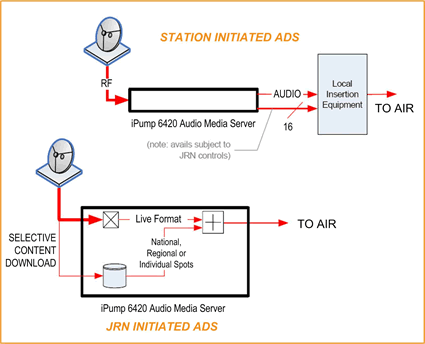
LOCAL OR REGIONAL ADVERTISING – another important 'localizing'
feature is the ability to play local or regional advertising.
Local stations sell advertising, and require cueing information
to properly trigger downstream insertion equipment (see figure).
The receiver / media server must support this with a bank of relays
for each audio output. Select relays are activated such that a
relay will only close if the associated decoder is outputting
an audio format that is currently undergoing a “break.”
These triggers can be further restricted to only those sites that
have contracted for this feature with JRN, by selectively including
them in special “Local Avail” groups maintained by the
control system.
Alternately,
ads may be inserted as files directly by the receiver / media
server itself, under complete control of JRN. This is done by
first loading a spot as a file onto the receiver/media server
hard drive. Spots with different content (but with a common name)
may be loaded regionally or individually into receiver / media
servers. Then at the spot avail time, a single control system
command is transmitted, resulting in highly “tailored”
ad output. Using the Internet-based return path, spots are verified
to have “landed” successfully on the receiver / media
servers, and “As-Run” logs may even be later retrieved
to verify the spots played at the station level.
TIMEZONE
DELAY AND SHOWSHIFTING – Two other features made possible
by file based networks are Timezone Delay and Showshifting™.
Timezone Delay allows an end station to completely shift the network
broadcast format such that the audio plays out of the unit in
exactly the same time relationship (to the local time zone) that
it had when it originated (relative to the network’s time
zone). Thus a typical audio format (e.g., “jazz”) may
have all of its songs, DJ banter, liners, PSAs, and even local
breaks and PAD (Program Associated Data) shifted forward in the
day by a set number of hours. Showshifting is another highly customizing
feature of the system. Using it, the station end user (or network
operator) may “point” to a show (such as “Neal
Boortz”) and specify that program to play out of the receiver
/ media server at 9PM every evening (rather than the 10AM time
at which it is transmitted). This may even occur if “Neal
Boortz” is transmitted on another channel than what the receiver
/ media server is statically set to decode. As with Timezone Delay,
all activity associated with that program (internal or external
ad insertions, liners, PAD data, etc.) are captured and used in
the correct manner as the show is later played out. Showshifting
yields tremendous satellite bandwidth savings over linear operations.
Without it, the network is forced to rebroadcast a show multiple
times to allow affiliates the ability to air it at a more desired
time slot.
This
paper is included in its entirety in the 2008 NAB BEC Proceedings,
available from NAB - to order, call 1-800-368-5644 (www.nabstore.com).
For additional conference information visit the NAB Show web page
at www.nabshow.com.

The April 28,
2008 Radio TechCheck is also available in an Adobe
Acrobat file.
Please click
here to read the Adobe Acrobat version of Radio TechCheck.
|
