|
Digital
Opportunities for Radio
Radio broadcasters
have many more options for distributing their content than ever
before. A session at the upcoming NAB Broadcast Engineering Conference
(BEC, April 12-17, 2008, Las Vegas, NV – see below for additional
information) entitled “Digital Opportunities for Radio”
includes a paper (excerpted here) by Melinda Driscoll and Nick
Kereakos (American Public Media | 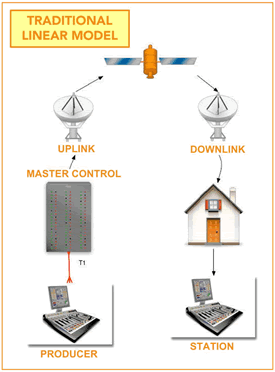 Minnesota
Public Radio, St. Paul, MN) and Laura Jensen (National Public
Radio, Washington, DC) which discusses various ways that public
radio broadcasters are changing traditional workflows to accommodate
new media. Minnesota
Public Radio, St. Paul, MN) and Laura Jensen (National Public
Radio, Washington, DC) which discusses various ways that public
radio broadcasters are changing traditional workflows to accommodate
new media.
TRADITIONAL
RADIO PRODUCTION WORKFLOWS – in traditional radio content
production models, produced content is targeted at single channel
terrestrial broadcast radio. Regardless of whether the radio content
is local, distributed, or even syndicated, it is still a single
channel medium limited within the constraints of the aural listening
experience. In recent years this reality has kept the production
process and audience digestion straightforward and linear (see
figure at right). This traditional model is characterized by building
a singular listening experience and the only written data is limited
to internal radio network messaging to inform program directors
of content for each episode.
SHIFTING
LANDSCAPE – during the infancy of the new media world
radio content generally made its way to consumers as a repurposed
entity. This meant that the same linear context existed on a new
channel, but wasn’t necessarily created with multiple mediums
in mind. Linear content combined with early low quality and lossy
encoders meant that listening to radio content on the Web had
limited market and audience penetration and may have been considered
more of an experiment and a learning tool rather than a legitimate
distribution channel. This is evidenced by an early common use
of the Web as a preview medium, keeping the data size low enough
to remain cost effective while giving the consumer an idea of
what the “real” content sounded like.
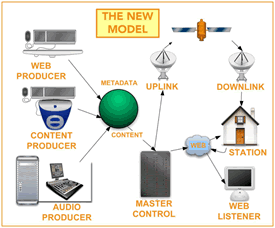
RE-DESIGNING
THE PRODUCTION MODEL – utilizing new channels and platforms
requires a new approach to the production cycle, an approach that
is smart and coordinated to align program content, metadata, and
targets. Prioritizing what data should be compiled and how the
content will be used must be decided early in the process to yield
maximum flexibility and listener impact. As we plan our production
workflow changes to adapt to these changes in audience use and
delivery technologies, we need to remember that the changes should
be driven by our audience needs and wants. In other words, our
new production processes shouldn’t focus only on enabling
channel delivery, they need to factor in the audience’s use
of these channels. Our production processes need to ensure that
our content is:
Available
– our content is available where our audience is looking;
Findable
– our content is presented, indexed, tagged so our
audience will find it;
Usable
– our content is presented in a way that’s accessible
and friendly to our audience’s behaviors.
 EXAMPLE:
MAKE IT FINDABLE – once we know where our audiences are
looking for our content, we need to be sure that they can find
our content there. Often, that means paying particular attention
to the search functions in the applications and directories where
our audiences are looking. For example, in September 2007 American
Public Media launched a new site on Apple’s iTunes “U
education” platform as part of Apple’s “Beyond
Campus” launch on iTunes U. Knowing that the iTunes U audience
would be looking for content in a much different way than we usually
present it to our public radio audience, we endeavored to tag
our content using common academic terms. In addition, we familiarized
ourselves with the iTunes U search function to determine which
metadata elements are most factored into search. We established
a workflow to insert keywords and descriptions accordingly. EXAMPLE:
MAKE IT FINDABLE – once we know where our audiences are
looking for our content, we need to be sure that they can find
our content there. Often, that means paying particular attention
to the search functions in the applications and directories where
our audiences are looking. For example, in September 2007 American
Public Media launched a new site on Apple’s iTunes “U
education” platform as part of Apple’s “Beyond
Campus” launch on iTunes U. Knowing that the iTunes U audience
would be looking for content in a much different way than we usually
present it to our public radio audience, we endeavored to tag
our content using common academic terms. In addition, we familiarized
ourselves with the iTunes U search function to determine which
metadata elements are most factored into search. We established
a workflow to insert keywords and descriptions accordingly.
This
paper will be presented on Sunday, April 13, 2008 starting at
11:30a.m. in room S226/227 of the Las Vegas Convention Center.
It will also be included in its entirety in the 2008 NAB BEC
Proceedings, on sale at the 2008 NAB Show. For additional
conference information visit the NAB Show web page at www.nabshow.com.
2008
NAB Broadcast Engineering Conference Opening Session
We Can Work Together: Advice to DTV and HD Radio Engineers
from the Consumer Electronics Retail Community
April 13, 2008 - 9:00AM - 9:30AM
Now
that DTV and HD Radio are on the air and receivers are in the
marketplace, feedback from the consumer electronics retail world
can help optimize these new services and increase the value proposition
to consumers. In this keynote session, experts in retail issues
associated with digital broadcasting will offer actionable advice
from the consumer retail world that can be productively used in
the broadcast engineering world to make the digital broadcasting
services even more compelling. Robert S. Schwartz, counsel to
the Consumer Electronics
Retailers Coalition, will cover DTV and Diane Warren, Executive
Vice President for the HD
Radio Alliance, will talk about HD Radio in this insightful
session.
2008
NAB Broadcast Engineering Conference Summary of Presentations
Check out the papers
that will be presented at the 2008 NAB Broadcast Engineering Conference
in Las Vegas, April 12 -17, 2008.
Mobile
TV: Opportunity at 100 MPH!
 Monday,
April 14 Monday,
April 14
7:30
a.m. - 8:30 a.m.
Las Vegas Hilton Ballroom A
The
Open Mobile Video Coalition (OMVC) invites engineers from television,
telcos, cable and OEMs to learn more about breakthroughs and milestones
in engineering, consumer interest and testing, as well as new
revenue opportunities in the fast approaching locally broadcast
Mobile TV world. Join OMVC executives for breakfast
with Master of Ceremonies Dan Abrams, NBC's chief legal correspondent
and the host of "Verdict with Dan Abrams" on MSNBC on
Monday, April 14 in Ballroom A at the Las Vegas Hilton.

The
April 7, 2008 Radio TechCheck is also available
in an Adobe Acrobat file.
Please click
here to read the Adobe Acrobat version of Radio TechCheck.
|