|
Arbitron
PPM Information for Broadcast Engineers
 The
Arbitron Portable People Meter (PPM) audience measurement system
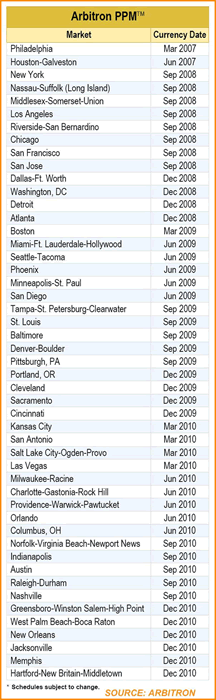
is now the ratings “currency” in Philadelphia and Houston-Galveston,
which means that PPM data has fully replaced the traditional diary
data in these markets (a schedule for the conversion of other
markets is shown at right). Last week, broadcast engineers in
the Washington, DC and Baltimore markets were invited to visit
Arbitron’s Columbia, MD facility for a technical briefing
on PPM technology, co-sponsored by Society of Broadcast Engineers
(SBE) chapters 37 (District of Columbia) and 46 (Baltimore). The
Arbitron Portable People Meter (PPM) audience measurement system
is now the ratings “currency” in Philadelphia and Houston-Galveston,
which means that PPM data has fully replaced the traditional diary
data in these markets (a schedule for the conversion of other
markets is shown at right). Last week, broadcast engineers in
the Washington, DC and Baltimore markets were invited to visit
Arbitron’s Columbia, MD facility for a technical briefing
on PPM technology, co-sponsored by Society of Broadcast Engineers
(SBE) chapters 37 (District of Columbia) and 46 (Baltimore).
Three particular
components of the PPM system—the encoder, the station monitor,
and the PPM itself— were discussed in detail at this briefing
which was led by Mr. Sam Brown, Broadcast Engineer with Arbitron:
The encoder
– Station ID, Program ID, and time tag information are inaudibly
added to a radio station’s audio signal in the encoder using
Arbitron’s patented Critical Band Encoding Technology (CBET).
Every AM and FM station in a PPM market is offered the encoders
it needs to encode its main-channel audio signal free-of-charge,
whether that station actually subscribes to Arbitron’s rating
service or not. The encoder (height 1U) fits into a standard studio
equipment rack and becomes part of the audio “air chain,”
providing continuous, real-time stereo encoding of program material
as it is broadcast. All encoders are installed as redundant pairs
to enhance system reliability. This equipment is self-monitoring
to ensure continuous operation and noninterference with the broadcast,
and will bypass itself in the event of a power failure or fault
detection.
Two different
models of encoder were shown at the briefing, one for analog audio
and one for digital (AES) audio. Arbitron broadcast engineers
work closely with station engineers to determine the best location(s)
for the encoders and pre-configure each encoder with call sign,
sample rate (for digital audio), etc., prior to shipping it to
the station. Once shipped, stations have 30 days to get the encoders
on-the-air so Arbitron recommends that stations pre-wire their
facilities to accommodate the encoders before requesting shipment.
Arbitron is
making encoders available for HD Radio multicast and streaming
Internet audio signals for a fee, and is scheduled to begin reporting
listening to these later this year.
The station
monitor – every station that broadcasts a PPM signal
must install PPM station monitors so they can check to see that
the over-the-air broadcast is being encoded properly. These monitors
are also provided to the station free-of-charge by Arbitron (except
for HD Radio multicast and streaming Internet audio signals).
The monitor will alert station engineers if it receives an incorrectly
encoded signal, or a signal that is not encoded at all. At the
briefing, Mr. Brown and his colleagues emphasized how important
it is that the encoding be present at all times on the signal,
for without it absolutely no listening can be measured.
The PPM
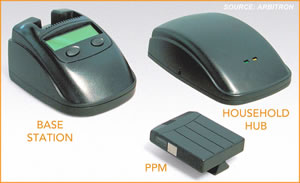
– there are three main parts to the PPM—the base station,
the PPM itself, and the household hub (see figure). The PPM is
a "mobile phone-sized" device occupying approximately
four cubic inches and weighing approximately 2.6 ounces. Arbitron
survey participants are instructed to wear the PMM from when they
get up in the morning until when they go to bed at night, and
all household members age 6 and older are given their own PPM.
The PPM has an especially sensitive audio transducer designed
to “hear” what the participant hears, digital signal
processing (DSP) circuitry to analyze the audio it hears for code
detection, on-board memory sufficient to store at least one day
of event codes, and a rechargeable battery which operates for
at least one day on a full charge.
 Each
PPM is equipped with a motion detector linked to a small green
light that is visible to the survey participant. The motion detector
is used by Arbitron to track whether the survey participant is
carrying the meter throughout the day. As long as the meter is
being carried, the motion detector senses the smallest movement
and keeps the green light illuminated. An accessory is available
for the PPM which allows it to monitor audio being listened to
with headphones or “ear buds.” This accessory fits over
top of the PPM and has two connectors—one attaches to a cable
going to the radio, the other to the headphone or ear bud cable. Each
PPM is equipped with a motion detector linked to a small green
light that is visible to the survey participant. The motion detector
is used by Arbitron to track whether the survey participant is
carrying the meter throughout the day. As long as the meter is
being carried, the motion detector senses the smallest movement
and keeps the green light illuminated. An accessory is available
for the PPM which allows it to monitor audio being listened to
with headphones or “ear buds.” This accessory fits over
top of the PPM and has two connectors—one attaches to a cable
going to the radio, the other to the headphone or ear bud cable.
At the end
of the day, the PPM is placed in the base station which extracts
data—both the collected identification codes and data from
the motion detector—and recharges the unit. The base station
connects wirelessly to the household hub and offers immediate
feedback to the survey participant. While each member of the household
has their own PPM and base station, only one hub is needed. The
hub has a modem (connected to the house phone line) which contacts
Arbitron at night and downloads the household data to the Arbitron
computers. In addition, the hub sends out a wireless signal to
each PPM allowing the PPM to distinguish between in-home and out-of-home
listening.
Other interesting
information about the PPM system mentioned at the briefing in Columbia
included the following:
- Respondents are awarded "points" based on the time
that the meter was actively in motion throughout the day. The
point total for the day and the total points awarded are displayed
on a liquid-crystal-display (LCD) messaging screen in the base
station, and are used as an incentive to encourage survey participants
to keep the PPM with them at all times;
- The data processing algorithms used by Arbitron are very
sophisticated and can determine, for example, if the same person
is carrying multiple PPMs;
- It is possible to do “multi-layer” encoding such
that commercials and network programming can have unique codes,
simultaneous with the station code;
- PPM encoding is by-design always below the peak level in
the audio signal and as such will never impact the modulation
level of the transmitted radio signal.
Currently,
PPM encoders are being installed in the San Francisco, Dallas,
Atlanta, Detroit, and Washington/Baltimore markets, and encoding
of the complete market is now being accomplished in New York,
Chicago, and Los Angeles (in addition to Philadelphia and Houston-Galveston).
For additional information on PPM, visit the Arbitron Web page
at www.arbitron.com/portable_people_meters/home.htm.
Additional technical details on the design of the PPM system are
available at www.arbitron.com/portable_people_meters/thesystem_ppm.htm.
2008
NAB Broadcast Engineering Conference Summary of Presentations
Check out the papers
that will be presented at the 2008 NAB Broadcast Engineering Conference
in Las Vegas, April 12 -17, 2008.
Mobile
TV: Opportunity at 100 MPH!
Monday, April 14 • 7:30 a.m. - 8:30 a.m.
Las Vegas Hilton Ballroom A
The Open Mobile
Video Coalition (OMVC) invites engineers from television, telcos,
cable and OEMs to learn more about breakthroughs and milestones
in engineering, consumer interest and testing, as well as new
revenue opportunities in the fast approaching locally broadcast
Mobile TV world. Join them for breakfast
on Monday, April 14 in Ballroom A.
The
March 24, 2008 Radio TechCheck is also available
in an Adobe Acrobat file.
Please click
here to read the Adobe Acrobat version of Radio TechCheck.
|