|
RF
Simulcasting over IP Networks
Simulcasting
on multiple overlapping transmitters on the same frequency can
provide broadcasters with significant advantages in increased
coverage and lower operating costs. A session at the upcoming
NAB Broadcast Engineering Conference (BEC, April 12-17, 2008,
Las Vegas, NV – see below for additional information) entitled
“New Technologies for Radio Listening” includes a paper
by Junius Kim of Harris Corporation describing how to utilize
IP connectivity between a studio and the multiple transmission
sites utilized in a simulcasting network.
INTRODUCTION
– RF simulcasting uses multiple, geographically diverse RF
transmitters operating on the same carrier frequency, modulating
the same program material. By using multiple transmitters, geographic
RF coverage area is expanded. This paper outlines a system for
audio simulcasting over an IP network. The system discussed uses
a 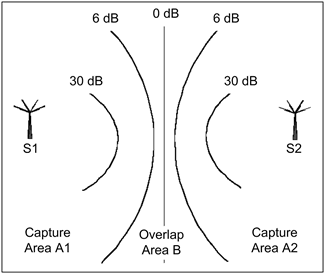 precision
absolute time reference provided by the Global Positioning System
(GPS). Using this reference, the system can measure the STL delay
between the studio and transmitter sites. The system uses this
information to set a programmable digital buffer delay to reach
a target delay. The buffer delay changes are smooth and hitless
resulting in no noticeable disturbance of the audio program material. precision
absolute time reference provided by the Global Positioning System
(GPS). Using this reference, the system can measure the STL delay
between the studio and transmitter sites. The system uses this
information to set a programmable digital buffer delay to reach
a target delay. The buffer delay changes are smooth and hitless
resulting in no noticeable disturbance of the audio program material.
SIMULCASTING
– broadcasting from two or more nearby transmitters on
the same frequency can lead to reception problems in the overlap
areas, i.e., the areas in which the RF signal level from multiple
transmitters is similar in strength. The figure at right depicts
the contours of relative signal strength from a two-site system.
In the overlap area, the relative power levels differ by less
than 6 dB. For simulcasting to work effectively, the broadcast
signal from each transmitter must arrive at the receiver at a
precisely controlled time.
MIGRATION
TO IP NETWORKS – previously, FM simulcasting systems were
typically limited to usage over Plesiochronous Digital Hierarchy
(PDH) network link types like T1 or E1 transmission links. Recently,
this technology has been successfully adapted for simulcasting usage
over packet switched networks like IP. IP networks offer the possibility
of highly flexible, low-cost audio transport, and when properly
managed can offer the degree of reliability required for use in
professional audio contribution and distribution networks. A simulcasting
system using an IP network must perform the following functions:
- Encoding and decoding of real-time program audio;
- Transport of program audio over IP via a process of packetization;
- Sending a GPS referenced timing marker from the studio site
to the transmitter site;
- Establishment and maintenance of timing across the IP network.
Circuit Emulation
Service (CES) technology has emerged as a method to transport Time
Division Multiplexing (TDM) trunks containing real-time applications
such as audio, across IP networks. This technology is sometimes
referred to as pseudo-wire, as it emulates the TDM circuit across
a packet network using virtual IP tunnel or path. These emulated
services can be implemented using a gateway device that provides
for an inter-working function (IWF) between TDM
and IP networks (see block diagram below). The primary benefit of
this technology is the cost and simplicity of deployment to support
all types of existing TDM applications without the need for complex
protocol inter-working functions.

NETWORK
JITTER
– the variation in the inter-packet arrival time at the receiving
gateway is caused by network jitter. The paths in an IP network
are connectionless and statistically multiplexed with other sessions.
The amount of network jitter depends on how the network has been
engineered and how many “hops” or routers must be traversed.
The figure below shows a diagram of a jitter buffer located at
the transmitter site. Each transmitted IP packet in the CES “stream”
will have a sequence number in its packet header. Upon reception,
the sequence number in the received packet header will be examined
to identify early, late, lost or out-of-order packets. If not
too early or too late, the packet will be placed into the jitter
buffer according to its sequence number. The packet shown at the
“bottom” of the jitter buffer is “played out”
to a TDM bus. It is processed by a packet to TDM conversion engine
which plays out the data in real time.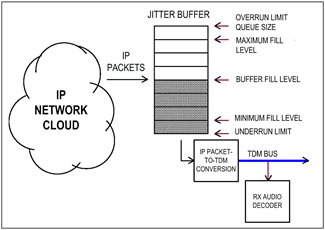 After playout, the packet can be discarded. Once converted to
TDM data, an audio decoder processes the data for usage by an
RF exciter.
After playout, the packet can be discarded. Once converted to
TDM data, an audio decoder processes the data for usage by an
RF exciter.
DELAY RESOLUTION
– the delay resolution is a function of the fastest clock
provided by the GPS receiver, typically 100 ns. Delay changes
and measurements can be made to within this granularity. This
resolution defines the accuracy of locating the simulcasting overlap
region. The geographical point in which the audio from two transmit
towers are in phase will move 1 km for every 5.364 µs of
delay variance, so 100 ns provides an accuracy of 18 meters.
This paper
will be presented on Tuesday, April 15, 2008 starting at 9 a.m.
in room S228 of the Las Vegas Convention Center. It will also
be included in its entirety in the 2008 NAB BEC Proceedings, on
sale at the 2008 NAB Show. For additional conference information
visit the NAB Show Web page at www.nabshow.com.
2008 NAB
Broadcast Engineering Conference Summary of Presentations
Check out the
papers
that will be presented at the 2008 NAB Broadcast Engineering Conference
in Las Vegas, April 12 -17, 2008.
The
March 10, 2008 Radio TechCheck is also available
in an Adobe Acrobat file.
Please click
here to read the Adobe Acrobat version of Radio TechCheck.
|