 |
Valcom AM Antenna Regulatory Procedures Simplified
Valcom (Guelph,
Ontario, Canada, www.valcom-guelph.com)
manufactures self-supporting whip antennas (see photo) suitable
for AM broadcasting which are shorter and more streamlined than
the quarter-wavelength towers typically used by AM stations. In
a recent Public Notice, the FCC’s Media Bureau announced
simplified procedures for AM station construction permit applications
which specify Valcom antennas. As indicated in the Public Notice,
based on FCC review of Valcom field tests and internal reports,
the Bureau will not routinely require the submission of a proof
of performance, current distribution measurements, or a formula
for the vertical plane radiation characteristic for nondirectional
AM facilities which utilize these antennas.
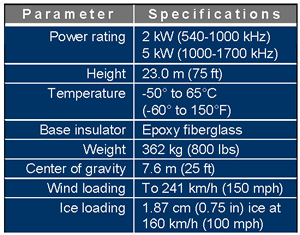 Some
of the specifications of a 75 foot Valcom antenna are shown in
the table. This antenna (as well as the 85 foot version) requires
use of a 120-radial buried ground system with each radial 120
feet long. The Commission indicates in the Notice that low-profile
Valcom antennas afford AM licensees the flexibility to place antennas
in areas where taller towers may be unacceptable, and may be more
economical to build and maintain than a standard antenna. Some
of the specifications of a 75 foot Valcom antenna are shown in
the table. This antenna (as well as the 85 foot version) requires
use of a 120-radial buried ground system with each radial 120
feet long. The Commission indicates in the Notice that low-profile
Valcom antennas afford AM licensees the flexibility to place antennas
in areas where taller towers may be unacceptable, and may be more
economical to build and maintain than a standard antenna.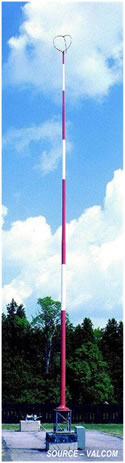 Currently,
the Commission will only authorize Valcom antennas for nondirectional
use; however, authorization of directional Valcom arrays will
be considered when more information is available on directional
operation. Currently,
the Commission will only authorize Valcom antennas for nondirectional
use; however, authorization of directional Valcom arrays will
be considered when more information is available on directional
operation.
A principal
part of Valcom’s FCC submission (and upon which this action
is based) is an Engineering Statement (dated January, 2007) from
the consulting engineering firm of du Treil, Lundin & Rackley,
Inc. This Statement was prepared to “...present and show
the analysis of field strength measurements that were made to
determine the radiation efficiency of an 85-foot pole transmitting
antenna manufactured by the Valcom Manufacturing Group, Ltd. on
1200 kHz and 1390 kHz and for a 75-foot pole transmitting antenna
of like construction on 1390 kHz and 1700 kHz.”
In this
Statement, signed by AM antenna expert Ron Rackley, the detailed
procedures and results of numerous field strength measurements
(nearly 500 in all) are presented, including graphical analyses
of the antennas’ measured performance. Mr. Rackley concludes
that “...the observed unattenuated field values of Valcom
poles exceed those shown for their physical heights on the graph
which appears as Figure 8 of §73.190 of the FCC Rules.”
He states his belief that two aspects of the antenna design are
responsible for this behavior–the “Valcosphere”
top-loading, and the fact that the antenna loading coils that
are situated far enough above ground to reduce the antenna-to-ground
voltage in the base region which, in turn, reduces dielectric
losses in the nearby soil. He further states that “...[t]he
effects lead to antenna efficiency improvements that are predictable
and measurable.”
Additional
specifics regarding licensing of facilities using these Valcom
antennas are discussed in the Public Notice, including the following:
- The Engineering Statement establishes radiation efficiency
values for the 75- and 85-foot Valcom antennas within specified
frequency ranges, all of which according to the FCC meet or
exceed the minimum efficiency for Class B, C, and D AM stations;
- Applicants specifying a Valcom antenna shall use the antenna
efficiency values established in the Engineering Statement,
provided that both the antenna and the ground system are the
same as those described therein. Use of any ground system other
than one consisting of 120 radials, each 120 feet long requires
submission of a proof of performance as set forth in §73.186;
- Applicants proposing to use Valcom antennas shall use the
formula in §73.160(b)(1), based on the physical height
of the radiator, in computing the vertical form factor commonly
referred to as f(Ø). This is a consequence of previous
studies which demonstrated that the antenna elevation pattern
can be represented by this formula;
- The requirement for current distribution measurements that
is normally applied to non-standard antennas has been eliminated
since the FCC’s Office of Engineering and Technology concluded
(in a 2003 memo) that the elevation pattern for a short vertical
monopole such as the Valcom antenna is virtually independent
of the current distribution along the radiating element.
The full text
of the Public Notice is available online at http://hraunfoss.fcc.gov/edocs_public/attachmatch/DA-08-448A1.pdf,
and the du Treil, Lundin & Rackley Engineering Statement is
available at http://hraunfoss.fcc.gov/edocs_public/attachmatch/DA-08-448A2.pdf.
Just
in from the FCC...
MEDIA BUREAU PROVIDES GUIDANCE FOR CONTINUED PRESUNRISE AND POSTSUNSET
OPERATIONS DURING MARCH 2008 BY AM STATIONS IN AREAS WITH
DAYLIGHT SAVING TIME
Daylight
Saving Time ("DST") commences at 2:00 AM on March 9,
2008. Certain AM stations currently operate with Presunrise Service
Authorizations ("PSRAs") and Postsunset Service Authorizations
("PSSAs"). Licensees with PSRAs and PSSAs located in
communities with DST should use the April DST "Advanced"
powers and time periods for the period between March 9, 2008,
and March 31, 2008. This adjustment is necessitated by the enactment
of the US Energy Policy Act of 2005 which extended the effective
period for DST into March for the first time.
For additional
information or to report potential interference which an AM station
believes to be the result of PSRA or PSSA operation by another
station during the DST portion of March 2008, contact Charles
Miller, Susan Crawford or Son Nguyen of the Audio Division at
(202) 418-2700.
2008 NAB
Broadcast Engineering Conference Summary of Presentations
Check out the papers
that will be presented at the 2008 NAB Broadcast Engineering Conference
in Las Vegas, April 12 -17, 2008.
Find registration, housing or additional information on the NAB
Show at http://www.nabshow.com/.

The March 3, 2008 Radio TechCheck is also available
in an Adobe Acrobat file.
Please click
here to read the Adobe Acrobat version of Radio TechCheck.
|
|
