 |
An
“Explosion” of Wi-Fi Radios
|
Radio
TechCheck Issue Date
|
Featured
Wi-Fi devices |
|
|
Reciva,
Linksys Wireless-B, Phillips Streamium |
|
|
Reciva,
Torian InFusion |
|
|
Solutions
Radio, Acoustic Energy |
|
|
Torian
InFusion, Acoustic Energy |
Since 2004,
NAB Radio TechCheck has featured occasional updates (see
table to right) on the status of so-called “Internet radio”
appliances,
stand-alone devices that use Wi-Fi technology to access streaming
audio on the Internet, without the need for connection to a computer.
The number and variety of Wi-Fi radios has increased dramatically
since the last update in late 2006–some of the latest products
(most available now) are described below.
Typically,
these devices are designed to access a specific Internet site;
many access a site maintained by Reciva, www.reciva.com,
which at last count provides access to 9,975 Internet radio stations
and 21,242 on-demand streams in 269 locations and 65 genres. Additionally,
many of these devices also provide access to the listener’s
own music collection existing on their personal computer (as long
as the computer and the Wi-Fi radio are connected to the same
Wi-Fi network).
AUDIOVOX
– at the 2008 International Consumer Electronics Show (CES),
AudioVox unveiled two tabletop Internet Wi-Fi radios, the RIR200
and RIR205 which reportedly will have suggested retail prices
of $99 and $149, respectively. Each radio features an analog AM/FM
receiver, Wi-Fi 802.11b/g compatibility, and direct access to
a custom Web radio service and to the Slacker Internet radio service
(see the May
7, 2007 issue of Radio TechCheck for additional information
on Slacker). Not yet available.
REVO
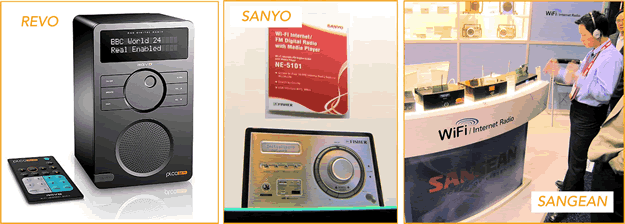
– the Revo Pico Wi-fi (shown below at left) accesses the
Reciva Web site, is compatible with Windows Media Audio (WMA),
MP3, MPEG-4 AAC, AU, WAV and AIFF formats, supports the ASX, RAM,
M3U, RPM, and PLS playlist formats (a discussion of the different
types of playlist formats can be found on the Internet here)
as well as RTSP, MMS, and HTTP streaming protocols. Additionally
the Pico has a built-in FM tuner. Cost - $350 (available now),
more information available online at www.revo.co.uk.
SANYO
– the unit shown in the photo below was on display in the
Sanyo booth at CES. To be marketed under the Fisher brand name,
the NE-5101 is not only a Wi-Fi radio but an FM radio and media
player as well, accommodating USB flash drive storage devices
with a connector on the front panel. Not yet available.
SANGEAN
– Sangean had a number of Wi-Fi radios on display at CES (see
photo below). The Sangean WFR-20 uses the Reciva Web site, is 802.11g/b
compatible, and works using a wired connection, as well (10/100
Mbps using an RJ-45 connector). Supported audio formats include
MP3, WMA, MPEG-4 AAC, WAV, AIFF, FLAC, and REAL. Cost – $250
to $350 (available now).
 CAMBRIDGE
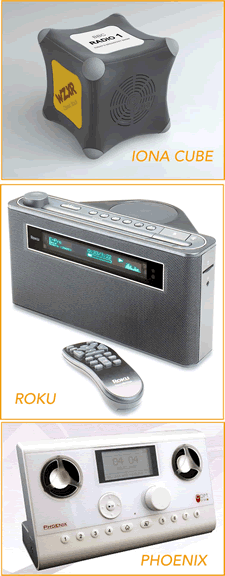
CONSULTANTS - the Iona “Cube” (see photo on the
right) developed by Cambridge Consultants, is a new concept in
low-cost, Wi-Fi enabled internet radio, and will reportedly sell
for about $50. The Cube’s design allows the listener to personalize
the device to play just their favorite radio stations or podcasts,
and greatly simplifies the way people select which Internet radio
stations they listen to, while significantly reducing the cost
of the radio at the same time. According to research, the average
person listens to between three to four radio stations regularly.
The Cube has been designed with this in mind. By turning the Cube
onto one of four sides, it will change to the desired radio station.
A fifth side is dedicated to the speaker and the final remaining
side is dedicated to switching the radio to the “off”
position. The Cube can be customized to play a listener’s
top four stations. Not yet available. A press release on the Cube
is available on line at www.cambridgeconsultants.com/news_pr198.shtml. CAMBRIDGE
CONSULTANTS - the Iona “Cube” (see photo on the
right) developed by Cambridge Consultants, is a new concept in
low-cost, Wi-Fi enabled internet radio, and will reportedly sell
for about $50. The Cube’s design allows the listener to personalize
the device to play just their favorite radio stations or podcasts,
and greatly simplifies the way people select which Internet radio
stations they listen to, while significantly reducing the cost
of the radio at the same time. According to research, the average
person listens to between three to four radio stations regularly.
The Cube has been designed with this in mind. By turning the Cube
onto one of four sides, it will change to the desired radio station.
A fifth side is dedicated to the speaker and the final remaining
side is dedicated to switching the radio to the “off”
position. The Cube can be customized to play a listener’s
top four stations. Not yet available. A press release on the Cube
is available on line at www.cambridgeconsultants.com/news_pr198.shtml.
ROKU
– the Roku R1000 SoundBridge Radio (see photo at right) is
a WiFi/AM/FM clock radio which has an SD/MMC card slot and a volume
ramping alarm that can play digital music, Internet radio, AM/FM
radio, playlists, podcasts or a choice of several alarm tones.
The SoundBridge has technologically advanced speakers, using two
patented LMD (Linear Magnetic Drive) stereo speakers in a tuned
enclosure powered by a 20 watt RMS digital amplifier, and a LMD
subwoofer powered by a 30 watt RMS digital amp. Cost is $300 (available
now). For more information go to www.rokulabs.com/products_soundbridgeradio.php.
PHOENIX
– developed by Com One, a subsidiary of Baracoda (specializing
in Bluetooth wireless barcode and RFID readers), the Phoenix WiFi
radio uses the Phoenix WiFi Internet portal and is powered by
four rechargeable Ni-Mh AA batteries. It supports MP3 (sample
rates up to 320 kbps), WMA, and WAV audio formats, the SHOUTcast,
MMS / MMSH - Microsoft® Media Streaming protocols, 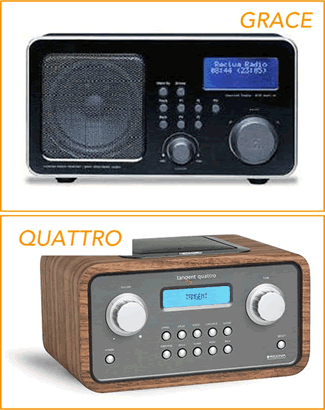 and
M3U, PLS and ASX playlist formats.. Cost is $200 (available now).
For more information go to
www.wifi-radio.biz. and
M3U, PLS and ASX playlist formats.. Cost is $200 (available now).
For more information go to
www.wifi-radio.biz.
GRACE and
QUATTRO – the Grace (by Intellitouch) and Tangent Quattro
(both at left) are more “traditional” tabletop-style
radios. The Grace is distinguished by its relatively low cost
(available now for $170) while the Quattro has a real walnut veneer
case but is more expensive (available now for $350). The Quattro
also has a built-in FM tuner.
Don't Miss NAB's AMDA Seminar
 NAB
Science & Technology is hosting a two-day course at NAB headquarters
on March 6-7, specially developed to instruct broadcast engineers
on how to prepare their AM stations for HD Radio. There is no
similar educational opportunity for engineers to learn the proper
techniques to maintain complex AM antenna systems ensuring that
their stations comply with the FCC rules and enjoy optimum coverage
and fidelity. Ronald Rackley, a principal in the firm of du Treil,
Lundin & Rackley, Inc. Consulting Engineers and Ben Dawson,
President/Senior Electrical Engineer of Hatfield and Dawson of
Hatfield and Dawson, will teach the course. Together they have
collaborated to instruct the next generation of AM broadcast engineers
and pass along the art of AM directional antenna system design
and maintenance. They were awarded NAB’s highest engineering
honor in 2006, the NAB Engineering Achievement Award for Radio.
For more information on how to register and housing go to AM
DA Seminar information on the NAB Website or contact Sharon
Devine sdevine@nab.org or
(202) 429-5338. NAB
Science & Technology is hosting a two-day course at NAB headquarters
on March 6-7, specially developed to instruct broadcast engineers
on how to prepare their AM stations for HD Radio. There is no
similar educational opportunity for engineers to learn the proper
techniques to maintain complex AM antenna systems ensuring that
their stations comply with the FCC rules and enjoy optimum coverage
and fidelity. Ronald Rackley, a principal in the firm of du Treil,
Lundin & Rackley, Inc. Consulting Engineers and Ben Dawson,
President/Senior Electrical Engineer of Hatfield and Dawson of
Hatfield and Dawson, will teach the course. Together they have
collaborated to instruct the next generation of AM broadcast engineers
and pass along the art of AM directional antenna system design
and maintenance. They were awarded NAB’s highest engineering
honor in 2006, the NAB Engineering Achievement Award for Radio.
For more information on how to register and housing go to AM
DA Seminar information on the NAB Website or contact Sharon
Devine sdevine@nab.org or
(202) 429-5338.
| Radio
TechCheck will not be published on February 18 but will
return on February 25. |

The
February 11, 2008 Radio TechCheck is also available
in an Adobe Acrobat file.
Please click
here to read the Adobe Acrobat version of Radio TechCheck.
|
|
