|
Audio
Coding Advancements Unveiled
Perceptual
audio coding technology is the foundation upon which digital audio
devices like MP3 players, satellite radios, and HD Radio receivers
are built. Using perceptual audio coding techniques it becomes
possible to reduce the digital bit rates required to store and/or
transmit audio signals to the point where all of these devices
become practical. Two new audio codecs were announced at last
month’s International Consumer Electronics Show (CES, www.cesweb.org)
which represent further advances in this technology.
 Fraunhofer
IIS (Erlangen, Germany, www.iis.fraunhofer.de/EN/index.jsp)
announced its new HD-AAC® codec which is a “fully scalable
to lossless audio coding solution.” This technology is designed
to bridge the gap between the needs of portable consumer applications
which require low bit rates and the needs of audio professionals
who require very high quality approaching that of the original,
uncompressed audio itself. To do this, HD-AAC utilizes two different
technologies–MPEG-4 Advanced Audio Coding (AAC) and MPEG-4
Scalable Lossless Coding (SLS). Fraunhofer
IIS (Erlangen, Germany, www.iis.fraunhofer.de/EN/index.jsp)
announced its new HD-AAC® codec which is a “fully scalable
to lossless audio coding solution.” This technology is designed
to bridge the gap between the needs of portable consumer applications
which require low bit rates and the needs of audio professionals
who require very high quality approaching that of the original,
uncompressed audio itself. To do this, HD-AAC utilizes two different
technologies–MPEG-4 Advanced Audio Coding (AAC) and MPEG-4
Scalable Lossless Coding (SLS).
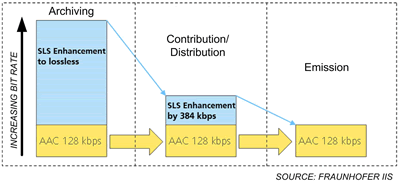
AAC is a state-of-the-art
perceptual codec which in HD-AAC is used to create a low bit rate
audio signal for applications such as consumer devices. On top
of this, the SLS scalable extension layer is utilized to increase
the signal-to-noise-ratio, and according to Fraunhofer reaches
losslessness at data rates comparable to that of current pure
lossless audio codecs, that is, at average compression ratios
of about 50% compared to the original audio material. The figure
illustrates how HD-AAC can be used to create audio with archival
(high bit rate), contribution/distribution (medium bit rate) or
emission (low bit rate) quality by various usage of the SLS enhancement
portion of the system.
The flexible
scalability of the SLS extension makes this coding solution applicable
to production environments, where the result is often transmitted
to several recipients through channels of differing bandwidth.
Also, for private and professional use in music archives, HD-AAC
enables both storing of the original music data and transferring
of highly compressed copies to portable devices without time-consuming
recoding or re-encoding operations.
Fraunhofer
IIS is offering HD-AAC software for both PC and embedded devices,
including microprocessors or DSPs from ARM, MIPS, Texas Instruments,
Analog Devices, Intel, AMD, and IBM. An HD-AAC white paper featuring
use cases, further technology background information and contacts
is available at http://www.hd-aac.com.
Additional information about MPEG-4 SLS is available on the MPEG
Web page at www.chiariglione.org/mpeg/technologies/mp04-sls/.
Also announced
at CES by Neural Audio (Kirkland, WA, www.neuralaudio.com) and
VoiceAge Corporation (Montreal, Canada, www.voiceage.com)
was the release of Neural-AMR-WB+ upgraded with Neural-THX®
Surround. Neural and VoiceAge indicate that Neural-AMR-WB+ is
capable of delivering surround sound content at bit rates lower
than 72 kbps, allowing next-generation mobile services and devices
to deliver “...TV-like high quality surround sound content
at
remarkably low bit rates.”
 Neural-AMR-WB+
is a surround sound version of AMR-WB+ (Extended Adaptive Multi-Rate
Wideband) which was developed jointly by Ericsson, Nokia and VoiceAge.
According to VoiceAge, this speech and audio codec is the 3GPP-recommended
hi-fi audio codec for Multimedia Messaging Service (MMS), Server-based
Streaming (PSS), and Multimedia Broadcast Multicast Service (MBMS)
over GSM and WCDMA cellular telephone networks. It is also recommended
for DVB-H applications. Neural-AMR-WB+
is a surround sound version of AMR-WB+ (Extended Adaptive Multi-Rate
Wideband) which was developed jointly by Ericsson, Nokia and VoiceAge.
According to VoiceAge, this speech and audio codec is the 3GPP-recommended
hi-fi audio codec for Multimedia Messaging Service (MMS), Server-based
Streaming (PSS), and Multimedia Broadcast Multicast Service (MBMS)
over GSM and WCDMA cellular telephone networks. It is also recommended
for DVB-H applications.
AMR-WB+ scales
to cover the full audio spectrum and uses high-efficiency parametric
stereo (HE-PS) to maintain high-fidelity stereo image reproduction
at even the lowest bit rates and excellent quality at higher rates.
VoiceAge reports that in characterization tests carried out by
third parties for the ETSI/3GPP standards organizations, at bit
rates of 14 and 24 kbps for mono and 18 and 24 kbps for stereo,
AMR-WB+ outperformed MPEG-4 AAC in all tests and outperformed
MPEG-4 HE-AAC in seven of eight tests. An array of audio recordings
is offered on the VoiceAge Web site (shown in the figure at left–
go to www.voiceage.com/other.php)
allowing for a comparison of original mono and stereo audio in
a variety of formats (music, speech, etc.) with the AMR-WB+ encoded
audio at bit rates ranging from 8.2 to 48 kbps. Additional information
about AMR-WB+ is available on the VoiceAge Web page at http://www.voiceage.com/prodamrwbplus.php.
Is Your AM DA Ready for HD Radio?
 NAB
Science & Technology is hosting a two-day course at NAB headquarters
on March 6-7, specially developed to instruct broadcast engineers
on how to prepare their AM stations for HD Radio. There is no
similar educational opportunity for engineers to learn the proper
techniques to maintain complex AM antenna systems ensuring that
their stations comply with the FCC rules and enjoy optimum coverage
and fidelity. Ronald Rackley, a principal in the firm of du Treil,
Lundin & Rackley, Inc. Consulting Engineers and Ben Dawson,
President/Senior Electrical Engineer of Hatfield and Dawson of
Hatfield and Dawson, will teach the course. Together they have
collaborated to instruct the next generation of AM broadcast engineers
and pass along the art of AM directional antenna system design
and maintenance. They were awarded NAB’s highest engineering
honor in 2006, the NAB Engineering Achievement Award for Radio.
For more information on how to register and housing go to AM
DA Seminar information on the NAB Website or contact Sharon
Devine sdevine@nab.org or
(202) 429-5338. NAB
Science & Technology is hosting a two-day course at NAB headquarters
on March 6-7, specially developed to instruct broadcast engineers
on how to prepare their AM stations for HD Radio. There is no
similar educational opportunity for engineers to learn the proper
techniques to maintain complex AM antenna systems ensuring that
their stations comply with the FCC rules and enjoy optimum coverage
and fidelity. Ronald Rackley, a principal in the firm of du Treil,
Lundin & Rackley, Inc. Consulting Engineers and Ben Dawson,
President/Senior Electrical Engineer of Hatfield and Dawson of
Hatfield and Dawson, will teach the course. Together they have
collaborated to instruct the next generation of AM broadcast engineers
and pass along the art of AM directional antenna system design
and maintenance. They were awarded NAB’s highest engineering
honor in 2006, the NAB Engineering Achievement Award for Radio.
For more information on how to register and housing go to AM
DA Seminar information on the NAB Website or contact Sharon
Devine sdevine@nab.org or
(202) 429-5338.
NAB Provides Members with Energy Consulting
to Lower Their Expenses
The APPI Savings
Solution Program is a National Association of Broadcasters member-only
benefit that manages and reduces member’s rising energy costs.
Members who utilize this program will benefit from APPI's extensive
knowledge of and expertise in electricity and natural gas markets
across the U.S. APPI analyzes, negotiates, and structures individual
and aggregation supply solutions for NAB members in deregulated
states. There are no upfront fees and compensation is results
based. As energy costs continue to rise and decrease your bottom
line, contacting APPI is a wise business decision. Contact APPI
at (800) 520-6685 or e-mail info@appienergy.com
and be sure to mention you are an NAB member or visit the APPI
website at www.appienergy.com.

The
February 4, 2008 Radio TechCheck is also available
in an Adobe Acrobat file.
Please click
here to read the Adobe Acrobat version of Radio TechCheck.
|

