 |
SDARS
Terrestrial Repeaters Subject of FCC FNPRM
XM
and Sirius, the two U.S. Satellite Digital Audio Radio Service
(SDARS) providers, utilize hundreds of terrestrial repeaters all
across the country to complement delivery of their satellite signals
to listeners' receivers. Late last month the FCC issued a Second
Further Notice of Proposed Rulemaking (in IB Docket No. 95-91)
seeking additional comment on the appropriate rules and policies
for licensing of these terrestrial repeaters, and a number of
the questions being asked here relate to exactly where and how
these repeaters may be used.
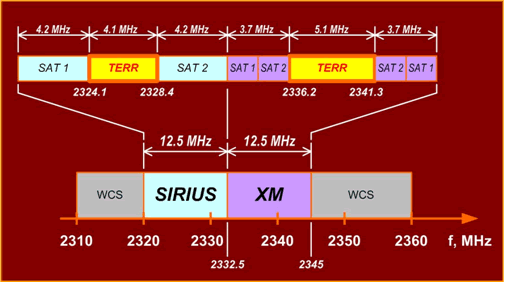 Each
service provider has set aside roughly one-third of their spectrum
for the exclusive use of terrestrial repeaters as shown in the
figure (repeater frequency bands in yellow, labeled TERR). Questions
regarding the use of repeaters were first raised by the Commission
in a 1997 Further Notice acknowledging the use of repeaters
"...in urban canyons and other areas where satellite signal
reception would be difficult," and proposed authorizing
deployment of repeaters "on an 'as-needed' basis in order
to meet service requirements." The 1997 Further Notice
also sought comment on how to "...ensure that any use of
SDARS repeaters remains complementary to the satellite service,"
as well as on the Commission's tentative conclusion to prohibit
the use of SDARS repeaters to transmit locally originated programming. Each
service provider has set aside roughly one-third of their spectrum
for the exclusive use of terrestrial repeaters as shown in the
figure (repeater frequency bands in yellow, labeled TERR). Questions
regarding the use of repeaters were first raised by the Commission
in a 1997 Further Notice acknowledging the use of repeaters
"...in urban canyons and other areas where satellite signal
reception would be difficult," and proposed authorizing
deployment of repeaters "on an 'as-needed' basis in order
to meet service requirements." The 1997 Further Notice
also sought comment on how to "...ensure that any use of
SDARS repeaters remains complementary to the satellite service,"
as well as on the Commission's tentative conclusion to prohibit
the use of SDARS repeaters to transmit locally originated programming.
Since the
inception of SDARS services in 2001, all terrestrial repeaters
have been operating under Special Temporary Authority (STA).
This is due primarily to the fact that the SDARS providers and
their spectral neighbors in the Wireless Communications Service
(WCS) band have been unable to agree on interference protection
criteria, and consequently the Commission has been unable to
establish final rules. Deployment of these repeaters has at
times been controversial. NAB, in a July 2007 filing with the
Commission, noted that, in constructing its network of repeaters,
"XM has engaged in what is perhaps the most widespread
violation of Commission technical rules by a major licensee
in the history of the Commission," noting that XM's own
submissions indicate that more than 40 percent of its nearly
800 repeaters were operating illegally, and further noting that
Sirius has engaged in analogous, although less extensive, violations
(the full text of NAB's filing may be viewed here).
Also in 2007, NAB and others argued against a Petition filed
by Sirius to deploy repeaters in Alaska and Hawaii since Sirius
does not provide satellite service in these states (NAB's Petition
may be viewed here).
A large
portion of the just-released FNPRM deals with the interference
protection criteria issues between the SDARS and WCS licensees;
of greater interest to radio broadcasters are the sections dealing
with where and how repeaters should be allowed to operate, in
particular:
-
Non-S band repeater feeds: Sirius has proposed feeding
terrestrial repeaters using a "VSAT" network operating
in the Ku band (12-14 GHz) rather than with the actual SDARS
S band signal. NAB has opposed the use of non-SDARS licensed
satellites to feed repeaters, arguing that the elimination
of a requirement that repeaters be fed from a SDARS satellite
paves the way for terrestrial repeaters to act independently
from the satellite-based network. Accordingly, NAB has previously
asked the Commission to adopt a rule requiring SDARS repeaters
to be fed only from the same satellite signal that is used
by subscribers and to expressly prohibit all other means of
signal delivery to SDARS repeaters;
-
Stand-alone operation: as previously mentioned, Sirius
has filed to operate terrestrial repeaters in Alaska and Hawaii;
NAB and the broadcasters' associations of Alaska and Hawaii
have petitioned to deny this STA request, arguing that these
repeaters would not be complementary to a satellite service,
but rather would be stand-alone terrestrial facilities. The
Commission is seeking comment on whether is it appropriate,
as a general principle, to adopt rules governing the ability
of SDARS licensees to deploy repeaters in geographic areas
not within the service footprint of SDARS satellites;
-
Local program origination from repeaters: in a 2001
Request for Further Comment on Selected Issues Regarding the
Authorization of SDARS Terrestrial Repeater Networks the
FCC proposed specific language stating that SDARS repeaters
would be limited to transmitting "the complete programming,
and only that programming, that is also transmitted by an
authorized DARS satellite and in such a way that the satellite
signal and the SDARS repeater signal are received nearly simultaneously
by SDARS subscriber receivers." The Commission is seeking
to update the record on the appropriate standard to be adopted
in this area.
The full text of this FNPRM
is available on the FCC web page at http://hraunfoss.fcc.gov/edocs_public/attachmatch/FCC-07-215A1.pdf.
Comment and reply comment deadlines will be established when
the FNPRM is published in the Federal Register and will be announced
in a future Radio TechCheck.
NAB
Seeks Nominations for 2008 Engineering Achievement Awards
NAB is looking
for nominees to consider for the prestigious NAB Engineering
Achievement awards. Separate awards will be given for achievements
in radio and television at the Technology Luncheon at the NAB
Show on April 16, 2008 in Las Vegas, Nevada. The qualifications
for nominating someone and the nomination form are downloadable
on NAB's
technology resources Webpage. You may also request a nomination
form by calling NAB Science & Technology at (202) 429-5346.
The deadline for nominations is January 15, 2008.

The
January 7, 2008 Radio TechCheck is also available
in an Adobe Acrobat file.
Please click
here to read the Adobe Acrobat version of Radio TechCheck.
| |