|



|
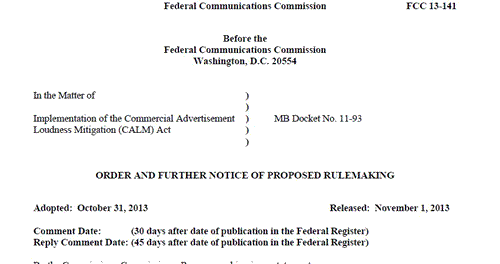
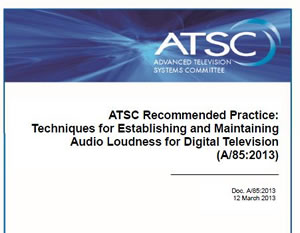
FCC Proposes Changes to Its CALM Act Rule On November 1, 2013 the FCC released a Further Notice of Proposed Rulemaking (FNPRM) seeking comment on proposed changes to its Commercial Advertisement Loudness Mitigation (CALM) Act rules. The FNPRM proposes minor rule changes to incorporate the Advanced Television Systems Committee’s (ATSC) recently published A/85:2013 in the CALM Act rules.
The FNPRM seeks comment on:
The FCC states in the FNPRM that while this proceeding is pending, the Current RP incorporated into the rules in 2011 will continue to be mandatory until the proposed rule modifications incorporating A/85:2013 take effect. Except that the FCC has waived this rule as necessary to permit parties the option to follow the loudness measurement method contained in the Successor RP, rather than that in the Current RP, prior to the rule modifications taking effect. The docket number of this proceeding is MB 11-93. Comments are due to the FCC on December 27, 2013, and reply comments are due on January 13, 2014. More information on the FCC CALM Act regulations is available here. |
|
|
NAB Show @ Mobile World Congress – Capturing the Moment Through Mobile and Broadcast – NAB Show will present a two-day symposium as part of the 2014 Mobile World Congress’ mPowered Industries media conference. The symposium, sponsored by Ericsson, will be held 25 and 26 February 2014 in Barcelona. Leaders in mobile communications, digital and mainstream media will explore how content and advanced delivery options are driving entertainment experiences on mobile devices. Click here for more details. NAB Show @ CABSAT – The Changing Landscape of Broadcasting – NAB Shows has partnered with the Dubai World Trade Center (DWTC) to produce the 2014 CABSAT Conference. Celebrating its 20th anniversary, CABSAT is the region’s leading annual event focusing on the broadcast, satellite and media industry. The two-day conference (11 and 12 March 2014) will attract attendees from the Middle East, Africa and South Asia who are actively engaged in the creation, management and delivery of entertainment and news content.
The December 23, 2013 TV TechCheck is also available in an Adobe Acrobat file. Please click here to read the Adobe Acrobat version of TV TechCheck |
Advertisements
|
 The
The
 The
CALM Act mandates that the Commission’s rules incorporate by
reference and make mandatory “any successor” to the RP.
On March 12, 2013, the ATSC published a successor document to its
2011 RP,
The
CALM Act mandates that the Commission’s rules incorporate by
reference and make mandatory “any successor” to the RP.
On March 12, 2013, the ATSC published a successor document to its
2011 RP,