|
 |
 |

|
NHK Demonstrates Olympian Ultra-HD During the recently concluded 30th Olympiad in London, Japanese broadcaster NHK conducted further testing of its next-generation television system called Super HiVision. The spectacle and fast action of the Olympic Games provided a high-profile platform for illustrating the system’s current capabilities. NHK worked with other Olympic broadcasters to present demonstrations of the service in various locations around the world. The demonstrations
were a joint effort of NHK, the BBC and Comcast/NBCU, and included
the capture, recording, and distribution of Super HiVision content
to eight viewing sites. Three such venues were set up in the UK
(in London and Bradford, England, and Glasgow, Scotland), with four
locations in Japan (three in Tokyo and one in Fukushima), and one
in the U.S. (Washington, DC). Selected Super HiVision material from
the Olympics was presented at each of the locations, most of which
were open to the public. The sole exception was the Washington DC
demo, which was an invitation-only opportunity hosted at the Comcast/NBCU
offices there. NAB Technology staff was invited to attend the U.S.
demonstration on August 3, 2012. Super HiVision is one of several so-called Ultra HD formats currently in development today, and it is generally considered to be the most advanced among them. It features 8k video imaging (7680 x 4320 pixels) and 22.2 channel audio. Video is currently presented at a 60p frame rate, but NHK intends to eventually increase the frame-rate to 120p. The 16:9 aspect ratio of current HDTV is maintained. Note that the “8k” terminology comes from the graphics and cinematic world, where the horizontal pixel count is traditionally used as a label. In television terminology, where a vertical line count has traditionally been used for this purpose, this image format could be called “4320p” – or more precisely, “4320p60.” (Conversely, the current HDTV format of 1920 x 1080 pixels would be called a “2k” format in graphics or cinematic parlance.) Even with the
contemplated use of next-generation compression systems (such as
ISO/MPEG HEVC or ITU H.265), the bandwidth required for transmission
of such content is quite high, given that the video resolution of
the format alone is 16 times greater than HDTV. NHK continues to
develop modulation and transmission methods to bring over-the-air
transmission of Super HiVision into a practical realm, and this
work is expected to continue for some time. (NHK is targeting the
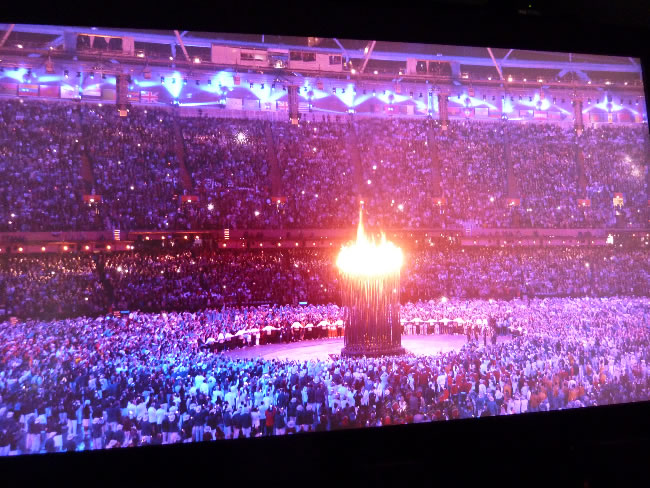
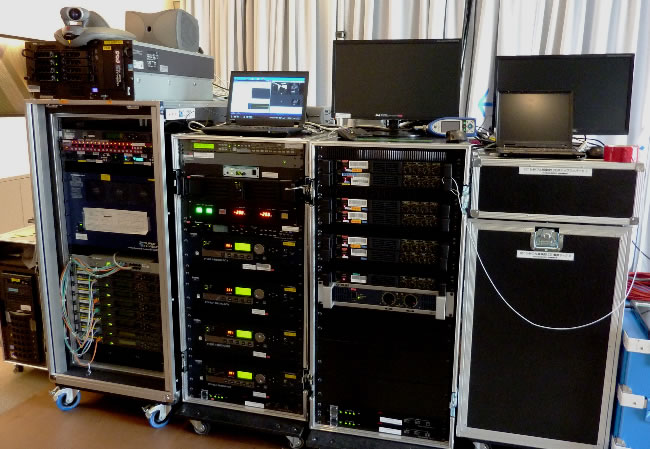
year 2020 for widespread deployment of the system.) Currently the largest 8k video display panels available to NHK are 85-inch-diagonal LCD screens (custom built for NHK), and these were used at all the demonstration venues. For a display of this resolution and size, the optimum viewing distance – i.e., the maximum viewing distance at which the resolution provided by the display can be acknowledged by a viewer with 20:20 vision – is only a little over 2.5 feet from the screen. (Such optimum viewing distance for a 4320-line display is determined to be 0.75 picture heights. For the 85-inch-diagonal display used here, 0.75x its height of 42 inches results in a 31.5-inch optimum viewing distance.) NHK and NBCU engineers acknowledged that this was somewhat impractical, but that it was only a temporary problem, as availability of larger ultra-HD displays is expected soon. Nevertheless, when viewed at such a close distance during this demo, it was indeed possible to see the extremely high image-resolution of the Super HiVision format. Wide shots of the Olympic opening ceremonies were perhaps most indicative, with each of the hundreds of performers on the field being clearly and distinctly visible even when the image was framed to include the entire stadium in the shot. At the Washington, D.C. demo site, a relatively large conference room was used, and the 24 audio speakers were arranged around its perimeter. This placed the optimum listening point for the Super HiVision sound at about 8 feet back from the screen. Thus the optimum viewing and listening distances were at substantially different locations, with the latter being more than three times further away from the screen than the former. This was also acknowledged as an issue by the NBCU engineers, again caused primarily by the inadequacy of current screen sizes at the necessary resolution. It implies, however, that for such larger room sizes, matching optimum visual and aural locations will require very large screens. Such screens may only become practical when their assembly from smaller, frameless elements is possible (as discussed in the July 30, 2012 edition of TV TechCheck), or by the use of flexible film displays. It may also relegate the 8k video format to commercial or public installations only, precluding widespread domestic implementations, at least upon initial introduction. Another probably inevitable development will be integration of the system’s electronics into practical packages far smaller than the multiple racks currently required by the current demonstrations (see photo). Impressions
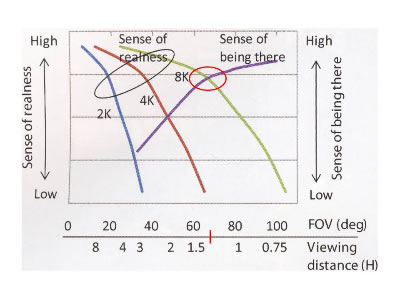
Video engineers discussed the need for imrovements in future camera designs to minimize thecurrently just-noticeable motion blur in some fast-action scenes, and visible noise under certain low-light conditions, but these refinements will also likely come over time. NHK engineers have further suggested that the traditional definition of “optimum viewing distance” might be redefined, suggesting that the ability to fully acknowledge the image resolution (which is how the current optimum distance described above is calculated) is countered by psychovisual measures of "image immersion” and “image realism”. (See chart. Red oval shows "sweet spot" between these attributes for 8k images, resulting in ~1.3x picture height as an optimum viewing distance by this metric. [Source:"'Super Hi-Vision' Video Parameters for Next-Generation Television," by Takayuki Yamashita, Kenichiro Masaoka, Kohei Ohmura, Masaki Emoto, Yukihiro Nishida, and Masayuki Sugawara; SMPTE Motion Imaging Journal, May-June 2012.] Using these considerations, the 85-inch 8k image of this demo might be optimally viewed at about 1.3 picture heights, or in this case, about a 4.5-foot distance, which did indeed seem more comfortable (and both real and immersive) during this demo than the 2.5-foot distance dictated by a purely resolution-acknowledging metric. Regardless, however, for the value of Super HiVision video to be appreciated, and the format’s potential impact to be fully realized, it is clear that super-large screens – on the order of 200 inches or more – will be required to optimally view the content. For typical American domestic viewing at about 9 feet from the screen – the so-called “Lechner Distance” – the traditional resolution metric would call for a nearly 300-inch-diagonal display, a 16:9 screen of some 12 feet in height. NHK is setting a high bar for broadcasters and consumer electronics manufacturers alike as television progresses to its next generation, and Super HiVision remains an interesting potential target. Ongoing future demonstrations are expected as the system develops further, and broadcasters are encouraged to seek out such demos to witness the system’s performance for themselves. Acknowledgements
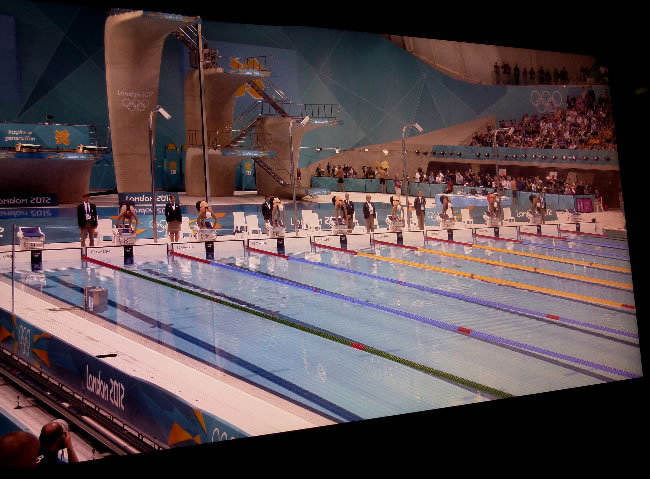
Start of an Olympics swimming event as seen on NHK Super HiVision screen, viewed from ~30 degrees off-axis. NAB
Satellite Uplink Operators Seminar
The class is taught by Sidney Skjei, M.S.E.E., P. E. of Skjei Telecom. Mr. Skjei has over 30 years experience in engineering, operating and developing a wide range of hardware and software satellite communications systems and services. He is highly knowledgeable in all major satellite communications operational areas: global, U.S. domestic and military. An article on Mr. Skjei and the seminar appears in the latest issue of TV Technology. The four-day seminar provides the operational training which minimize the risk of satellite transmission interference. This is an important seminar since the FCC rules require that "a trained operator be present at all times during transmissions, at either an earth station site or designated remote control point" [Section 25.271 (b)].
The seminar fee is $1,250 (NAB members) and $1,550 (all others). The seminar fee includes a Satellite Uplink Handbook, continental breakfast and lunch. Space is limited so if you don't want to miss this opportunity, go to the Satellite Seminar Web page or call Cheryl Coleridge at (202) 429-5346. If you are interested in sponsorship opportunities for this event contact NAB Advertising at (800) 521-8624 or advertising@nab.org.
Additional information and registration is available online. Registration Open for 2012 IEEE Broadcast Symposium  Registration
for the 2012 IEEE
Broadcast Symposium is now underway. This year, the October
17-19, 2012 event's technical
program includes more than 20 presentations from top industry
leaders on cutting edge broadcast engineering topics, as well as
half-day tutorial sessions on broadcast IP technology and broadcast
engineering computer simulation tools. Registration
for the 2012 IEEE
Broadcast Symposium is now underway. This year, the October
17-19, 2012 event's technical
program includes more than 20 presentations from top industry
leaders on cutting edge broadcast engineering topics, as well as
half-day tutorial sessions on broadcast IP technology and broadcast
engineering computer simulation tools.
In addition to technical presentations and tutorial sessions, this year's program features a panel discussion on broadcast towers and an update on the government's broadband plan, spectrum usage, and broadcast audio issues. The Symposium also offers attendees the opportunity to network and socialize with their peers at evening receptions and luncheon programs. This year's luncheon keynote speakers are Kevin Gage, NAB's executive vice president and chief technology officer, and Sam Matheny, Capitol Broadcasting's vice president of policy and innovation. For those unable to attend in person, all Symposium sessions will be made available globally via live and archived streaming on the Internet. Also, up to 2.5 Continuing Education units (CEUs) are available to on-site attendees. Complete information is available on the Symposium website. The three-day event will be held at The Westin Alexandria hotel in Alexandria, Va. Early registration is encouraged in order to take advantage of special rates which expire after Oct. 1, 2012. Special early bird hotel room rates are also available. For complete registration information, visit the organization's website at http://bts.ieee.org/broadcastsymposium. |
 Join
fellow satellite uplink operators, engineers and technicians for
NAB's Satellite Uplink Operators Training Seminar on September
24- 27 at NAB headquarters in Washington, D.C. In this comprehensive
four-day class, you'll learn how to set up an interference-free
uplink every time. This seminar provides in-depth information on
the theory of satellite communications and all operational aspects
of the ground equipment for uplink and downlink facilities and is
applicable to distributing signals for both analog and digital television
and radio.
Join
fellow satellite uplink operators, engineers and technicians for
NAB's Satellite Uplink Operators Training Seminar on September
24- 27 at NAB headquarters in Washington, D.C. In this comprehensive
four-day class, you'll learn how to set up an interference-free
uplink every time. This seminar provides in-depth information on
the theory of satellite communications and all operational aspects
of the ground equipment for uplink and downlink facilities and is
applicable to distributing signals for both analog and digital television
and radio.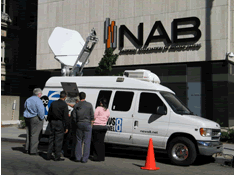 In
addition to classroom instruction, students will receive hands-on
training in a satellite newsgathering (SNG) truck as well as an
all-day field trip to a nearby, large satellite teleport and operations
center.
In
addition to classroom instruction, students will receive hands-on
training in a satellite newsgathering (SNG) truck as well as an
all-day field trip to a nearby, large satellite teleport and operations
center.  This
informative program is a can't-miss day for station engineers, broadcast
executives, the content creation community and other industry professionals.
Leading industry experts will discuss critically important topics
including:
This
informative program is a can't-miss day for station engineers, broadcast
executives, the content creation community and other industry professionals.
Leading industry experts will discuss critically important topics
including: |
|




ADVERTISEMENTS