|
All-pass Diplexer Further Explained at IEEE Broadcast Symposium With the FCC now authorizing increased power levels (up to -10 dBc) for the digital portion of FM IBOC signals, broadcasters have been looking for economical ways to increase their digital power and improve their digital coverage. A new technology developed by Electronics Research, Inc. (ERI, Chandler, Ind.) called the "all-pass diplexer" offers a new way to combine analog and digital signals with higher-power operation in mind. This technology was described in a paper earlier this year at the 2012 NAB Broadcast Engineering Conference in Las Vegas, Nev. (see the April 30, 2012 issue of Radio TechCheck for additional information). More recently, ERI provided additional insight into some of the details behind the all-pass diplexer at the 2012 IEEE Broadcast Symposium held October 17-19 in Alexandria, Va. This latest paper, entitled "An Update to the All-pass Diplexer: Imperfect Conditions and How To Account For Them," was written by Nicholas Paulin of ERI and is excerpted here. INTRODUCTION - the all-pass diplexer was introduced to solve the problem of combining frequency adjacent transmitters. The proximity of the transmitter frequencies is defined as 0.04% frequency bandwidth separation. The uniqueness of the all-pass diplexer is centered around phase shifting technology rather than sharp tuned filter responses or notch cavities that are used in other transmitter diplexing methods.
The group delay is correctable using existing available technologies. The all-pass diplexer has two inputs, each of which maintain a constant input VSWR for each transmitter. The ports are designated for either the analog or digital transmitter. The two input ports have a high degree of isolation between them, which helps keep unwanted emissions low. There are two output ports of the circuit. The first is the main output, which is where the highest percentage of the RF power flows. The second output is connected to a reject load. This load takes the remainder of the power that was not phased properly and turns it into heat, thus keeping reflections low and the circuit balanced. ALL-PASS
SPECIFICATION UPDATE - an initial estimate of thermal losses
was made by integrating the insertion loss response over the used
frequency spectrum. This method is perfectly suitable for signals
with an even power density such as TRANSMITTER
ISOLATION CONSIDERATIONS - to this point, we have talked about
the non-ideal conditions that can cause isolation performance issues
within the all-pass diplexer circuit, but what if something beyond
the controlled When the all-pass diplexer is tuned under perfect conditions, the isolation between analog and digital inputs is better than -40 dB. As the VSWR of the antenna becomes less ideal, isolation is slowly lost. Again, integrating these plots over the used spectrum is needed to get a more accurate estimate of what the transmitters will see. The table at right shows the weighted average analog isolation and the integrated digital isolation figures and show the importance of having a well-tuned system from beginning to end. For additional information on the ERI all-pass diplexer, contact Mr. Paulin at npaulin@eriinc.com. |
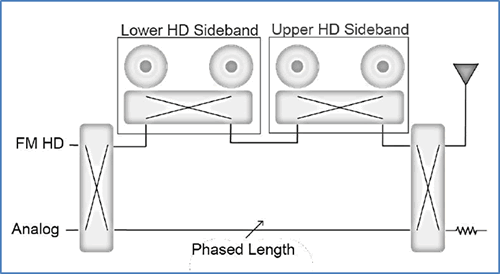 The
all-pass diplexer uses two group delay compensation modules which
use a total of four resonant cavities to perform the phase shifting
(see figure at right). These phase shifters are then placed between
two 90 degree hybrid couplers in order to create a constant impedance
circuit. The benefits of this approach can be summarized by noting
that the efficiency remains high for both FM analog and digital
transmitters while keeping the group delay distortion to a minimum.
The
all-pass diplexer uses two group delay compensation modules which
use a total of four resonant cavities to perform the phase shifting
(see figure at right). These phase shifters are then placed between
two 90 degree hybrid couplers in order to create a constant impedance
circuit. The benefits of this approach can be summarized by noting
that the efficiency remains high for both FM analog and digital
transmitters while keeping the group delay distortion to a minimum.
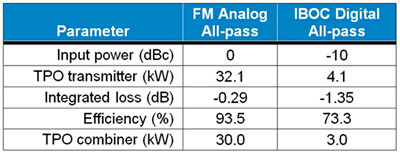 digital
FM transmitters, however, analog FM transmitters do not have this
quality. The power density response was generated using the NRSC
mask specification so that a more accurate representation of the
thermal losses would weigh the power density response of the transmitter
against the insertion loss response of the all-pass diplexer. This
approach changes the initial estimate of 0.42 dB average insertion
loss to 0.29 dB average insertion loss and equates to a 2.7% change
in efficiency. An updated power budget reflecting this improved
method of calculating the losses is shown in the table above. The
corrected efficiency of the all-pass allows for higher published
power handling ratings of this device than previously anticipated.
digital
FM transmitters, however, analog FM transmitters do not have this
quality. The power density response was generated using the NRSC
mask specification so that a more accurate representation of the
thermal losses would weigh the power density response of the transmitter
against the insertion loss response of the all-pass diplexer. This
approach changes the initial estimate of 0.42 dB average insertion
loss to 0.29 dB average insertion loss and equates to a 2.7% change
in efficiency. An updated power budget reflecting this improved
method of calculating the losses is shown in the table above. The
corrected efficiency of the all-pass allows for higher published
power handling ratings of this device than previously anticipated.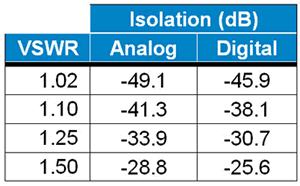 environment
of the transmitter building changes? The antenna as a load is the
last component in the RF path, so if something changes with the
antenna, it affects the whole system. Ideally, antennas act as perfect
loads on hot and cold days, are broad band, and ice does not affect
them. Unfortunately, reality is not ideal. Any number of events
can affect the impedance of an antenna.
environment
of the transmitter building changes? The antenna as a load is the
last component in the RF path, so if something changes with the
antenna, it affects the whole system. Ideally, antennas act as perfect
loads on hot and cold days, are broad band, and ice does not affect
them. Unfortunately, reality is not ideal. Any number of events
can affect the impedance of an antenna. |
|


ADVERTISEMENTS