|  |  |

|
Emergency Alerting Front and Center at 2011 NAB Show One of the important services that broadcasters provide to the public is the timely and ubiquitous delivery of emergency alerting information. At last week’s 2011 NAB Show (April 9-14, Las Vegas, Nev.) the Emergency Alert System (EAS) took center stage with a number of exciting announcements and interesting, informative panels with participation from top FCC and FEMA officials as well as representatives from the broadcasting industry. 
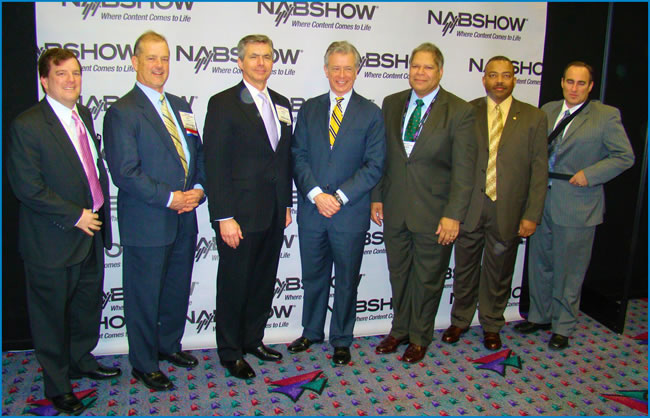
On Wednesday, April 13 a panel of emergency communications experts
from the Federal Emergency Management Agency (FEMA), the FCC and
the broadcast industry met to discuss the new Common Alerting Protocol
(CAP) that has been adopted by FEMA . Moderated by NAB Associate
General Counsel Larry Walke (shown in photo at far left), the “Next-Generation
EAS: The Final Stretch” panel participants included (shown
in photo next to Mr. Walke, from left to right) Whit Adamson, President,
Tennessee Association of Broadcasters; Adm. Jamie Barrett (ret.),
Chief, Public Safety and Homeland Security Bureau, FCC; Greg Cooke,
Public Safety and Homeland Security, FCC; Damon Penn, Assistant
Administrator, National Continuity Programs (NCP), FEMA; Antwane
Johnson, Division Director and Program Manager, FEMA and Wade Wittmer,
Deputy Division Director, FEMA. This panel began with a short video produced by FEMA explaining the history and goals of the Integrated Public Alert Warning System (IPAWS). A wide-ranging discussion about the EAS system in general and the status of IPAWS in particular followed, which included the following points:
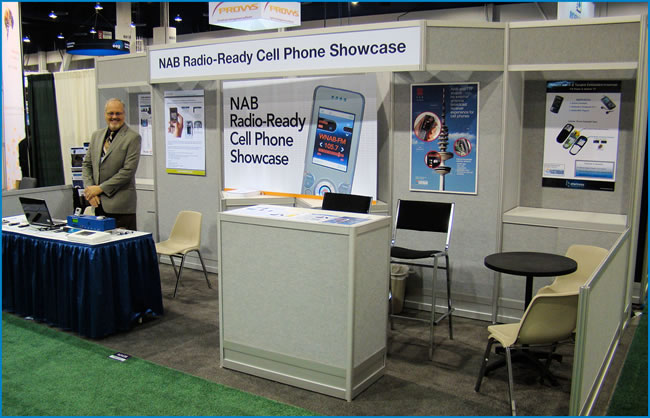
Emergency alerting
technology was on display at the NAB Radio-Ready Cell Phone Showcase.
An array of cell phones which include broadcast radio reception
capability were on display in the Showcase as was a demonstration
of radio’s emergency notification capabilities utilizing the
Radio Data System (RDS) FM subcarrier. Partnering with NAB on the
Showcase was Global Security Systems, LLC, (GSS),
developers of the ALERT FM,
emergency alerting system. Shown below in the photo is Doug Raines,
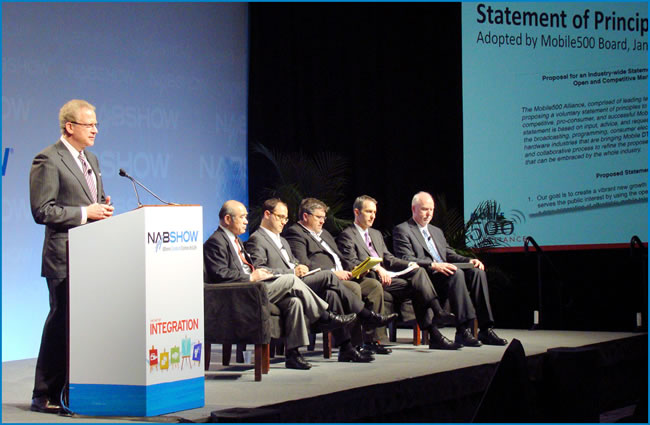
Vice President, Business Development with GSS. On Tuesday, April 12 a special NAB Show Super session was held to highlight the role that mobile DTV played in alerting the public during the recent earthquake and tsunami in Japan. “Emergency Alert with Mobile DTV” was organized by the Mobile500 Alliance in association with NAB and supported by ATSC, MCV, and OMVC. Moderated by John Lawson, Executive Director, Mobile 500 Alliance (shown in the photo standing at the podium), the panelists included (shown in the photo sitting, from left to right) Hideichi Tamegaya, Joshibi University in Japan, Claude Seyrat, Expway, Kerry Oslund, Schurz Communications, Robert Dunlop, Fisher Communications Inc. (KOMO) and John McCoskey, Chief Technology Officer, PBS. Through a system of sensors, Japanese broadcasters transmitted an early warning of the impending disaster. As discussed during the session, when cell networks failed and power went down, one-seg mobile digital TV devices (which receive a narrowband version of the Japanese Integrated Services Digital Broadcast, ISDB, digital TV transmissions) were a lifeline. Mr. Tamegaya and Mr. Seyrat offered first-person accounts of their experiences in Japan during the earthquake.
John McCoskey of PBS used this session as an opportunity to announce a new pilot program with the goal of leveraging the power of Mobile DTV as part of the Integrated Public Alert and Warning System (IPAWS) for the United States. Beginning later this year, PBS will initiate testing on a next-generation emergency alert system, which is designed to deliver multimedia alerts using video, audio, text and graphics to cell phones, tablets, laptops and netbooks, as well as in-car navigation systems. Building on the flexibility of the ATSC Mobile Digital TV broadcast standard, the PBS pilot project will test capabilities designed to lead to a comprehensive new Mobile Emergency Alert System (MEAS). PBS has identified key partners to support the project, including LG Electronics Inc. and its U.S. R&D subsidiary, Zenith, which will develop handheld mobile DTV devices to receive the new alerts and will provide funding for the project. Also working with PBS, the Corporation for Public Broadcasting (CPB) is providing matching grants to local public television stations for Mobile DTV broadcasting equipment. PBS plans to announce stations for the pilot project in the near future. PBS also plans to work closely with the U.S. Department of Homeland Security’s Federal Emergency Management Agency, the Federal Communications Commission and other agencies in devising and implementing the pilot project. The full press release on the PBS announcement may be found here. |
|
The Federal Communications Commission (FCC) is conducting a session for consultants on Tuesday, June 21, 2011 at their headquarters in Washington, DC on Communications Towers and Environmental/Historic Preservation Compliance. Training will be provided by staff from the FCC, USDA Rural Utilities Service, NTIA, FEMA and the Advisory Council on Historic Preservation. For additional information contact Steve DelSordo and to register contact James Swartz who are both at the FCC. To attend the session you must preregister.
|