The National Association of Tower Erectors (NATE, Watertown,
S.D., www.natehome.com)
has launched a free, Internet-based tower site Hazard Recognition
Guide with the goal of improving safety on broadcast and communications
tower sites. This guide has been designed to help project managers,
site superintendents and other responsible personnel on a tower
site to recognize and deal with hazardous situations. NATE launched
the Guide at NATE 2010, its annual trade show held last week in
Lake Buena Vista, Fla.
NATE teamed with Cellular South (and another, unnamed cellular
carrier), and with SBA Communications Corporation, an independent
owner and operator of wireless communications towers across North
America, to develop this Guide. The Association has leveraged
its repository of tower safety standards and safety resources
to ensure the Hazard Recognition Guide provides personnel
with the information required to empower everyone on a broadcast
or communications tower site with the knowledge of safe operating
procedures.
The Guide is designed to empower on-site employees of tower owners, carriers,
broadcasters and general contractors to recognize hazards on broadcast
and communications tower sites and take steps to alleviate those
situations quickly and effectively. The Hazard Guide also provides
additional resources such as OSHA guidelines where further information
about specific topics can be obtained.
As part of its mission to increase safety on all broadcast and communications
tower sites, NATE is offering the Guide free to anyone in the
industry. To access, go to www.hazardrecognition.com,
fill out the (free) registration information, then under COURSES
click on the "NATE Hazard Recognition Guide," and under TRAINING
click on "NATE Hazard Recognition Guide," and finally, click on
the "Run training" button which will initiate the Guide player
in your Web browser.
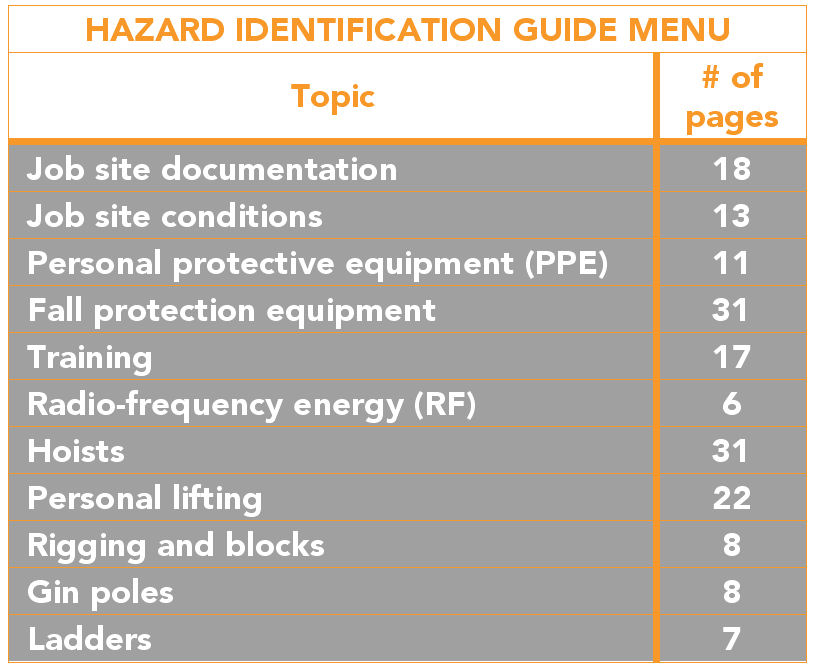
The Guide is organized into eleven "chapters" which are listed in the table
below along with the number of pages in each chapter. Within each
chapter, a series of questions are posed which lead to a discussion
of good safety practices and ways to identify hazards. When appropriate,
safety regulations are quoted which apply to the situation being
discussed. For example, in the personal protective equipment (PPE)
chapter there is a question about hand protection for which Title
29 of the Code of Federal Regulations (CFR), Part 1910 (Occupational
Safety and Health Standards) is excerpted as follows:
"29 CFR 1910.138 requires that employers require their employees to wear hand protection
when employees' hands are exposed to hazards such as harmful substances,
cuts, or lacerations, severe abrasions, punctures, chemical burns,
thermal burns or harmful temperature extremes. Employers shall
base the selection of the performance characteristics of the hand
protection relative to the tasks to be performed, conditions present,
duration of use and the hazards and potential hazards identified."
Other specific information of interest includes the following:
Detailed description of "Personal Fall Arrest Systems"
with information on such components as anchorages, body harnesses,
D-rings, snap-hooks, and carabiners;
Tower climber fall protection training information, citing specific relevant
regulations and retraining requirements;
Detailed information on the inspection, testing, and maintenance of hoists.
2010 NAB Broadcast Engineering Conference Summary of Presentations
Check out
the papers
that will be presented at the 2010 NAB Broadcast Engineering
Conference in Las Vegas, April 10-15, 2010. Find registration,
housing or additional information on the NAB Show at http://www.nabshow.com/2010/default.asp.
ADVERTISEMENT

|


