|



|
WiFi Evolution: 802.11ac and Beyond Radio and TV broadcasters are among the many users of WiFi for wireless local area networking in their daily operations. As throughput and reliability of WiFi has increased, it has become increasingly common to use it even for program contributions and other critical remote operations. It is also frequently used by broadcast audiences for distribution of received broadcast content within the home, vehicle or elsewhere. So it may be welcome news that the WiFi standard is receiving yet another update. The IEEE 802.11ac standard is the natural evolution of IEEE 802.11n, which has been a popular and successful WiFi standard since its publication in 2009 (although pre-release 802.11n-class devices were available earlier). The new 801.11ac standard supports gigabit data transfer rates for wireless networks. An 802.11ac access port therefore can support multiple high-quality video streams to multiple IP devices simultaneously. The standard was ratified by WiFi Alliance in 2013, and many devices are already in the market. 802.11ac is backward compatible with 802.11n and 802.11a standards. It is predicted that by 2015, 802.11ac will be the most common WiFi standard on new devices. Meanwhile, a typical 802.11ac access point will fall back to 802.11n to connect with client devices not yet equipped with 802.11ac capability (just as 802.11n access points did for their predecessor 802.11b/g clients).
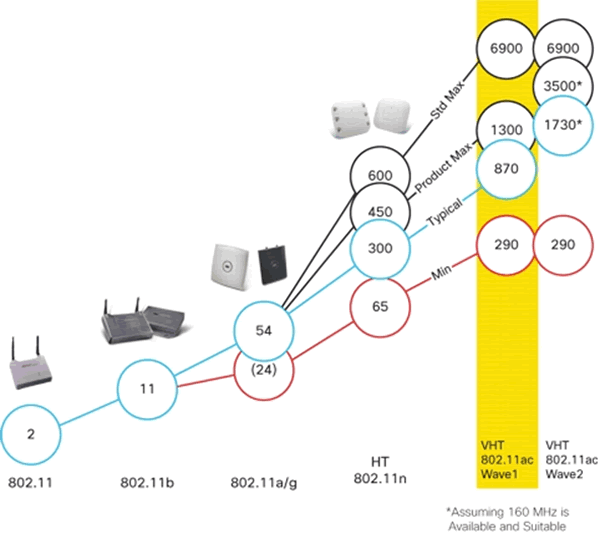
Figure 1: Evolution of 802.11. Values in the circles represent throughput in megabits per second (Mbps). (Source: Cisco) The goal of the specification is to improve the popular features of 802.11n and drop the unused features on 802.11n to make the new standard simpler. The improvements of 801.11ac are in the following three areas: support for additional spectrum, beam forming, and denser modulation. The products will be rolled out in two phases: Wave 1 and Wave 2 (more on this below).
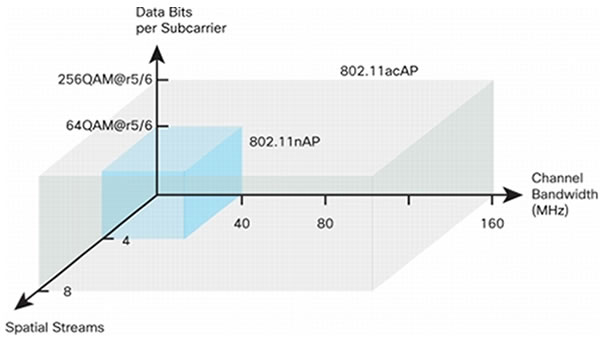
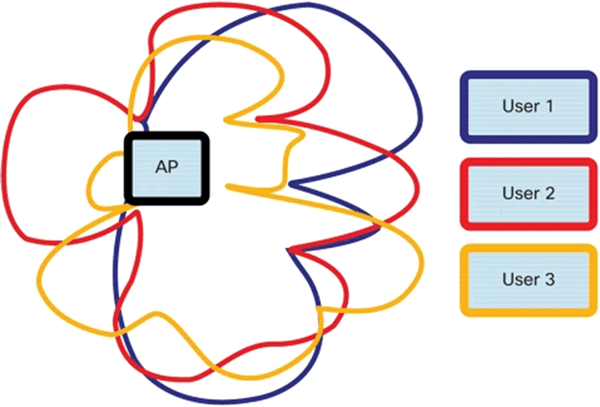
Figure 2: Improvements of 802.11ac over 802.11n. (Source: Cisco) Importantly, the 802.11ac standard allows the use of 5 GHz band only—a departure from most previous WiFi devices, which used the 2.4GHz band. (The 802.11n format optionally allowed either 2.4 or 5 GHz operation, and only the 802.11a format, more commonly found among enterprise WiFi installations, operates solely at 5 GHz). The 2.4 GHz spectrum is a popular swath of unlicensed bandwidth for consumer devices, and is plagued by interference from microwave ovens, Bluetooth devices, baby monitors, cordless phones and amateur radio equipment that use the band. Moreover, 802.11ac breaks new ground in channel bandwidths, which have previously been limited to 20 MHz and 40 MHz. The 802.11ac format uses 80 MHz channels. Channel bonding has also been improved in 802.11ac, and as a result two 80 MHz channels can be bonded into a single 160 MHz channel. This wider bandwidth and lower interference operation in the 5 GHz band are key to the new standard’s performance improvements. Another upgrade is advanced beamforming capability, which is known as multiuser MIMO (MU-MIMO). Figure 3 explains the beamforming capability through an example. The figure shows that antenna gain is increased in the direction of the targeted user and a null is formed in the direction of interferers. The MU-MIMO mode can support up to 8 data streams.
Figure 3: MU-MIMO example. (Source: Cisco) Finally, the third component of throughput increase is the denser signal constellation for modulation. 802.11ac will support 256 QAM, which represents 8 bits per modulation symbol. 802.11n supports 64 QAM, which supports 6 bits per modulation symbol. There is a concern that the denser constellation could reduce the range in its pursuit of higher throughput. Proponents claim that the beamforming technology makes up for the power deficit, however. Other improvements of 802.11ac include standardized channel sounding and beamforming, improved Request to Send/Clear to Send (RTS/CTS) mechanisms, stronger Clear Channel Assessment (CCA), and a new primary channel selection rule. As noted above, 802.11ac products are planned to be released in two stages. Wave 1 will feature 256 QAM modulation and 80 MHz channel bandwidth. Other advanced features such as 80+80 MHz channel bonding and MU-MIMO are scheduled for Wave 2. As of January 2014, only the Wave 1 products are available in the market. Some experts warn that not all features of 802.11ac will be successful, however. For example, the maximum number of streams will be limited to 6 instead of 8 because both MU-MIMO and space-time code (STC, a form of diversity transmission for increased robustness) cannot work together. Experts also argue that the combination of 256QAM and MU-MIMO is impractical. Regardless of doubts, experts generally agree that the Wave 1 products may achieve 800 Mbps data transfer rate, while Wave 2 products will exceed 1 Gbps data transfer rate. Another developing WiFi standard, IEEE 802.11ad, will also hit the market soon. 802.11ad is more of an overhaul, and it will not be backward compatible with older WiFi standards. The IEEE 802.11ad standard will operate in the 60 GHz band and will provide up to 7 Gbps speed, which is seven times faster than 802.11ac connections. Because of the electromagnetic propagation characteristics at 60 GHz, however, operating range will be quite short and the signal will not penetrate most room boundaries. Experts are predicting that 802.11ad will be used mainly to connect with peripheral devices within a room, whereas 802.11ac will be used to provide the in-home network. 802.11ad is also considered a strong contender for use in the Internet of Things (IoT).
NAB Show @ CABSAT - The Changing Landscape of Broadcasting - NAB Shows has partnered with the Dubai World Trade Center (DWTC) to produce the 2014 CABSAT Conference. Celebrating its 20th anniversary, CABSAT is the region's leading annual event focusing on the broadcast, satellite and media industry. The two-day conference (11 & 12 March 2014) will attract attendees from the Middle East, Africa and South Asia who are actively engaged in the creation, management and delivery of entertainment and news content.
|
|
 The January 27, 2014 TV TechCheck is also available in an Adobe Acrobat file. Please click here to read the Adobe Acrobat version of TV TechCheck |
 Advertisements
|