|
 |
 |

| New
Updates for Emergency Radios
It's well known that, in an emergency, a portable battery-powered radio is your best friend. You can continue to get needed emergency information even if the power goes out. However, in an extended emergency, if you don't have an extended supply of batteries, your portable radio, or your radio in your mobile phone, will eventually become useless. That is, unless there is another source of power available that you can harness. There is a long history of hand-crank radios on the market that meet this practical need. Eton Corporation (www.etoncorp.com) just announced several new updated models, all with AM/FM and NOAA radio capability, with some interesting and convenient features.
No later than June 30, 2012, all broadcast stations must have CAP
capable EAS equipment installed and operating in their facilities.
FCC rule 11.56 requires all broadcasters to have equipment installed
and operating that can receive and decode National Level (federal)
Emergency messages (EANs) encoded in the Common Alerting Protocol
(CAP) format. The original CAP compliance deadline was March 31, 2011. In response
to a petition filed by NAB and others, the FCC extended that deadline
to September 30 2011. On Friday September 16, 2011, the FCC released
an order further extending the deadline to June 30, 2012. This requirement was reaffirmed in the most recent FCC EAS Report
and Order released January 10, 2012 (Fifth Report and Order in EB
Docket No. 04-296 - "5th R&O"). The rules adopted
in the 5th R&O also require broadcasters to interface with and
monitor FEMA's Integrated public Alert and Warning System (IPAWS)
server for those federal CAP-formatted EAS messages. However, because
IPAWS monitoring will be largely conducted via an Internet connection,
the FCC will consider, on a case by case basis, applications for
waivers from this monitoring requirement based on the physical lack
of availability of broadband. The 5th R&O is available here.
The order extending the Cap compliance deadline is here.
IEEE Broadcast Technology Society Issues Call for Papers
The submission deadline for abstracts has been extended to May 31, 2012. Visit the symposium website for additional information. This Symposium is produced by the IEEE Broadcast Technology Society. |
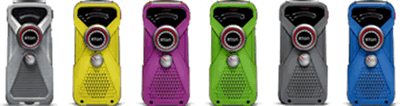 The
FRX1, 6" H x 4.5" W x 3" D, is compact, includes
an LED flashlight and has an retail price (MSRP) of $25.00. According
to the manual, five minutes of cranking will give about ten minutes
of radio playing time.
The
FRX1, 6" H x 4.5" W x 3" D, is compact, includes
an LED flashlight and has an retail price (MSRP) of $25.00. According
to the manual, five minutes of cranking will give about ten minutes
of radio playing time. The
FRX3 is larger at 7.875" H x 7" W x 3.5" D and has
an MSRP of $60.00. It includes a digital clock and alarm, and can
be powered from 3 AAA batteries, in
The
FRX3 is larger at 7.875" H x 7" W x 3.5" D and has
an MSRP of $60.00. It includes a digital clock and alarm, and can
be powered from 3 AAA batteries, in 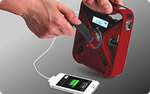 addition
to the cranking, solar panel, DC power input and rechargeable battery
options.
addition
to the cranking, solar panel, DC power input and rechargeable battery
options.  A
Call for Papers has been issued for the 2012 IEEE Broadcast Symposium,
to be held October 17-19, 2012, in Alexandria, Va. The Symposium
Committee seeks timely and relevant technical papers relating to
all aspects of broadcast technology, in particular on the following
topics:
A
Call for Papers has been issued for the 2012 IEEE Broadcast Symposium,
to be held October 17-19, 2012, in Alexandria, Va. The Symposium
Committee seeks timely and relevant technical papers relating to
all aspects of broadcast technology, in particular on the following
topics:
  The May 21, 2012 Radio TechCheck is also available in an Adobe Acrobat file. Please click here to read the Adobe Acrobat version of Radio TechCheck. The
next issue of Radio TechCheck
will be published on Monday, June 4, 2012. |
ADVERTISEMENTS