FacebookTwitterLinkedIn
August 8, 2011
TV Tech Check

OMVC Mobile DTV Field Testing

Mobile DTV is a consumer service offering users a direct feed of broadcast television programming through a variety of wireless mobile devices. Promoted in the U.S. by the Open Mobile Video Coalition (OMVC) and others, Mobile DTV is rolling out in numerous markets throughout the country. The OMVC, a coalition of commercial and public broadcasters, worked with ATSC in developing the DTV standard that paved the way for commercial deployment of the service. Since adoption of the standard, the OMVC has sponsored field testing of Mobile DTV to gain a better understanding of how Mobile DTV signals perform in different environments. The field tests also help determine operating parameters that will result in the best coverage and viewer experience.
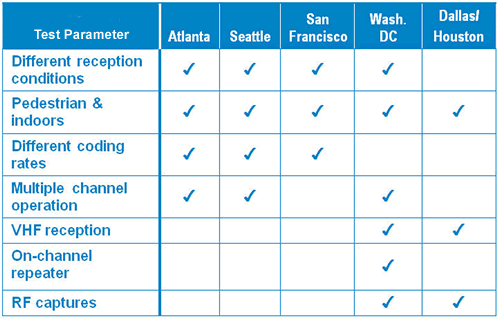
OMVC field tests have been conducted in a number of U.S. cities, as shown in the table to the right. Each city offered an opportunity to test one or more of the parameters of interest as illustrated. All of these tests have been completed except for the ones in Dallas/Houston which are still underway. Listed below are some major findings and observations from these tests for each of the different performance categories:

  • Different reception conditions: Not surprisingly, mobile DTV performance is directly affected by signal level. Multipath (i.e., complexity of echoes and Doppler) did not significantly affect performance. Mobile DTV signal reception using a fixed outdoor antenna was very good in Washington, D.C., San Francisco and Atlanta (within a 30-mile radius of the transmitters). The system did not perform as well in Seattle (terrain and urbanization contributed to reception failures and shortfall).

  • Pedestrian and indoors: Reception for pedestrian operation using a mobile DTV-equipped phone with extendable antenna was achievable for signal levels equal to or greater than -62 dBm for mixed rate and -64 dBm for 1/4 rate (“Rate” refers to Turbo coding rate, one of the parameters varied during the tests. Turbo coding is an error-correcting coding technique used to increase signal robustness.) These findings were true whether the measurements were taken indoors or outdoors, walking or stationary. Occasionally, failures in reception occurred at signal levels higher than -62 dBm.

  • Different Turbo coding rates: The 1/4 rate Turbo code performed slightly better than the mixed rate Turbo code. The 3.5 to 4 dB improvement in White Noise reception threshold measured in the lab (for 1/4 rate compared to mixed rate codes) translated into a 3 to 5% improvement in coverage area in the field. The 1/2 rate Turbo code did not perform as well.

  • Multiple channel operation: Mobile reception of different RF channels operating from different transmitter locations looked very promising. This was especially true if the transmitters were within a reasonable distance of each other and were operating at comparable power and height. The data also suggest that a multi-channel pedestrian service would be more difficult to achieve than for mobile service.

  • VHF reception: Currently there is not enough data to evaluate mobile DTV performance at VHF. More testing of this parameter is currently underway.

  • On-channel repeater:This improved the overall mobile DTV reception, especially indoors. Mobile DTV devices were able to demodulate the more complex echoes generated by the repeater. Failures occurred in a few instances where the repeater signal level was between zero and 4 dB above the main signal. The on-channel repeater had a more significant impact on 8-VSB legacy receivers (i.e., non-mobile DTV receivers). Failures occurred in many instances where the repeater signal level was between zero and 8 dB above the main signal, and the failures varied significantly depending on the make and model of the 8-VSB legacy device.

  • RF captures: Some RF signals were “captured” in the field then directly fed (using coax) into prototype receivers in the lab. Depending on the complexity of the echoes in the RF capture, the reception threshold for the directly-fed signals ranged from -78 to -84 dBm. The same signals received in the field using a mobile phone with a built-in mobile DTV receiver and antenna showed a threshold penalty of 15 to 20 dB. This is probably attributable to the random orientation of the receive antenna and the overall performance of the mobile DTV-equipped phone’s receiving system.

Additional information about OMVC mobile DTV field testing is available in an archived webcast that was conducted by Broadcast Engineering magazine on July 27, 2011. Featured in this webcast are NAB’s Victor Tawil, senior vice president in the Technology Department, and Charles Cooper, principal with the broadcast consulting engineering firm of du Treil, Lundin & Rackley. Also discussed in the webcast is a new prediction model for mobile and handheld Mobile DTV service.

Proposals Now Being Accepted
for 2012 NAB Broadcast Engineering Conference

Las Vegas Convention Center, Las Vegas, Nevada USA
Conferences April 14 – 19, 2012 Exhibits April 16 – 19, 2012

The 2012 NAB Show will host the 66th NAB Broadcast Engineering Conference. This world-class conference addresses the most recent developments in broadcast technology and focuses on the opportunities and challenges that face broadcast engineering professionals around the world. Each year hundreds of broadcast professionals attend the conference. They include practicing broadcast engineers and technicians, engineering consultants, contract engineers, broadcast equipment manufacturers, distributors, R&D engineers plus anyone specifically interested in the latest broadcast technologies.

If you feel qualified to speak at the NAB Broadcast Engineering Conference, we invite you to submit a technical paper proposal. The deadline for submitting your proposal is October 21. If you have any questions, contact John Marino, vice president, NAB Science and Technology at 202 429 5346.


The August 8, 2011 TV TechCheck is also available in an Adobe Acrobat file. Please click here to read the Adobe Acrobat version of TV TechCheck.

ADVERTISEMENTS