|  |  |

|
“Second Screen” Players Abound The practice of watching television while also engaging in the use of another connected device – such as a PC, or more recently, a smartphone or tablet – has become quite popular among some segments of the television audience of late. The new terminology that has emerged in the industry for this practice is “second screen,” referring to the use of the ancillary device as another display viewed simultaneously alongside the primary TV screen. 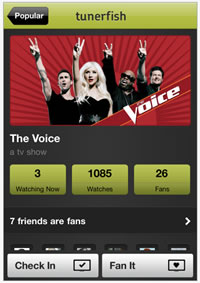
While the trend toward using a second device while watching TV is not really new, what has changed recently is the use of social networks on these devices while doing so. This process intrinsically provides a forum for real-time, side discussion of live television broadcasts by viewers. Well-known, established social networks have provided a convenient site for such discussions, particularly Twitter, which lends itself to fast, short comments by viewers that they can easily read and write while still paying attention to the broadcast. Most recently,
however, this specific application of social network usage has proven
compelling enough for the development of a number of new companies
devoted exclusively (or nearly so) to providing social networking
platforms for television viewers alone. Last week, a sold-out conference
on the topic of “Social TV” was held in Los Angeles which
provided a venue to observe the surprising number of players that
have already launched service in this space.
ClipSync: The Silicon Valley company ClipSync is a web-based service that integrates social networking with a TV-viewing and interaction platform on a single screen. Its surrounding of the TV content with ancillary chat and other content seems optimized for larger screens (PC or tablet), and thus is not a true “second-screen” service, but clearly leverages traditional TV content in a social TV setting.
Get Glue: Calling itself “the fastest growing social network for entertainment,” this fan-based social platform targets TV as well as books, movies and music. It allows users to check-in with short messages about what they are currently watching (or reading, etc.), and users can earn points for discounts, stickers or elevation to “guru” status for their favorite content. It offers mobile apps for all popular devices, and therefore operates as a true “second-screen” service.
Media-Sync: A company called TVAura Mobile (a joint venture between The Nielsen Company and Digimarc Corporation) has developed the Media-Sync platform, which uses audio watermarks (encoded in TV programs’ soundtracks for audience measurement purposes) to also make connected devices “content aware.” Apps downloaded to a mobile device pick up the watermarks from the TV speakers via the device’s microphone, then use this data to sync to online content associated with the current TV program (whether playing live or from DVR) for display on the mobile device’s screen. ABC has used the system to provide second-screen content for selected episodic series.
Miso: Miso is a San Francisco-based startup that brands itself as a “social TV platform that makes watching TV more fun.” Besides simple check-ins on what users are currently watching, it has developed a number of program-specific mobile apps allowing viewers to interact with additional show-related content on the second screen while watching the program on TV.
SnappyTV:
This service allows users to “snap” short clips from TV
programs as they watch, add their comments, and share the captioned
clips with other network members, or post to a user’s Facebook
page. Because Snappy TV is designed to clip from TV shows as the
user is viewing them on a networked device, it is less of a “second-screen”
and more of a “social-TV” service, but it could still
be used to access a TV show through the SnappyTV service for clipping
on a mobile device, while the user was watching the same show on
TV or from a DVR.
Tunerfish:
A Comcast Interactive Media spinoff, Tunerfish bills itself as “a
social discovery engine for TV, movies and online video,” and
is currently in beta. It operates as a simple, Twitter-like, short-message
feed.
TVplus: Based in Orange County, Calif., TVplus is a website designed for use while watching live TV. The site’s landing page features a program guide (currently covering prime time on ABC, CBS, Fox, NBC and The CW), from which users can select the show they are currently watching, and then watch synchronized contextual content for the program on the browser screen. Vualla: An iPad app billed as a “social TV companion,” it provides a TV program guide, check-in service and an integrated Twitter client showing trending TV topics, plus a link to Facebook, for posting comments, photos and videos about TV programs the user is currently watching. (There is currently no active website for the company, but the Vualla app is available at the iTunes store.) Other Second-screen Services There are a few other, larger players also trying their hand at addressing the second screen, including “over-the-top” TV content services Hulu and Netflix. (Netflix is currently on its second try at this, having launched and shuttered a similar attempt in 2010.) Meanwhile,
hybrid TV services and platforms like Yahoo Connected TV and GoogleTV
also offer services that could be used on the second screen, and
other giants like Apple and Microsoft are rumored to be considering
their own, as well. Second-screen standardization is also being considered by the ATSC as part of its ATSC 2.0 initiative, but it remains to be seen if or how any such effort would interface with any of the varied players listed here. TV broadcasters may want to keep abreast of all such trends that leverage their content in these alternate environments, with an eye on developing future opportunities for their own benefit on the “second screen.” |







|
Proposals
Now Being Accepted The 2012 NAB Show will host the 66th NAB Broadcast Engineering Conference. This world-class conference addresses the most recent developments in broadcast technology and focuses on the opportunities and challenges that face broadcast engineering professionals around the world. Each year hundreds of broadcast professionals attend the conference. They include practicing broadcast engineers and technicians, engineering consultants, contract engineers, broadcast equipment manufacturers, distributors, R&D engineers plus anyone specifically interested in the latest broadcast technologies. If you feel qualified to speak at the NAB Broadcast Engineering Conference, we invite you to submit a technical paper proposal. The deadline for submitting your proposal is October 21. If you have any questions, contact John Marino, vice president, NAB Science and Technology at 202 429 5346.
The July 25, 2011 TV TechCheck is also available in an Adobe Acrobat file. Please click here to read the Adobe Acrobat version of TV TechCheck. |



ADVERTISEMENTS