|  |  |

|
Advanced
Hybrid Broadcast and Broadband System 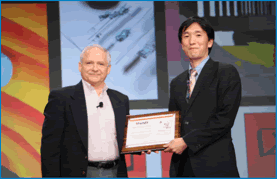
Digital TVs that connect to the Internet are becoming the rule rather than the exception and broadcasters are eager to make use of this expanded functionality to better serve their viewers. A paper, excerpted here, from the 2011 NAB Broadcast Engineering Conference (BEC, April 9-14, 2011, Las Vegas, Nev.) describes an effort underway by the Science and Technology Research Laboratories of the Japan Broadcasting Corporation (NHK) to develop an advanced hybrid broadcast and broadband system called "Hybridcast." This paper, Advanced Hybrid Broadcast and Broadband System for Enhanced Broadcasting Services, was co-authored by Akitsugu Baba, Kinji Matsumura, Sigeaki Mitsuya, Masaru Takech, Yasuaki Kanatsugu, Hiroyuki Hamada, and Hisakazu Katoh, all with NHK. For their efforts, this group of co-authors was awarded the NAB Best Paper Award for "…a paper of exceptional merit published in the 2011 NAB BEC Proceedings." This award was presented at the NAB Technology Luncheon on Wednesday, April 13. Shown in the photo is Mr. Baba receiving the award from BEC Conference Committee Chairperson Dom Bordonaro of Cox Radio.
BASIC ARCHITECTURE OF HYBRIDCAST - The Hybridcast system consists of three blocks: broadcaster servers, service-provider servers and receivers (see figure below). The broadcaster servers broadcast content and content-related information, which only the broadcasters hold, to the service provider servers. The service provider servers provide applications, content and the relevant information to the receivers or end users; the broadcasters can provide services in this block as well. Hybridcast receivers execute applications to realize various services. Such an application-centric service enables a rather simple receiver implementation.
Applications executed on a Hybridcast receiver, called "Hybridcast applications," handle the broadcast content as well as the content and relevant information obtained from the service provider servers. The applications can also utilize receiver functions such as the synchronization and the multi-device linkage. These applications are available from a known application repository, and can be created by third parties as well as by the broadcasters and service providers. The participation of third-party application developers is expected to spawn a legion of developers and thereby increase the number of Hybridcast users. However, the authenticity of such applications is an important issue. In the case of some applications, an application administrator may require to authenticate and authorize them. CONCLUSION - We propose the Hybridcast system that will provide new services using a broadcast-broadband combination. In this paper, examples of services enabled by Hybridcast, basic system architecture, and the key technologies used in the Hybridcast system are described. The feasibility and usability of Hybridcast services and the flexibility of the Hybridcast system architecture are verified by means of prototypes. This paper is
included in its entirety in the 2011 NAB Broadcast Engineering
Conference Proceedings, available on-line from the NAB
Store. For additional conference information visit the NAB
Show web page. |
 INTRODUCTION
- NHK is developing an advanced hybrid broadcast and broadband system
called Hybridcast to integrate broadband technology with broadcasting.
Hybridcast provides many features, including precise synchronization
of content from different delivery channels, support for third party
applications and program presentation by seamless interaction among
multiple device types, including mobile terminals. In addition,
Hybridcast is designed to simplify the implementation of receivers
by using server-side cloud computing technology. Compatibility with
existing digital broadcasting systems is also provided.
INTRODUCTION
- NHK is developing an advanced hybrid broadcast and broadband system
called Hybridcast to integrate broadband technology with broadcasting.
Hybridcast provides many features, including precise synchronization
of content from different delivery channels, support for third party
applications and program presentation by seamless interaction among
multiple device types, including mobile terminals. In addition,
Hybridcast is designed to simplify the implementation of receivers
by using server-side cloud computing technology. Compatibility with
existing digital broadcasting systems is also provided. NEW
SERVICES AVAILABLE UNDER HYBRIDCAST - Broadcasting is the fundamental
component of all the services described in this paper. Content elements
and additional functionalities offered over broadband are for enhancement
and enrichment of the existing broadcast services. One service is
the multi-device linkage service, the purpose of which is to establish
a convenient and personalized viewing environment by seamlessly
working across multiple device types, including mobile terminals.
To establish such an environment, an application on the terminal
communicates and works synchronously with the application on a Hybridcast
receiver. For example, a mobile terminal can be used as a remote
control to manipulate Hybridcast content as shown in the figure
at right. In addition, it can be used to access personalized services
such as recommendations and bookmarking. In this case, a mobile
terminal acts as a secondary display for watching TV.
NEW
SERVICES AVAILABLE UNDER HYBRIDCAST - Broadcasting is the fundamental
component of all the services described in this paper. Content elements
and additional functionalities offered over broadband are for enhancement
and enrichment of the existing broadcast services. One service is
the multi-device linkage service, the purpose of which is to establish
a convenient and personalized viewing environment by seamlessly
working across multiple device types, including mobile terminals.
To establish such an environment, an application on the terminal
communicates and works synchronously with the application on a Hybridcast
receiver. For example, a mobile terminal can be used as a remote
control to manipulate Hybridcast content as shown in the figure
at right. In addition, it can be used to access personalized services
such as recommendations and bookmarking. In this case, a mobile
terminal acts as a secondary display for watching TV.
|
FCC
to Conduct Training for Consultants on Communications Towers and
Environmental/Historic Preservation Compliance For additional
information contact Steve
DelSordo and to register contact James
Swartz who are both at the FCC. To attend the session you
must preregister. Now
Available: 2011 NAB Broadcast Engineering Conference Proceedings Available as a book with CD. List price: $142. NAB member price: $120. CD-only list price: $95. NAB member price: $80. For details and to purchase, visit the NAB Store. Quantities are limited. IEEE Broadcast Technology Society Extends Call for Papers Deadline 
The deadline for the Call for Papers for the 2011 IEEE Broadcast Symposium has been extended to May 15, 2011. This year's Symposium will be held October 19-21, 2011, in Alexandria, Va. The Symposium Committee seeks timely and relevant technical papers relating to all aspects of broadcast technology, in particular on the following topics: See the
Call
for Papers for additional information. This Symposium is
produced by the IEEE Broadcast
Technology Society.
|
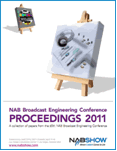 This
selection of papers presented at the 65th NAB Broadcast Engineering
Conference at the 2011 NAB Show include a variety of topics from
ways to further implement and improve existing digital broadcasts
to cloud-based technologies, emergency operations, 3DTV and the
impact of innovative technologies on the broadcast industry.
This
selection of papers presented at the 65th NAB Broadcast Engineering
Conference at the 2011 NAB Show include a variety of topics from
ways to further implement and improve existing digital broadcasts
to cloud-based technologies, emergency operations, 3DTV and the
impact of innovative technologies on the broadcast industry.
ADVERTISEMENTS