|  |  |

|
Registration
Open for NAB Satellite Uplink Operators Seminar The next NAB
Satellite Uplink Operators Seminar is October 3-6, 2011 at NAB headquarters
in Washington, D.C. This seminar provides in-depth information on
the theory of satellite communications and all operational aspects
of the ground equipment for uplink and downlink facilities and is
applicable to distributing signals for both analog and digital television
and radio. “The NAB course offers many features that other satellite operators courses do not, such as a variety of hands-on training sessions, more hours of personal instruction and a general satellite systems and television focus as opposed to just training on a specific type of terminal – for example a flyaway SNG terminal,” commented Mr. Skjei. We also cover specific operations of SNG truck terminals, including a practical session which affords students a shirtsleeves experience in uplinking from an SNG truck.” NAB
Satellite Uplink Operators Training Seminar Certified As part of SUIRG's goal to stop interference before it begins, they maintain a satellite operations training certification program. NAB submitted its training program to SUIRG for review and consideration and received the SUIRG certification in 2009. Comments from Prior Seminar Attendees I was very
impressed with the amount of knowledge and hands on experience the
instructor has in all aspects of satellite communications including
many related fields. This is
a great seminar to attend. I felt that no matter what your level
of knowledge, you will learn something and end up with a better
understanding of your equipment. Sidney Skjei
is a pioneer in the satellite industry. Learning from his expertise
is extremely beneficial. He answered students’ questions fully
and explained satellite concepts completely. 
The four-day
seminar provides the operational training which minimize the risk
of satellite transmission interference. This is an important seminar
since the FCC rules require that "a trained operator be present
at all times during transmissions, at either an earth station site
or designated remote control point" [Section 25.271 (b)]. The seminar fee is $1,250 (NAB members) and $1,550 (all others). The seminar fee includes a Satellite Uplink Handbook, continental breakfast and lunch. Space is limited so if you don't want to miss this opportunity, go to the Satellite Seminar Web page or call Cheryl Coleridge at (202) 429-5346. If you are interested in sponsorship opportunities for this event contact NAB Advertising at (800) 521-8624 or advertising@nab.org. |
 The
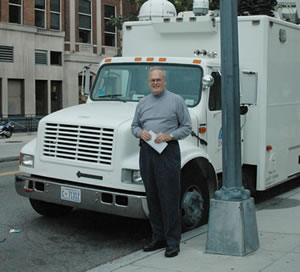
class is taught by Sidney Skjei, M.S.E.E., P. E. of Skjei Telecom.
Mr. Skjei has over 30 years experience in engineering, operating
and developing a wide range of hardware and software satellite communications
systems and services. He is highly knowledgeable in all major satellite
communications operational areas: global, U.S. domestic and military.
Mr. Skjei believes that satellite operators should have a basic
understanding of other parts of the broadcast transmission system.
Digital television (DTV) and, in particular, high definition (HDTV)
are now standard through all parts of the broadcast television chain,
from production to distribution to the home. The seminar provides
significant background information on these topics. The Compressed
Digital Television and Transmission section of the seminar covers
the theory of digital video with an introduction to compression
techniques and systems, concentrating on MPEG-2, MPEG 4 Part 10,
(AVC) and JPEG 2000 all of which may be used for broadcast digital
video backhaul and distribution. The seminar also discusses the
various standard definition (SDTV) and HDTV formats with detailed
analysis of how these are carried in satellite transmission systems.
The
class is taught by Sidney Skjei, M.S.E.E., P. E. of Skjei Telecom.
Mr. Skjei has over 30 years experience in engineering, operating
and developing a wide range of hardware and software satellite communications
systems and services. He is highly knowledgeable in all major satellite
communications operational areas: global, U.S. domestic and military.
Mr. Skjei believes that satellite operators should have a basic
understanding of other parts of the broadcast transmission system.
Digital television (DTV) and, in particular, high definition (HDTV)
are now standard through all parts of the broadcast television chain,
from production to distribution to the home. The seminar provides
significant background information on these topics. The Compressed
Digital Television and Transmission section of the seminar covers
the theory of digital video with an introduction to compression
techniques and systems, concentrating on MPEG-2, MPEG 4 Part 10,
(AVC) and JPEG 2000 all of which may be used for broadcast digital
video backhaul and distribution. The seminar also discusses the
various standard definition (SDTV) and HDTV formats with detailed
analysis of how these are carried in satellite transmission systems. The
The 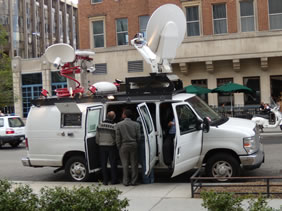 In
addition to classroom instruction, students will receive hands-on
training in a satellite newsgathering (SNG) truck as well as an
all-day field trip to a nearby, large satellite teleport and operations
center.
In
addition to classroom instruction, students will receive hands-on
training in a satellite newsgathering (SNG) truck as well as an
all-day field trip to a nearby, large satellite teleport and operations
center. |
Now
Available: 2011 NAB Broadcast Engineering Conference Proceedings Available as a book with CD. List price: $142. NAB member price: $120. CD-only list price: $95. NAB member price: $80. For details and to purchase, visit www.nabstore.com. Quantities are limited. IEEE Broadcast Technology Society Extends Call for Papers Deadline 
The deadline for the Call for Papers for the 2011 IEEE Broadcast Symposium has been extended to May 15, 2011. This year's Symposium will be held October 19-21, 2011, in Alexandria, Va. The Symposium Committee seeks timely and relevant technical papers relating to all aspects of broadcast technology, in particular on the following topics: See the
Call
for Papers for additional information. This Symposium is
produced by the IEEE Broadcast
Technology Society.
|

ADVERTISEMENTS