|  |  |

|
3D over ATSC at 2011 NAB Show One of the many intriguing demonstrations at the 2011 NAB Show appeared in the International Research Park (IRP), a section of the exhibition floor exclusively devoted to display of new, media-related research projects. Among the IRP exhibitors again this year was the Electronics and Telecommunications Research Institute (ETRI), Korea's largest government-funded research organization. One of ETRI's demonstrations - appearing for the first time outside Korea - presented a method for delivering high-definition 3D television using existing ATSC services. 3D over ATSC This approach would allow a broadcaster to present two separate 2D services with essentially the same content to legacy receivers of both fixed and mobile ATSC formats, while new receivers could combine the two signals received from the single DTV channel to provide a 3D version of this same content. The proposal requires no new technology at the broadcast end (aside from proper routing and signaling of the two video channels in their respective encoders). Development is required primarily on the receiver side only, where new 3D consumer devices would combine the two ATSC services for a proper stereoscopic display. Note that such a receiver would still require only a single tuner, since both video signals are carried in the same ATSC broadcast channel. Mix and Match
First, consider that the two video signals of the stereoscopic pair would be transmitted using different codecs and different transport methods: the left-eye video signals are MPEG-2 encoded, and delivered via an MPEG-2 transport stream, while the right-eye signals are H.264-encoded and delivered via IP transport (per the ATSC A/53 and A/153 standards respectively). Next, because A/153 targets the smaller mobile and handheld receiver screens, its maximum video resolution capability is intentionally lower than that of the HD content that can be delivered to larger screens via the "fixed" DTV services of A/53 (typically a maximum of 1080 lines in A/53, versus 240 lines in the baseline profile of A/153, although this could be increased via use of the format's optional Scalable Video Coding [SVC]). So the two channels of the stereoscopic video in the ETRI system would most likely be transmitted at different video resolutions. Here's where an important piece of research plays a role: psychovisual testing reveals when a normal binocular viewer's two eyes are each presented with 3D images of differing resolution that the viewer's resulting perception of overall image quality is closer to that of the higher resolution image than the lower one. While this may seem counterintuitive from an engineering perspective, it is not so hard to accept in the psychological context, when one considers that human visual acuity typically differs between an individual's two eyes, and well-established research has shown that the visual cortex of the brain attempts to optimize perception toward that of the better eye. Finally, of course, there is the engineering performed by ETRI to properly signal, synchronize and resolve the two sets of received images that have each passed through different codecs and transports, such that they properly "fuse" to a high-definition, 3D image for the viewer. A Good First
Showing Fabrication of the prototype equipment required for presentation of this system was completed only days before the 2011 NAB presentation, so rigorous objective and subjective tests (including examination of any long-term fatigue effects resulting from ocular imbalance) have yet to be conducted on this system. If initial viewing at its debut trade-show demonstration is any indicator, however, the ETRI proposal may provide a viable method for ATSC broadcasters to deliver high-resolution 3D-TV content in an efficient and backward-compatible manner. For further information on this technology, contact Jinsoo Choi at +82 42 860 5185 or jschoi@etri.re.kr. |
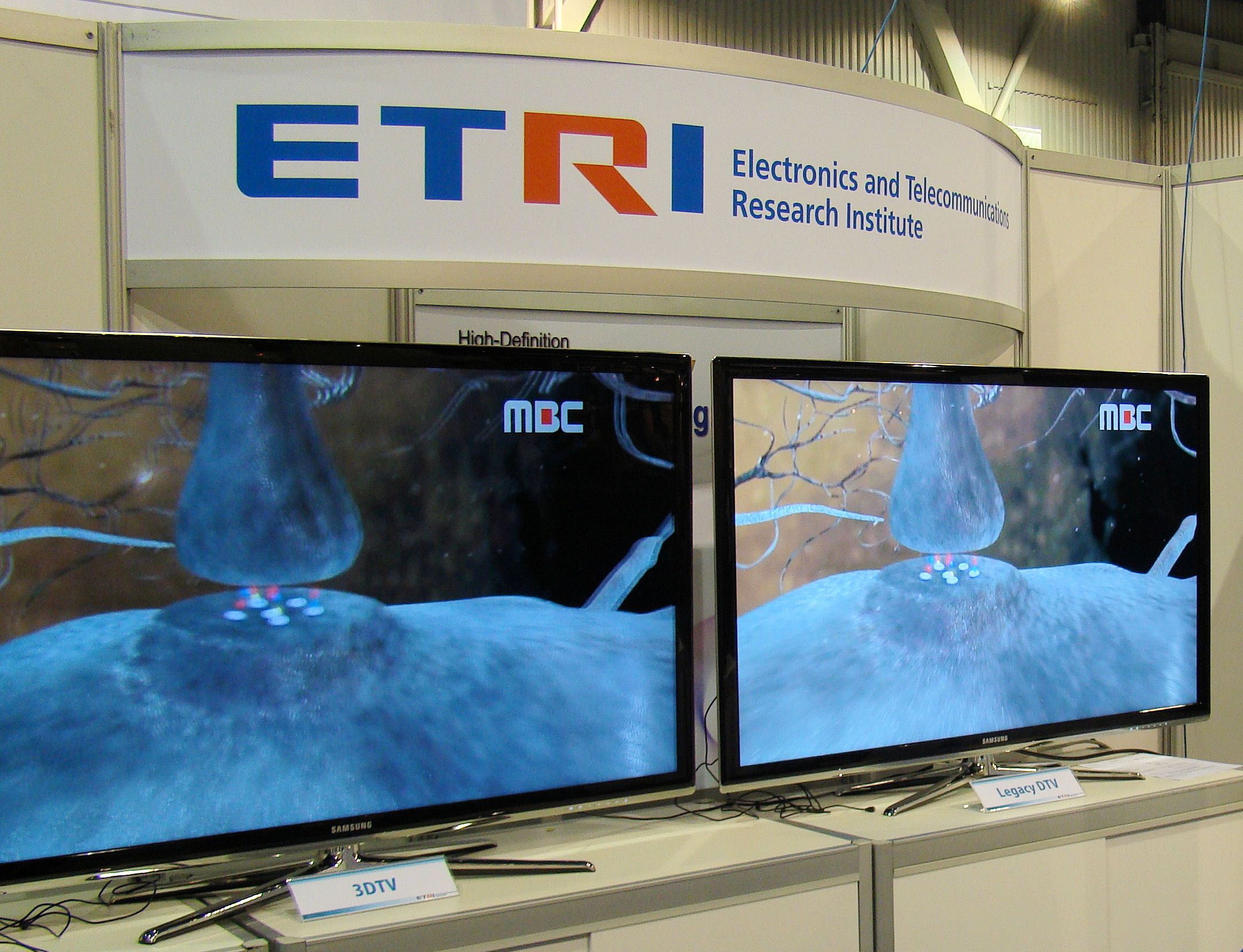 The ETRI demonstration at NAB 2011 illustrated this well (see photo).
The encoded video signals were shown as fully compatible 2D images
on standard ATSC and ATSC M/H receivers, while a high-quality 3D
image was presented on a current-production 3D display (using glasses),
which was fed a stereoscopic image from the ETRI prototype 3D receiver.
The ETRI demonstration at NAB 2011 illustrated this well (see photo).
The encoded video signals were shown as fully compatible 2D images
on standard ATSC and ATSC M/H receivers, while a high-quality 3D
image was presented on a current-production 3D display (using glasses),
which was fed a stereoscopic image from the ETRI prototype 3D receiver.|
NHK Receives 2011 Best Paper Award at NAB Show NHK engineer Akitsugu Baba and other engineers from Japanese public broadcaster NHK received the NAB Best Paper Award for their paper published in the NAB Broadcast Engineering Conference Proceedings titled “Advanced Hybrid Broadcast and Broadband System for Enhanced Broadcasting Services.” Shown in the photo is Mr. Baba with NAB Broadcast Engineering Conference Chairman, Dom Bordonaro of Cox Radio. The award was presented at the NAB Technology Luncheon on Wednesday April 13. The paper discusses an advanced television hybrid broadcast and broadband system called Hybridcast™ which NHK is developing to integrate broadband technology with television broadcasting.
|



ADVERTISEMENTS