|  |  |

|
The Changing Face of Broadcast Captioning While often overlooked, the role of broadcast television captioning continues to change and expand. New workflows and delivery formats (including 3D) affect the production, transport and transcoding of these essential components, and new accessibility regulations may increase broadcasters' requirements in this area. A session at the upcoming NAB Broadcast Engineering Conference (BEC, April 9 - 14, 2011, Las Vegas, Nev. - see below for additional information), entitled "The Future of Television Broadcasting," includes a paper, excerpted here, which considers existing and emerging issues in captioning for broadcast. "Captioning for Next Generation Broadcasting" was authored by Sam Pemberton, Softel USA. CHANGING PRODUCTION AND BROADCAST WORKFLOWS - The subtitling component needs to be closely integrated into the broadcasters overall solution and, ideally, considered during the initial design of a system. With a goal of reaching the widest possible audience across multiple platforms, requiring support for a multitude of output video formats, the broadcasters' focus is shifting away from the traditional production systems and transmission chain, towards Digital Asset Management Systems (DAMS). To aid format and resolution conversions for diverse distribution formats, many broadcasters want to store video assets as a single common "mezzanine" format. This represents the highest quality version. Thereafter, all subsequent broadcast and streaming versions will be derived from it. 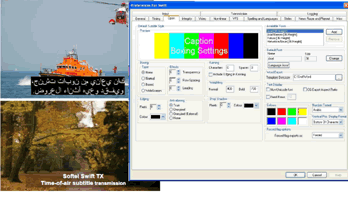
To optimize repurposing, the storage of subtitle data should align with this principle and be stored as a high level generic form of subtitle data. With this approach there are two key overarching methodologies to consider. One relies on the creation of a "master" subtitle which has as much information as possible related to the subtitle, allowing less sophisticated derivatives to be readily produced. In effect this becomes the "mezzanine" format subtitle. A "mezzanine" subtitle typically relies on informed choices being made during the creation/preparation phase for presentational aspects such as font, color, positional and alignment information, drop shadow and character edging. Using a mezzanine format enables the subtitle data to support the media asset over its lifetime, allowing for elegant, effective and highly automated translation to various output distribution formats. CONSIDERING STEREOSCOPIC 3D - Caption and subtitle technology companies are now creating and offering tools which allow for 2D subtitles to be repurposed for 3D content. This involves using a video analysis tool which builds a "3D object map" from the media assets. This 3D metadata allows users of compatible subtitle creation systems to have their software automatically calculate an optimum placement for each subtitle in the Z-axis. Naturally, the user should always be given the opportunity to override any default positioning as chosen by the system. However this automated step enables far more effective production timelines - almost in-line in fact with the creation and re-purposing of more traditional 2D subtitles. The importance of getting the correct depth positioning should not be underestimated. Poorly placed subtitles can distract and in extreme case break the 3D experience. The goal is for the subtitles to enhance and never detract from it. "BINDING" CONTENT FOR PRESENTATION - After the creation phase has been completed, the subtitle data must then be "bound" to the content, enabling presentation to the viewer when they watch the programming. This binding can be considered as occurring in one of three periods of time:
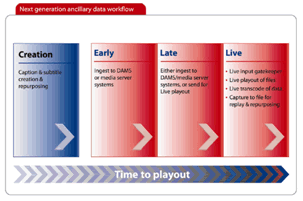
In previous tape-based workflows, pre-prepared content was early-bound by creating a sub-master tape which would have the subtitles encoded in to the VBI space on the tape, by inserting into baseband video. Although this is still possible, it is being largely phased out as it is so labor intensive and slow. In modern workflows, files are now either sent for time-of-air transmission (a live bind), or are transcoded into a file-based video asset (during early or late binding). Mr. Pemberton
will present this paper on Sunday, April 10, 2011 starting at
10:30 a.m. in room S219 of the Las Vegas Convention Center. The
paper will also be included in its entirety in the 2011 NAB Broadcast
Engineering Conference Proceedings, on sale at the 2011 NAB Show
Store, and available on-line from the NAB
Store after the convention. Other papers being presented during
this session (9:30 a.m. - 12:00 p.m.) include the following: For additional
conference information visit the NAB
Show website. |
|
Upcoming EAS Webinar - How to Implement the Common Alerting Protocol (CAP) On March 10, 2011 at 4:00 p.m. (ET), the National Alliance of State Broadcasters Associations will hold the second in a series of webinar presentations on the Emergency Alert System (EAS). This webinar will present three case studies designed to provide helpful information on how broadcasters and state governments can work together to implement the next generation of CAP-based EAS systems. The discussion will also address potential funding sources, as well as how to identify new technologies that will make the transition easy. Please visit http://www.easalert.org/ for more information and instructions on how to register. IEEE Broadcast Technology Society Issues Call for Papers 
A Call for Papers has been issued for the 2011 IEEE Broadcast Symposium, to be held October 19-21, 2011, in Alexandria, Va. The Symposium Committee seeks timely and relevant technical papers relating to all aspects of broadcast technology, in particular on the following topics:
The submission
deadline for abstracts is May 1, 2011. There is additional information
on the Symposium on the IEEE
Broadcast Technology Society website.
All broadcasters are required by FCC §73.682(d) to send a notice of the change to daylight savings time as specified in detail by Annex A of A/65:2009, as well as to send accurate time. Currently the DS_day_of_month in the System Time Table (STT) must have the value '8' and the DS_hour must have the local hour on which you will switch. The DS_status must be '0' until after the change when it must switch to '1'. The seconds count sent in the STT is decoupled from daylight savings time, does not change, and is separately required to be accurate within one second at all receivers. Compensation for delay and jitter through the emission system (as compared to the source clock) is the responsibility of the broadcaster. Both the time
and the daylight savings indication values can impact receiver
operation if incorrect.
The March 7, 2011 TV TechCheck is also available in an Adobe Acrobat file. Please click here to read the Adobe Acrobat version of TV TechCheck. |
ADVERTISEMENTS