|  |  |

|
Resources
for Finding Mobile DTV Devices 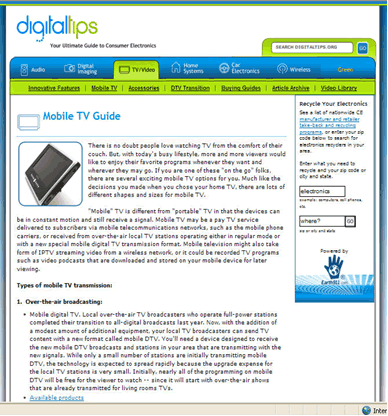
A search of Amazon.com reveals, four Items available for purchase: LG DP570MH 7-Inch Portable DVD and Mobile DTV, a PixTree USB Mobile DTV tuner, a Coby TV-To-Go USB Receiver and a Ceiling Mount 10.3 inch LCD Monitor with Mobile DTV Tuner by Power Acoustik. All list for under $100.00 except the Power Acoustik which is about $250.00 (with a DVD player added it's about $450). General information about Mobile DTV and M/H technology can be found on the Open Mobile Video Coalition (OMVC) and the ATSC's website. There will be
a session on Implementing Mobile TV as part of the NAB 2011 NAB
Broadcast Engineering Conference on Sunday, April 10 beginning
at 1:00 p.m. in room S219 of the Las Vegas Convention Center as
well as a Super Session on Mobile TV on Monday from 2:30 p.m. to
3:45 p.m. in Room S222. There are additional details on these sessions
and the 2011 NAB Show on the show website.
|
 Stations
often get inquiries from their viewers about where they can get
information on devices that can be used to receive Mobile DTV broadcasts.
One website - maintained by the Consumer Electronics Association
(CEA) - that has information on Mobile DTV (MDTV) is
Stations
often get inquiries from their viewers about where they can get
information on devices that can be used to receive Mobile DTV broadcasts.
One website - maintained by the Consumer Electronics Association
(CEA) - that has information on Mobile DTV (MDTV) is |
Upcoming EAS Webinar - How to Implement the Common Alerting Protocol (CAP) On March 10, 2011 at 4:00 p.m. (ET), the National Alliance of State Broadcasters Associations will hold the second in a series of webinar presentations on the Emergency Alert System (EAS). This webinar will present three case studies designed to provide helpful information on how broadcasters and state governments can work together to implement the next generation of CAP-based EAS systems. The discussion will also address potential funding sources, as well as how to identify new technologies that will make the transition easy. Please visit http://www.easalert.org/ for more information and instructions on how to register. Last Call for Nominations for the 2011 NAB Technology Innovation Awards NAB is currently accepting nominations for the 2011 NAB Technology Innovation Awards. First presented at the 2009 NAB Show, NAB presents the award to organizations that bring advanced technology exhibits and demonstrations of significant merit to the NAB Show. The nominated exhibit should present advanced research and development projects in communications technologies that have not yet been commercialized. Candidates for the Technology Innovation Awards must be organizations who are currently exhibiting at the NAB Show. The size of the organization is not a determining factor. Nominated projects may not be commercial products that have been offered for sale prior to or at the NAB Show. The merit of the technology exhibit is the sole factor to be taken into account. The entry deadline is March 4, 2011. The awards will be presented at the NAB Technology Luncheon on April 13, 2011 at the NAB Show in Las Vegas. IEEE Broadcast Technology Society Issues Call for Papers 
A Call for Papers has been issued for the 2011 IEEE Broadcast Symposium, to be held October 19-21, 2011, in Alexandria, Va. The Symposium Committee seeks timely and relevant technical papers relating to all aspects of broadcast technology, in particular on the following topics:
The submission
deadline for abstracts is May 1, 2011. There is additional information
on the Symposium on the IEEE
Broadcast Technology Society website.
All broadcasters are required by FCC §73.682(d) to send a notice of the change to daylight savings time as specified in detail by Annex A of A/65:2009, as well as to send accurate time. Currently the DS_day_of_month in the System Time Table (STT) must have the value '8' and the DS_hour must have the local hour on which you will switch. The DS_status must be '0' until after the change when it must switch to '1'. The seconds count sent in the STT is decoupled from daylight savings time, does not change, and is separately required to be accurate within one second at all receivers. Compensation for delay and jitter through the emission system (as compared to the source clock) is the responsibility of the broadcaster. Both the time
and the daylight savings indication values can impact receiver
operation if incorrect.
The February 28, 2011 TV TechCheck is also available in an Adobe Acrobat file. Please click here to read the Adobe Acrobat version of TV TechCheck. |
ADVERTISEMENTS