|
 |
 |

|
2011 Radio Show Highlights Last week,
the radio industry gathered in Chicago, Ill. for the 2011
Radio Show, produced by the Radio Advertising Bureau (RAB)
and NAB. This was the second year
for the RAB/NAB show HD Radio
Exhibit Features Autos, New Technology 
In addition to the in-vehicle radios, a wide array of automotive after-market and portable receivers were on display in the iBiquity booth. The two JVC automotive receivers shown here (models KWNT50-HDT and HWNT30-HDT) were displaying album art (receiver on right) and station logo (receiver on left) graphics being delivered over the HD Radio signal from Clear Channel station WNUA-FM (95.5 MHz) using iBiquity’s “Artist Experience” technology. These JVC receivers also have built-in navigation and are capable of receiving traffic and other information (utilizing “Journaline”) over Clear Channel’s Total Traffic Network (TTN) data service. Also being demonstrated in the booth (on a prototype portable HD Radio receiver) was the iBiquity “Active Radio” emergency alerting technology using a signal from Clear Channel station WVAZ-FM (102.7 MHz). 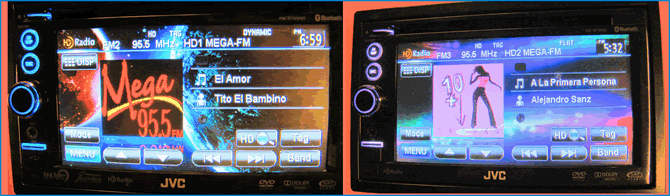
NRSC Adopts Updated IBOC Standard 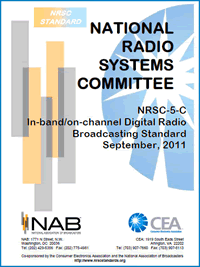
The National Radio Systems Committee (NRSC), co-sponsored by NAB and the Consumer Electronics Association (CEA), met at the Radio Show on Thursday, September 15 and adopted an updated version of its in-band/on-channel (IBOC) digital radio broadcasting standard, NRSC-5-C. The new version includes more than 70 modifications that address improvements and refinements to the HD Radio system benefitting both broadcasters and listeners. NRSC-5-C, In-band/on-channel Digital Radio Broadcasting Standard, was adopted by the Digital Radio Broadcasting (DRB) Subcommittee, which is co-chaired by Andy Laird, vice president and chief technology officer, Journal Broadcast Group, and Mike Bergman, vice president of new digital technologies, Kenwood USA. It was developed by the subcommittee's IBOC Standards Development Working Group (ISDWG), which is chaired by Dom Bordonaro, chief engineer, Cox Broadcasting – Connecticut. The more than 70 modifications in this new version include the ability to use asymmetric sidebands, new modes of operation, and updated RF masks. A major part of this work has been the update of "reference documents" by iBiquity Digital Corporation, which contain the technical details of the standard. The updated Standard will be available free-of-charge on the NRSC's website, following a final, procedural review that will take approximately two weeks. Additional information about the NRSC, including information on becoming a member, is also available on the website. “Hybrid Radio” Demonstrated 
An exciting demonstration of a “hybrid radio" which can seamlessly switch between a radio station’s over-the-air broadcast signal and IP streaming signal (over mobile broadband) was conducted by Nick Piggott (shown in the photo to the right), Head of Creative Technology with Global Radio (UK) and chair of the RadioDNS project. RadioDNS is an open project with the goal of bringing together broadcast radio and IP to create a better radio experience. This hybrid radio demonstration used the FM radio included in a Sony Ericsson smart phone which was also connected to the AT&T 3G mobile broadband network. A number of Clear Channel and Cox Radio stations have been working with RadioDNS on this technology. For the demonstration, the FM radio was tuned to one of the Clear Channel or Cox radio stations registered in the RadioDNS database. A special hybrid radio “app” was created for the smart phone and used for this demonstration. Wherever possible, this app selects the over-the-air broadcast radio signal, but when that signal becomes weak, it switches over to the IP streaming signal. As the broadcast signal improves, it switches back from the streaming signal to the broadcast. All this happens without listener intervention. This app works by enabling listeners to choose which station they want to listen to, not which system (FM analog, HD Radio digital, IP stream). The app’s station preset function can store all the information needed to find the station in a number of different ways, and then determines which signal for that station is best. Consequently, if the listener is in the coverage area, they will likely listen to the broadcast signal, but if not, the IP streaming signal will automatically be provided. The discovery
of the information needed to make all this happen uses the RadioDNS
lookup process, and a small amount of configuration information
held on each station website. RadioDNS doesn't aggregate this information,
it just links radio receivers to it. Videos of the hybrid radio
demo are available on YouTube: Garmin Navigation Device Uses HD Radio Data for Traffic Info 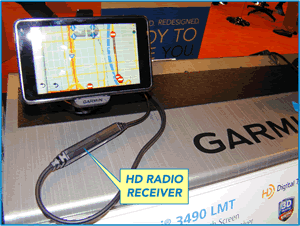
A new navigation device was on display in the iBiquity booth that includes an HD Radio data-only receiver (no audio). The Garmin nüvi 3490LMT will be available on October 16, 2011 with a suggested retail price of $399 and will be able to receive traffic data over an HD Radio data channel from Broadcast Traffic Consortium (BTC)-affiliated stations. According to the Garmin product brochure, this new receiver will receive traffic updates "every 30 seconds, 4 to 10 times faster than competing services." This receiver is also capable of receiving BTC traffic information over an RDS digital FM subcarrier, at reduced data rates compared to the HD Radio service. A photo of the new Garmin receiver is shown at right, as displayed in the iBiquity booth. The HD Radio receiver portion is located in the power cord of the device as indicated in the photo; note that the power cord functions as the antenna for this receiver as well. Garmin has plans to incorporate the HD Radio receiver circuitry into the navigation device itself in future models. 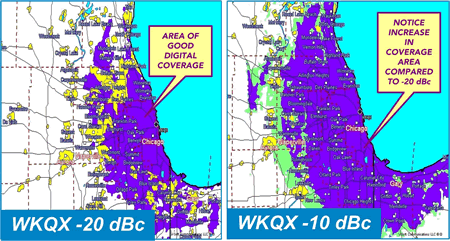
Paul Brenner, SVP and CTO of Emmis Communications and President of the BTC, gave a presentation at the Radio Show technical conference entitled "Data Application Case Studies," and discussed how important the FM IBOC digital power increase is to providing good coverage to the Garmin and future BTC traffic devices. Shown in the maps above are a comparison of the expected data broadcasting coverage for Chicago station WKQX (101.1 MHz, now WWWN) for -20 dBc digital signal power (left map) and with the digital power increased to -10 dBc (right map). These maps were prepared using Vsoft analytics and the good coverage area (purple shading) is based upon IBOC packet reception rates and latency of reception. |
 partnership
and all indications are that this year’s event was a great
success with increased attendance, well-attended conference sessions
and robust traffic on the exhibit floor. Included in this week’s
Radio TechCheck is a summary of some of the technology highlights
from this year’s show.
partnership
and all indications are that this year’s event was a great
success with increased attendance, well-attended conference sessions
and robust traffic on the exhibit floor. Included in this week’s
Radio TechCheck is a summary of some of the technology highlights
from this year’s show.|
FEMA
IPAWS Special Event - Prepared & Ready: The meeting will be held on Microsoft Live Meeting 2007 (This link will be active the morning of September 30). Additional information is available here. FCC
Extends EAS-CAP Compliance Deadline On Friday, September 16, the FCC released a Fourth Report and Order (Fourth R&O) in the EAS proceeding (EB Docket No. 04-296) which amends section 11.56 of the Commission's EAS rules extending the deadline requiring EAS Participants to be able to receive CAP-formatted EAS alerts as required by Part 11 from September, 30 2011 to no later than June 30, 2012. On May 25, 2011, the Commission issued the Third Further Notice of Proposed Rulemaking (Third FNPRM) which sought comments on a wide range of tentative conclusions and proposed rule revisions that would more fully delineate and integrate CAP into the Commission's Part 11 EAS rules. Among other things, the Third FNPRM asked whether the existing September 30, 2011, deadline for CAP-compliance is sufficient or whether the Commission should extend or modify it so it would be triggered by some action other than FEMA's adoption of CAP. The Commission received 30 comments and 12 reply comments in response to the Third FNPRM. The majority of commenters requested a further extension of the deadline. (See TechCheck from August 1, 2011.) On July 29, NAB and a number of other broadcast organizations filed a petition asking the FCC to rule expeditiously on the deadline extension issue. In the Fourth R&O the FCC stated that an extension of the current CAP compliance deadline is warranted and that they:
The fourth R&O is available on the FCC's Web page. The
First Public Trial of a TV White Space The FCC's Office of Engineering and Technology (OET) announced that on September 19, 2011, it will commence a 45-day public trial of Spectrum Bridge Inc.'s TV band database system. According to OET, the trial is intended to allow the public to test the database to ensure that it is correctly identifying channels that can be used by TV white space devices; properly registers facilities entitled to protection, such as licensed wireless microphones, cable head ends, etc.; and provides protection to all authorized services and registered facilities. The complete text of the OET Public Notice is available at here. The trial will begin at 8:30 a.m. EDT and parties may access the Spectrum Bridge's TV band database at: http://whitespaces.spectrumbridge.com/Trial.aspx. Broadcasters
are encouraged to test the database to ensure that it is providing
accurate channel availability results and that wireless microphone
and MVPD registration process is operating properly. One simple
test is to query the database to determine the available TV channels
for white space devices at a particular location and then register
a wireless microphone use at that location on one or more of those
channels to see if the database correctly takes those registrations
into account. If any problems are found, please send that information
to NAB's Technology department at st@nab.org.
The September 19, 2011 Radio TechCheck is also available in an Adobe Acrobat file. Please click here to read the Adobe Acrobat version of Radio TechCheck.
|



ADVERTISEMENTS