|
 |
 |

|
Many countries around the world are considering when and how to make the transition to terrestrial digital radio. In the U.S., that decision took place in 2002 when the FCC adopted the HD Radio in-band/on-channel system, developed by iBiquity Digital Corporation, for use in the existing AM and FM radio bands. Another system that can be implemented in the FM band is called “DRM+” and was developed by Digital Radio Mondiale (DRM),a consortium of broadcasters, network providers, transmitter and receiver manufacturers, universities, broadcasting unions and research Institutes (see the June 28, 2010 issue of Radio TechCheck for background information on DRM). Earlier this month, DRM released a report describing a test of DRM+ conducted in India. This report is remarkable in that it is the first English language report detailing the performance of DRM+. A number of tests done in Kaiserslautern, Germany beginning in May 2008 were publicized but the only reports available on these earlier tests were written in German. The India test was conducted in New Delhi and organized jointly by All India Radio (AIR) and the DRM Consortium, and took place as part of a week-long workshop on DRM technology (from May 23-27, 2011) covering issues of planning, transition, simulcast, content and receiver design and deployment. A single test frequency of 100.1 MHz was used and the DRM+ signal was configured to carry three program channels – two audio channels, “Gold DRM (FM)” and “Rainbow DRM (FM),” and a data channel programmed with AIR news using Journaline (a new data application for digital radio systems, providing hierarchically-structured textual information). 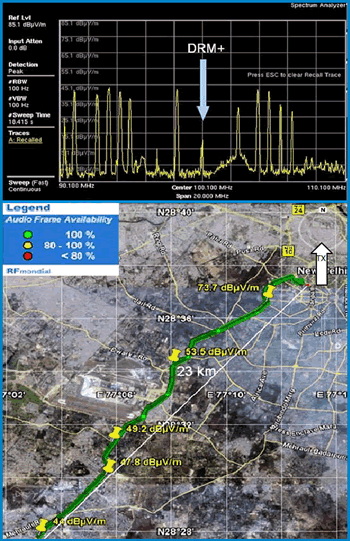
As with most digital radio systems, DRM+ supports a wide range of optional modes that are selected depending upon the desired application. Two test modes were measured during this test – a 4-quadrature-AM (QAM) mode designed for robustness (bit rate ranges from 40-75 kbps), and a 16-QAM mode (bit rate ranges from 100 to 190 kbps) which provides for higher capacity but reduced robustness compared to the 4-QAM mode. In the 16-QAM mode, the live stereo audio source was converted on-the-fly into 5.1 MPEG Surround Sound (compatible with all mono/stereo receivers) based on Fraunhofer IIS "SX Pro" multichannel sound technology. Additionally, a pseudo-random bit sequence (PRBS) was generated and transported as part of the DRM transmission to allow for calculation of the exact bit error ratio (BER) of the received DRM signal. A four-bay transmit antenna was utilized, mounted at a height of 74 m above ground on one side of the tower. A 300 W transmitter was used; factoring in cable losses and antenna gain, the resulting ERP was approximately 500 W directed towards the southwest. Reception quality was measured using a test vehicle going in four directions from central New Delhi (where the transmitter was installed). The receiver used for these tests was the RFmodiale DRM+ Measurement Receiver. A typical spectrum plot and test run map are shown in the image at right. A suite of test scenarios for both the 4-QAM and 16-QAM modes are detailed in the report. According to the report, coverage and performance were good and comparable to what was expected in simulation. The full text of the DRM+ report contains a description of the DRM+ system parameters, system setup and equipment that was used in the trial and the measured results, and may be downloaded here. |
|
Proposals
Now Being Accepted for 2012 NAB Broadcast Engineering Conference The 2012 NAB Show will host the 66th NAB Broadcast Engineering Conference. This world-class conference addresses the most recent developments in broadcast technology and focuses on the opportunities and challenges that face broadcast engineering professionals around the world. Each year hundreds of broadcast professionals attend the conference. They include practicing broadcast engineers and technicians, engineering consultants, contract engineers, broadcast equipment manufacturers, distributors, R&D engineers plus anyone specifically interested in the latest broadcast technologies. If you feel
qualified to speak at the NAB Broadcast Engineering Conference,
we invite you to submit
a technical paper proposal. The deadline for submitting your proposal
is October 21. If you have any questions, contact John Marino,
vice president, NAB Technology at 202 429 5346.
The August 29, 2011 Radio TechCheck is also available in an Adobe Acrobat file. Please click here to read the Adobe Acrobat version of Radio TechCheck. There will be no Radio TechCheck on September 5. Radio TechCheck will return on September 12. |




ADVERTISEMENTS