|
 |
 |

|
The National Radio Systems Committee (NRSC), co-sponsored by NAB and the Consumer Electronics Association (CEA), has been extremely active in recent months developing and updating terrestrial radio broadcasting technology standards, guidelines and reports. A series of NRSC meetings will take place on Thursday, September 15, 2011 from 1:45-4:30 p.m. CDT in conjunction with the Radio Show in Chicago, Ill. All those interested in attending (not just NRSC members!) are encouraged to do so (with the exception of members of the press). At present the NRSC is organized into a Full Committee and three Subcommittees as shown in the organizational chart below. Also shown in the chart are the chairmen of each Subcommittee. Face-to-face meetings of the Subcommittees are typically held three times a year – in January at the International Consumer Electronics Show (in Las Vegas), in April at the NAB Show (also in Las Vegas) and in September at The Radio Show. Participation by telephone is always available, as well. The NRSC Full Committee meets on an annual basis and as needed to consider possible new work items. Most of the work within the Subcommittees takes place in sub-groups that meet by teleconference with extensive use of “web meeting” tools for document review and collaborative efforts. Here are brief summaries of the most important items currently being worked on in each group: Digital Radio Broadcasting (DRB) Subcommittee – for the past 18 months the Subcommittee’s IBOC Standards Development Working Group (ISDWG, chaired by Dom Bordonaro, Cox Broadcasting Connecticut) has been developing a major revision to the NRSC-5 In-band/on-channel Digital Radio Broadcasting Standard. Now completed, this revision will be presented to the Subcommittee at the September 15 meeting for a vote to adopt. This updated document includes over 70 modifications which address improvements and refinements made to the HD Radio system (upon which the Standard is based) such as the ability to use asymmetric sidebands, new modes of operation, and updated RF masks. A major part of this work has been the update of “reference documents” by iBiquity Digital Corporation which contain the technical details of the Standard. 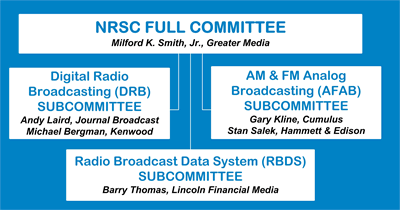
A new DRB Subcommittee Sub-group, the Geo-coding Usage Task Group (GUTG, chaired by Mike Starling, NPR) is investigating possible location-based services technologies that could form the basis for future NRSC Standards and/or Guidelines. As part of this work, the GUTG has developed a set of “use cases” and “storyboards” describing terrestrial radio services which utilize location-based information to enhance the listener’s experience and provide new revenue opportunities for broadcasters. Radio Broadcast Data System (RBDS) Subcommittee – earlier this year, the RBDS Subcommittee adopted an updated version of the NRSC-4 RBDS Standard (see the April 11, 2011 issue of Radio TechCheck for additional information). In a departure from previous versions, this latest version includes only those sections which differ from the European version of the Standard, IEC 62106, Specification of the Radio Data System (RDS) for VHF/FM sound broadcasting in the frequency range from 87.5 to 108.0 MHz. This more concise version of the Standard is expected to simplify design and development of compatible devices by transmission equipment and receiver manufacturers. Work on the update to NRSC-4 was accomplished by the RDS Usage Working Group (RUWG, chaired by Steve Davis, Clear Channel Broadcasting). With this update complete, the RUWG is now focusing on development of a number of Guideline documents – an RDS Usage Guideline, containing in-depth information on features such as RadioText+ and Open Data Applications, receiver implementation guidelines and transmission and display of program associated data; a Metadata Distribution Guideline focusing on standard methods for creation, packaging and distribution of metadata, most importantly program associated data (PAD) such as song title, artist and album name; and a Local Metadata Creation Guideline which will provide information on how individual stations can best create, manage and schedule their own metadata not available from other sources. The RUWG is also expected to release an NRSC Report containing statistical information on character lengths associated with various PAD fields, which will be useful for broadcasters in structuring their PAD transmissions and for receiver manufacturers in designing receiver displays. AM and FM Analog Broadcasting (AFAB) Subcommittee – this is a new Subcommittee which first met in March of this year, formed to deal with analog broadcasting-related issues and technologies. Precursor to the AFAB Subcommittee was the long-standing AM Broadcasting (AMB) Subcommittee, which has been “absorbed” by the new group. Work items being pursued by the AFAB Subcommittee include the study of a proposed single sideband suppressed-carrier (SSB-SC) method of generating an FM stereo multiplex signal (see the September 13, 2010 issue of Radio TechCheck for additional information), and discussion of various methods of AM carrier control being employed around the world and their suitability for use in the U.S., in particular whether these methods are compatible with AM IBOC transmissions. Anyone who has a business interest in the technology being investigated by the NRSC is welcome to join the Subcommittee and participate in its activities. Member representatives of the NRSC are generally engineers, scientists or technicians with in-depth knowledge of the subject being studied. In order to promote the free exchange of ideas during Committee work; members of the press are not allowed to attend NRSC meetings. However, members of the press are free to contact Committee chairpersons, NAB or CEA with general questions about meetings. Contact David Layer at NAB (dlayer@nab.org) for additional information. |
|
Tower Day, Friday September 16 will focus on an often overlooked asset – the tower. Tower construction, maintenance, safety and management are covered during these presentations. If you aren’t leasing space on your tower, you are leaving money on the table. Space on your tower is a valuable asset that can become a consistent, additional stream of recurring revenue. Learn how to market your tower, how to price the space and the keys to a successful landlord/tenant agreement. Find out how to sell your tower and lease it back. The panel of experts discussing towers will be led by Don Bishop, Biby Publishing with panelists Clayton Funk, Media Venture Partners; Adam Kauffman, NTP Wireless and Patrick McCamley, TowerSource, LLC. The technical side of collocation cannot be ignored. Your new tenants will want a clear signal and a safe workspace. A successful collocation begins with a professional design and installation with attention to user compatibility, overload and intermodulation. Following occupational RF exposure and OSHA rules is critical to the safety of your guests’ workers. This panel will be moderated by Sharpe Smith, editor, AGL Bulletin and DAS Bulletin with panelists Richard Biby, AGL Magazine; Jim Hopkins, SiteMaster, Inc. and Duane C. MacEntee, Stainless, LLC. As you plan your Radio Show schedule, be sure to check out the full list of Radio Show sessions, click here. For more information about the Radio Show, visit www.RadioShowWeb.com. Proposals
Now Being Accepted for 2012 NAB Broadcast Engineering Conference The 2012 NAB Show will host the 66th NAB Broadcast Engineering Conference. This world-class conference addresses the most recent developments in broadcast technology and focuses on the opportunities and challenges that face broadcast engineering professionals around the world. Each year hundreds of broadcast professionals attend the conference. They include practicing broadcast engineers and technicians, engineering consultants, contract engineers, broadcast equipment manufacturers, distributors, R&D engineers plus anyone specifically interested in the latest broadcast technologies. If you feel
qualified to speak at the NAB Broadcast Engineering Conference,
we invite you to submit
a technical paper proposal. The deadline for submitting your proposal
is October 21. If you have any questions, contact John Marino,
vice president, NAB Science and Technology at 202 429 5346.
The August 22, 2011 Radio TechCheck is also available in an Adobe Acrobat file. Please click here to read the Adobe Acrobat version of Radio TechCheck. |
 Just 23 days
from today the Radio Show will begin in Chicago (September 14
– 16) at the Hyatt Regency. The Engineering program at the
Radio Show will feature a series of expert tutorials and presentations
covering the challenges of creating, operating and maintaining
a modern radio facility.
Just 23 days
from today the Radio Show will begin in Chicago (September 14
– 16) at the Hyatt Regency. The Engineering program at the
Radio Show will feature a series of expert tutorials and presentations
covering the challenges of creating, operating and maintaining
a modern radio facility.


ADVERTISEMENTS