|  |  |

|
The Transmitter Efficiency Calculator 
NAB FASTROAD today unveiled a new, Internet-based Transmitter Efficiency Calculator that broadcasters can use to predict approximate transmitter system energy costs both for present operations and for the "what if" evaluation of prospective, future purchases. With funding from the NAB FASTROAD technology advocacy program, this Web tool was developed by the broadcast engineering consulting firm of Cavell, Mertz & Associates (CMA, Manassas, Va.), and builds upon the data presented in a FASTROAD-funded Transmission Efficiency White Paper authored by CMA and released earlier this year. The FASTROAD Transmitter Efficiency Calculator is useful for planning of AM, FM and DTV transmission facilities, both analog and digital. The database that serves as the engine for the Calculator utilizes data provided by equipment manufacturers, which may be expanded in the future as manufacturers provide additional information. 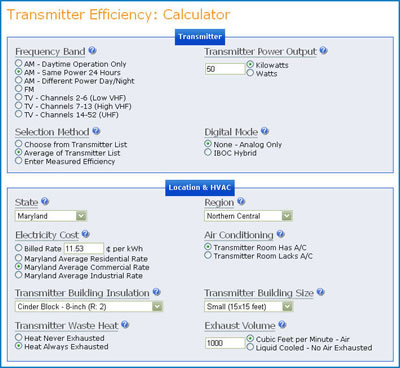
Transmitter site power consumption and costs may be quickly and easily approximated using the Calculator based on the answers to a series of simple questions relating to the broadcast transmitter configuration, geographical location, the building structure in which the transmission equipment is housed and the on-site cooling capabilities. One possible set of input parameters for a 50 kW AM station are shown in the screen capture at right. In addition to the input parameters, the results of the Calculator depend upon a set of assumptions regarding transmission facilities including:
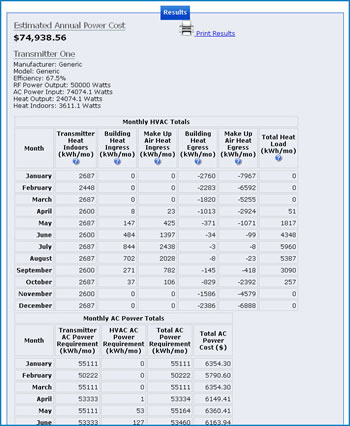
Climate considerations are based on historical records of monthly heating and cooling degree-days, which, in turn, are based on daily mean temperatures. While these estimates consider the regional differences in climate, they are not known to be precise. The Calculator results for the input parameters shown in the first screen capture (above) are shown in the second screen capture (at right). This Calculator's strength comes from the ability to generate consistent and repeatable results. Therefore, while the assumptions and simplifications may impact bottom-line accuracy, results are believed valid when making “what if” comparisons of different transmitters and scenarios. The Transmission
Efficiency Calculator, the full text of the CMA White Paper, entitled
“Power Efficient Broadcast Facility Transmission Design,”
and information on the NAB FASTROAD technology advocacy program
are available at www.NABFASTROAD.org.
Comment and feedback on the Calculator are encouraged and can be
directed to David Layer, senior
director, advanced engineering in NAB’s Science and Technology
department. The Calculator will be discussed at the 2011 NAB Show
in the NAB
Broadcast Engineering Conference (April 9-14, 2011, Las Vegas,
Nev.) on Thursday morning, April 14 as part of the “Green Technology”
session. |
|
The Federal Communications Commission (FCC) is conducting a session for consultants on Tuesday, June 21, 2011 at their headquarters in Washington, DC on Communications Towers and Environmental/Historic Preservation Compliance. Training will be provided by staff from the FCC, USDA Rural Utilities Service, NTIA, FEMA and the Advisory Council on Historic Preservation. For additional information contact Steve DelSordo and to register contact James Swartz who are both at the FCC. To attend the session you must preregister.
The April 4, 2011 Radio TechCheck is also available in an Adobe Acrobat file. Please click here to read the Adobe Acrobat version of Radio TechCheck. |