|  |  |

|
Mobile
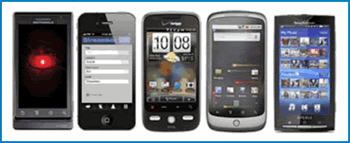
Radio Production Tools to be Topic at NAB Radio remotes are a content staple, providing variety and community interest to local radio programs. A session at the upcoming NAB Broadcast Engineering Conference (BEC, April 9 – 14, 2011, Las Vegas, Nev. – see below for additional information) titled “The Future of Radio Broadcasting” includes a paper, excerpted here, which presents an overview of several new small, mobile content production and delivery tools, including the video and audio capabilities of enhanced 3G/4G smartphones which provide for recording, editing, real-time streaming and uploading from the field. “Next Generation of Radio Content Collection and Delivery Tools” was authored by Pierre Robidoux, senior engineer, CBC/Radio-Canada. INTRODUCTION – using a phone to go on air is nothing new. What is new, though, is going on air with a portable wireless device that sounds as good as a studio system. Newer still is having a small device – a smartphone – in the palm of your hand capable of doing mobile content production and contribution for radio. This paper doesn’t endorse or promote any particular smartphone brand or IP audio codec. It merely presents the various options available to broadcast radio stations seeking IP/Ethernet-based solutions for mobile wireless audio production and collection. WHAT IS A SMARTPHONE? – the first known use of this word was in 1997. A smartphone is often described as a cell phone with some “computing capabilities.” It can be also defined as a very small mobile computer with wireless (data) communication capability, offering (cellular) digital telephony, text messaging, Web access and a host of other applications such as still picture photography and audio/video recording. Technically, a smartphone is just another IP “end device” accessing the IP-based studio production system from the outside.
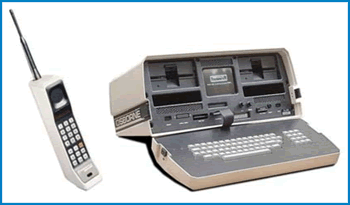
As a reference
for comparison, below are some specifications for the first portable
computer, manufactured by the Osborne Computer Corporation (shown
in photo at right, with an early model wireless phone): WIRELESS
AND INTERNET NETWORKS – on what network is the data (or
signal) produced by a smartphone (or a small portable wireless audio
codec) transported? The answer is twofold: A real-time audio stream will normally use UDP over IP or RTP/UDP over IP for transport. Also, named carriers, operators or wireless service providers offer either the CDMA/EV-DO or the GSM/HSPA (voice/data) communication protocol. It should be noted that even if these protocols offer upload bit rates in the Mbps range, streaming 256 kbps or 384 kbps is often a challenge or simply impossible. Smartphones are generally locked (i.e., the device is tied to a specific carrier) and each provider supports only a limited number of smartphones. An unlocked smartphone may be used on any carrier’s network (if supported). The new 4G protocols, LTE (Long Term Evolution) and LTE-Advanced, will offer higher bit rates and the potential for some form of quality of service (guaranteed access and minimal bandwidth). COMPRESSION
ALGORITHMS – numerous choices have to be made regarding
audio data rates, modes and even packet sizes (for some algorithms).
The proper choice of compression algorithm and settings will depend
on the: When digital audio signals pass through multiple encode/decode cycles, this is generally referred to as cascading. Some coding schemes are more resilient than others to multiple cascades. Audio signal degradation will be more severe when several different coding algorithms are used on the same cascade. Mr. Robidoux
will present this paper on Sunday, April 10, 2011 starting at 9:30
a.m. in room S228 of the Las Vegas Convention Center. It will also
be included in its entirety in the 2011 NAB Broadcast Engineering
Conference Proceedings, on sale at the 2011 NAB Show Store and available
on-line (after the Show) from the NAB Store. Other papers being
presented during this session include the following: For additional conference information visit the NAB Show website. |
|
Upcoming EAS Webinar – How to Implement the Common Alerting Protocol (CAP) On March 10, 2011 at 4:00 p.m. (ET), the National Alliance of State Broadcasters Associations will hold the second in a series of webinar presentations on the Emergency Alert System (EAS). This webinar will present three case studies designed to provide helpful information on how broadcasters and state governments can work together to implement the next generation of CAP-based EAS systems. The discussion will also address potential funding sources, as well as how to identify new technologies that will make the transition easy. Please visit http://www.easalert.org/ for more information and instructions on how to register. IEEE Broadcast Technology Society Issues Call for Papers 
A Call for Papers has been issued for the 2011 IEEE Broadcast Symposium, to be held October 19-21, 2011, in Alexandria, Va. The Symposium Committee seeks timely and relevant technical papers relating to all aspects of broadcast technology, in particular on the following topics:
The submission
deadline for abstracts is May 1, 2011. There is additional information
on the Symposium on the IEEE
Broadcast Technology Society website.
The March 7, 2011 Radio TechCheck is also available in an Adobe Acrobat file. Please click here to read the Adobe Acrobat version of Radio TechCheck. |