|
ATSC
Hosts Symposium on Next Generation Broadcast Television
The ATSC DTV
system has been in a constant state of evolution since the adoption
of the first ATSC Standard, A/53, in 1995, including the recent
creation of a system and standard for mobile DTV (ATSC A/153,
available for download free-of-charge at www.atsc.org).
By and large, one of the requirements for new additions and enhancements
to the system has been that of backwards compatibility, such that
any new feature or service does not "break" existing
receivers or adversely impact services already included in the
standards.
Recently,
the ATSC formed a "Planning Team," the Next-Generation
Broadcast Television Team (PT-2), to explore potential technologies
to be used to define a future terrestrial broadcast digital television
standard, one that would not be constrained by the backwards compatibility
requirement (see the June
21, 2010 issue of TV TechCheck for additional information
on ATSC Planning Teams). As part of the PT-2 process, the first
ATSC Symposium on Next Generation Broadcast Television (NGBT)
was held last week in Alexandria, Va., focusing on new technologies
that may have application for next generation broadcast content
delivery systems.
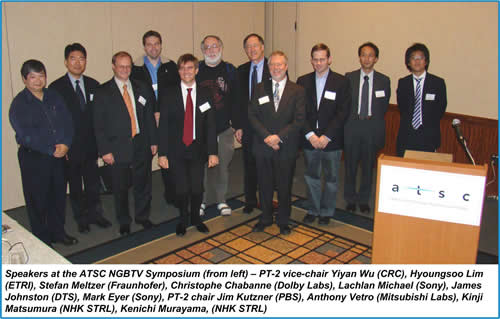
Nine
presentations on NGBT technology were made at this symposium;
the speakers are shown in the photo below.
A list of
presentation titles and authors is given here along with a brief
synopsis on the topics covered:
Advanced
Video Codecs: What's On The Horizon?, Anthony Vetro, Mitsubishi
Labs - Mr. Vetro discussed current work being done in the
area of video coding technology including the work of the Joint
Collaborative Team on Video Coding (JCT-VC) and the High Efficiency
Video Coding (HEVC) project which promises to reduce required
bit rates for HD video up to 50% compared to existing MPEG-4 AVC
technology.
Transmission
Technologies for Next-generation Digital Terrestrial Broadcasting,
Kenichi Murayama, NHK STRL - NHK is researching and developing
Super Hi-vision for a next-generation ultra-high-definition broadcasting
system. In conjunction with this, NHK has successfully field tested
transmission of broadcast data at around 60 Mbps on a single terrestrial
television broadcasting channel (6 MHz bandwidth).
Latest
Trends in Worldwide Digital Terrestrial Broadcasting and Application
- Lachlan Michael, Sony Corporation - Mr. Michael talked about
trends in various areas of DTV technology, including modulation
(continued focus on multipath resistance), forward error correction
(FEC) trends (new techniques including Low Density Parity Check,
LDPC, codes) and new technologies including 1024 QAM and Multiple
Input Multiple Output (MIMO) antenna configurations.
Toward
the Construction of Hybridcast, Kinji Matsumura and Hisakazu Katoh,
NHK STRL - a TV-centric broadcast and communications hybrid
system was described and some features of this system were demonstrated
including program customization, social network interaction on
the TV screen, program recommendation and multi-device linkage.
Surround
Demystified, Christophe Chabanne, Charles Robinson and Jeff Riedmiller,
Dolby Labs - Mr. Chabanne discussed features of the SMPTE
S428-3-2006 standard which is the genesis of all existing surround
formats, and offered "3D audio" as an area for development
in next-generation surround sound. In this context, 3D audio refers
to a system that provides a more immersive and realistic sound
experience than currently available.
A Revolutionary
Digital Broadcasting System: Making the Fullest Possible Use of
Bandwidth, Mark Eyer, Sony Corporation - Sony anticipates
that the next generation broadcast system will be able to offer
10 HDTV channels in the same bandwidth that the legacy ATSC DTV
system utilizes for a single HDTV channel, and presented a variety
of "use cases" for this next-generation system.
Beyond
Coding: Getting 3D Audio into the Home, James D. Johnston, DTS
- Mr. Johnston examined some of the important requirements for
home reproduction of "3D audio," how these requirements
interact with the home playback system and how playback equipment
can take stock of its own capabilities in order to get as close
as possible to the content creator's original intent.
Self-Organizing
Broadcast Network, Hyoungsoo Lim and Heung Mook Kim, ETRI
- Self-Organizing Network (SON) technology could be applied to
the next-generation broadcasting. A SON would require feedback
from user equipment (a television or set-top box) regarding reception
power and timing. With this information, the SON would in real-time
adjust transmit signal power and antenna pattern to optimize reception
over the broadcast coverage area.
MPEG-4
HE-AAC - The Audio Codec for the Next Generation Broadcast Television,
Robert Bleidt, Harald Fuchs, Stefan Meltzer and Stephan Schreiner,
Fraunhofer - Audio requirements for NGBT include multichannel
audio, 3D audio extension, parallel transmission of different
language tracks, additional channels for the hearing and visually
impaired, and the transport of metadata containing, for instance,
dynamic range or downmix parameters. Mr. Meltzer discussed different
approaches for fulfilling these requirements, including use of
the existing MPEG-4 HE-AAC audio coding system.
A second
symposium is scheduled for February 15, 2011 in Rancho Mirage,
Calif., in conjunction with the Hollywood Post Alliance Technology
Retreat. For additional information about the work of the ATSC
PT-2 and this next Symposium, contact the PT-2 chair, Jim Kutzner
at jkutzner@pbs.org.
|