|
Disabilities
Act Imposes New Obligations on Broadcasters
On October
8, 2010, the President signed into law (“enactment”)
the “Twenty-First Century Communications and Video Accessibility
Act of 2010” (“Act”). This legislation requires
a number of communications industry sectors–including television
broadcasting–as well as consumer electronics to make their
systems and services accessible to persons with disabilities.
Among other
things, the Act requires broadcasters, video programmers, video
distributors, consumer electronics manufacturers and others to
ensure that persons with disabilities can access communications,
entertainment and media services. The legislation imposes new
responsibilities on TV broadcasters with respect to video descriptions
and closed captioning of Internet video content as well as initiates
an FCC process that will likely result in additional obligations
regarding the accessibility of emergency information delivered
to viewers.
As an initial
matter, the Act requires that, within 180 days of enactment (around
April 2011), the FCC creates and holds the first meeting of a
new Advisory Committee called the Video Programming and Emergency
Access Advisory Committee. This Advisory Committee will have primary
responsibility for studying, preparing reports and making recommendations
on technical and operational matters associated with the new video
description, closed captioning and emergency information regulations.
The Advisory Committee will consist of representatives from the
video programming and broadcast television industries as well
as other stakeholders. The Act requires the Committee to rely,
to the greatest extent possible, on standards or protocols adopted
by industry standards-setting organizations in formulating its
recommendations regarding video descriptions, closed captions
or emergency information.
Video
Description
The Act gives the FCC the authority to reinstate its 2000 video
description rules (which were struck down in a 2002 court challenge).
The reinstated rules will be limited to the scope of the original
2000 FCC Video Description Report and Order, that is, stations
affiliated with the Big Four networks in the top 25 DMAs, (and
the top five cable networks nationwide) must provide 50 hours
per quarter (approximately four hours per week) of video described
programming. The rules must be reinstated no later than one year
after the legislation’s enactment (approximately October
2011). The rules can only apply to television programming in digital
format but video description will not be required for live or
near-live programming. Also at that time, the FCC must establish
an appropriate phase-in period for the video description rules
(in the original rules it was 18 months). The Act also gives the
FCC the authority to provide waivers or exemptions in situations
where providing video description would be economically burdensome
or technically infeasible.
Once the
phase-in period for the reinstated rules is complete, the FCC
has the authority to expand, over time, the number of hours of
video descriptions required and the number of markets in which
video descriptions must be provided. However, before any expansion
can occur the FCC must file a report with Congress that addresses
a number of issues regarding the implementation of video description.
Specifically the FCC must conduct a proceeding one year after
the initial phase-in is complete and then file the report one
year after the start of the proceeding. Once that report is filed,
the FCC can expand the video description rules based on a schedule
contained in the Act that extends out to approximately 10 years.
Thus, depending
on the phase-in schedule adopted by the FCC, sometime after a
year from now, stations in the top 25 DMAs that are ABC, CBS,
FOX and NBC affiliates will need to have the technical capability
to pass through the video description audio track sent in the
network feed.
In a related
matter, the Act also requires the Advisory Committee to study
and within 18 months of enactment (around April 2012), issue a
report on the technical, operational and economic issues associated
with the delivery of video descriptions for programming distributed
using Internet protocol (distributed over the Internet).
Emergency
Information
The Act requires that, 18 months after enactment, the Advisory
Committee must submit to the FCC a report which studied the issue
of making emergency information accessible to persons with disabilities
(this is to be part of the report on video description). Not later
than one year after that report is submitted (around April 2013),
the FCC is required to complete a proceeding to:
- Identify methods to convey emergency information (as that
term is defined in section 79.2 of title 47, Code of Federal
Regulations) in a manner accessible to individuals who are blind
or visually impaired; and
- Promulgate regulations that require video programming providers
and video programming distributors (as those terms are defined
in section 79.1 of title 47, Code of Federal Regulations) and
program owners to convey such emergency information in a manner
accessible to individuals who are blind or visually impaired.
While, not
explicitly stated in the Act, it is generally understood that
this provision will require all TV stations to make their emergency
crawls audible for visually impaired viewers. That is, when a
station runs a crawl with emergency or warning information, they
must also send an audio track which states the same information
contained in that crawl.
Closed
Captions
The Act requires that video programming “distributed using
Internet protocol” (i.e. delivered via the Internet) will
have to be captioned once that same programming appears on television,
with captions. The Advisory Committee will examine technical issues
concerning Internet closed captioning and must recommend standards,
protocols and other procedures that video programmers must follow.
The Committee must submit a report to the FCC within six months
of its first meeting (approximately October 2011). Once the FCC
has received this report, it must commence a rulemaking, to be
completed within six months (approximately April 2012), that must
address a number of specific issues outlined in the Act that will
define how the new Internet captioning rules will be implemented.
A copy of
the bill can be found on THOMAS, The Library of Congress’s
legislative information webpage at: http://thomas.loc.gov/cgi-bin/bdquery/z?d111:S3304:/.
Click on “text of legislation” then click on “S.3304.ENR”
(Item four at the top of the page). The video programming portion
of the Bill is in Title II.
NAB
Holds Satellite Uplink Operators Training Seminar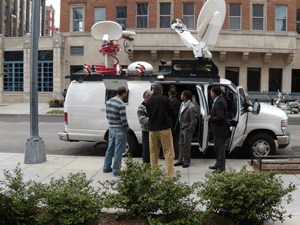
Last week,
NAB hosted the NAB Satellite Uplink Operators Seminar at NAB headquarters
in Washington, D.C. In addition to classroom course work, the
seminar includes hands-on training with a satellite uplink truck
provided this year by Fox-owned WTTG in Washington, D.C. (shown
in the photo to the right) and also a visit to the in SES Americom
Facility in Woodbine, Md. Sidney Skjei of Skjei
Telecom is the course instructor.
NAB has trained more than 650 engineers and technicians from radio
and television stations, universities and satellite services from
across the U.S. and abroad, including engineers from China, Europe
and Mexico. Look for the upcoming announcement on the 2011 class
schedule.
|