August 30, 2010
TV Tech Check

FCC Proposes to Let Other Entities Share the 7 and 13 GHz BAS Bands

On August 5, the FCC released a Notice Of Proposed Rulemaking and Notice Of Inquiry (NPRM/NOI) seeking comment on a number of proposals for increasing utilization of and providing increasing flexibility in the microwave bands.

In the Notice of Proposed Rulemaking portion, the Commission makes specific proposals that would allow Fixed-Service Point-to-Point microwave users (FS) licensed under part 101 of the rules to share certain spectrum bands currently used by the Broadcast Auxiliary Service (BAS) and the Cable TV Relay Service (CARS). The notice states that the FCC is not proposing to modify existing licenses and that any new licenses in this band will need to provide full protection for existing licensees.

The Commission has tentatively concluded that the 2025–2110 MHz band would not be a good candidate for FS sharing, at this time, because of the stresses and disruptions caused by the recently completed 2GHz relocation. In addition, they believe that the extensive number of BAS licensees in the band do not make the 2025–2110 MHz band a good candidate for additional sharing among fixed services. Instead, the FCC seeks comment on introducing FS systems into 750 megahertz located in the 6875–7125 MHz and 12700–13200 MHz bands.

In particular, the FCC seeks comment on how sharing between TV pick-up operations in the 6875–7125 MHz and 12700–13200 MHz bands (where ad-hoc frequency coordination is used) and FS would affect the flexibility of broadcasters in arranging their ENG operations. They also ask whether they should require BAS licensees to identify TV pickup receive-only sites in the ULS (it is currently optional) to aid in coordination with FS operations. The FCC also proposes to make additional channel bandwidths available in the 6875–7125 MHz and 12700–13200 MHz bands

With respect to technical rules for FS operation, the FCC proposes to apply the same technical parameters that currently apply to the Upper 6 GHz band to the adjacent 6875–7125 MHz band, because those bands are contiguous and should be able to use similar equipment. Those specific rules are:

  • applying a maximum frequency tolerance of 0.005 percent;
  • applying a maximum transmitter power of +55 dBw;
  • applying the antenna standards currently applicable to Upper 6 GHz Band stations authorized after June 1, 1997 to the 6875–7125 MHz band;
  • applying the capacity and loading requirements contained in Section 101.141(a)(3) of the Rules to this band; and,
  • confirming that the 17 kilometer minimum path length requirement of Section 101.143 would apply in the 6875–7125 MHz band.

The Commission also proposes to retain the rules that are already applicable to the 12700–13200 MHz band, with one exception. Currently, there is no minimum payload capacity applicable to the 12700–13200 MHz band. They propose to apply the minimum payload capacity and channel loading requirements that are currently applicable to the 11 GHz band to the 12700–13200 MHz band. They also seek comment on any special technical rules that might be necessary in that band.

The NPRM also seeks comment on a proposal to permit broadcasters greater access to Part 101 spectrum by eliminating the "final link" rule. While broadcasters are allowed to obtain private fixed service licenses under Part 101 of the Commission's Rules, Section 101.603(a)(7) prohibits broadcasters from using Part 101 stations as the final link in the chain of distribution of the program material to broadcast stations (e.g. an STL). The NPRM states the FCC believes that the "final link" rule may no longer serve a useful purpose and, in fact, may inhibit the full use of Part 101 spectrum.

The Notice of Inquiry portion of the item seeks comment on three issues:

  • Modification of Efficiency Standards in Rural Areas: seeks comment on whether lowering the current efficiency standards in rural areas would lower costs associated with providing backhaul service.
  • Review of Part 101 Antenna Standards: seeks comment on whether to review the antenna standards in any particular band to allow smaller antennas, to identify opportunities to facilitate increased deployment of FS facilities without subjecting other licensees to increased interference.
  • General Review of Rules: seeks comment on whether the Commission should examine any additional modifications to the Part 101 rules, or other policies or regulations, to promote flexible, efficient and cost-effective provisions of wireless backhaul service.
  • Comments on these proposals are due to the Commission by October 25, 2010 and reply comments are due on November 22. The Docket number is WT 10-153 and a copy of the NPRM/NOI is available at: http://hraunfoss.fcc.gov/edocs_public/attachmatch/FCC-10-146A1.pdf.

Sign up for NAB's 2010 Satellite Uplink Operators
Training Seminar
October 4 - 7, 2010
Washington, DC
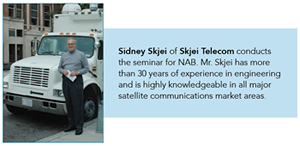
In just four days, NAB will teach you the skills necessary for the proper operation of the satellite uplinks. Now certified by the Satellite Users Interference Reduction Group (SUIRG), this course offers expert training for you and your staff. Interference is an industry-wide problem. One solution is well-trained operators. The seminar includes: in-depth information about the theory of satellite communications, a satellite newsgathering truck demonstration and a half-day field trip to SES Americom Operations Center. Space is limited so register now. There is additional information on NAB's website or contact Cheryl Coleridge at 202 429 5346.

ATSC Digital Television Transmission System Seminar
VSB Special Update Seminar

SCETV Telecommunications Center, Columbia, S.C.
Thursday, September 23, 2010
8:30 a.m. to 5:30 p.m.

An updated one-day seminar will be presented on the ATSC's digital television vestigial sideband (VSB) transmission system. The seminar will cover the fundamentals of the new mobile DTV transmission standard and its relationship to the legacy 8-VSB system. It will also cover practical broadcaster recommendations for improved DTV service and viewer educations as learned from last year's post June 12 field tests. The seminar is conducted by Gary Sgrignoli, DTV transmission engineer with Meintel, Sgrignoli & Wallace. This seminar is for broadcasters, broadcast consultants, equipment manufacturers, translator/LPTV operators and cable operators. For more information at SCETV contact Hap Griffin at 803 737 3486 or Tara Thomas at 803 737 3500. You may also contact the instructor Gary Sgrignoli at 847 259-3352.

Proposals Now Being Accepted for
2011 NAB Broadcast Engineering Conference
Las Vegas Convention Center, Las Vegas, Nevada
Conferences April 9 - 14, 2011/ Exhibits April 11 - 14, 2011
Deadline for submission is October 22, 2010
.

The 2011 NAB Show will host the 65th NAB Broadcast Engineering Conference. This world-class conference addresses the most recent developments in broadcast technology and focuses on the opportunities and challenges that face broadcast engineering professionals. Each year hundreds of broadcast professionals from around the world attend the conference. They include practicing broadcast engineers and technicians, engineering consultants, contract engineers, broadcast equipment manufacturers, distributors, R&D engineers plus anyone specifically interested in the latest broadcast technologies.

In order to be considered, proposals must explain what attendees can expect to learn from the paper, must not be a sales pitch and should be no more than 200 words in length.

Papers accepted for presentation at the 2011 NAB Broadcast Engineering Conference will be eligible for the NAB Best Paper Award. Established in 2010, the Best Paper Award honors the author(s) of a paper of exceptional merit published in the NAB Broadcast Engineering Conference Proceedings. The yearly proceedings, published as both a book and a CD-ROM is a compendium of these technical papers, and an important archive of the leading edge of broadcast engineering issues.

Technical paper proposals submitted for the 65th annual Broadcast Engineering Conference will be accepted until the October 22 deadline. If you have any questions, contact John Marino, VP NAB Science and Technology at (202) 429-5346.


The August 30, 2010 TV TechCheck is also available in an Adobe Acrobat file.
Please click here to read the Adobe Acrobat version of TV TechCheck.

ADVERTISEMENTS


TV TechCheck will not be published on September 6, but will return on
September 13
.