|
Broadcasters
and the Disaster Information Reporting System (DIRS)
The
FCC created the Disaster Information Reporting System (DIRS) in
2007 to help the FCC and the Department of Homeland Security's
National Communications System (NCS) obtain accurate information
regarding the status of communications services during a major
disaster, particularly during restoration efforts. Earlier this
month, the FCC 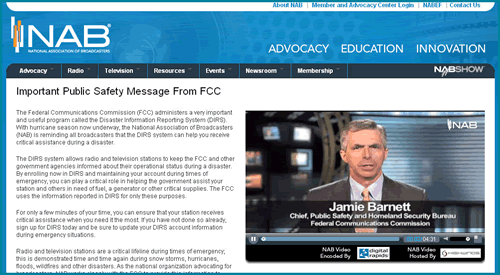 issued
a Public Notice encouraging radio and television broadcasters
who have not yet enrolled in DIRS to do so. They also encouraged
radio and television broadcasters who are already enrolled to
update their contact information on a routine basis. issued
a Public Notice encouraging radio and television broadcasters
who have not yet enrolled in DIRS to do so. They also encouraged
radio and television broadcasters who are already enrolled to
update their contact information on a routine basis.
Additionally,
NAB recently produced a brief video in conjunction with the FCC
that explains the importance of broadcaster participation in DIRS.
Featured in this video is the Chief of the FCC’s Public Safety
and Homeland Security Bureau, Jamie Barnett (shown here). This
video may be viewed on the NAB Web page: www.nab.org/documents/landingpages/dirs.asp.
DIRS is a
voluntary, web-based system that communications companies, including
wireless, wireline, broadcast and cable providers, can use to
report communications infrastructure status and situational awareness
information during times of crisis. The FCC, Federal Emergency
Management Agency (FEMA) and local public safety officials rely
on the information in DIRS to identify and help broadcast stations
in need of fuel, generators and other needed equipment during
times of emergencies. Broadcasters’ participation in DIRS
is especially important during hurricane season. In the Public
Notice, the FCC’s Media and Public Safety and Homeland Security
Bureaus acknowledge the nearly 800 broadcasters nationwide who
are now enrolled in DIRS, and reiterates the request that those
who have not yet enrolled do so as soon as possible given the
forecast for significant hurricane activity this summer and fall.
In more detail,
the Commission requests that each broadcaster participating in
DIRS obtain an individual DIRS User ID for all employees who may
provide information on the status of their company’s communications
equipment in the event of a disaster. When a qualified user applies
for a DIRS User ID, he or she must provide the following: a contact
name, company name, phone number, cell phone number, Blackberry/pager
number and email address. This information will be secured by
the Commission and protected from public release.
When a major
disaster is declared and disaster data collection is activated,
all affected contacts in DIRS will receive an email informing
them of the DIRS activation and requesting status information
on their station(s). In addition, broadcasters needing assistance
can convey those needs to the FCC and its federal partners via
DIRS.
Using DIRS
streamlines the reporting process and allows broadcasters to share
station status with the Commission, the Department of Homeland
Security (including FEMA) and other federal agencies quickly and
efficiently. Broadcasters can access DIRS at www.fcc.gov/DIRS
to enroll and to obtain a User ID. DIRS can also be accessed under
e-filing on the Commission’s main Web page (www.fcc.gov)
or on the PSHSB Web page (www.fcc.gov/pshs
using the “REPORTING SYSTEMS” link).
For questions
about DIRS, contact John Healy at the FCC by email (John.Healy@fcc.gov)
or phone (202-418-2448). The full text of the FCC’s Public
Notice is available at www.fcc.gov/Daily_Releases/Daily_Business/2010/db0806/DA-10-1459A1.pdf.
Also available on the Internet is an archived webcast on DIRS
which first aired in July 2009, produced by NAB in conjunction
with the FCC. This 2009 NAB webcast is available on the TV Worldwide
website at www.tvworldwide.com/events/nab/dirs/090714/.
|