|
Advanced
Audio/Video Interfaces for Consumer Devices
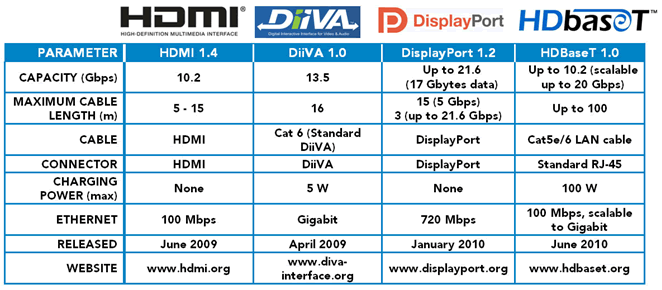
There was a time when audio/video enthusiasts could get by with RCA-connectorized composite video and audio cables, or perhaps an S-Video cable, but since the era of high definition digital TV, those days are long gone. As the capabilities and complexity of home entertainment components has increased, so too has the need for better and more capable interface standards. While most current equipment relies upon the popular High Definition Multimedia Interface (HDMI), there are a number of advanced A/V interfaces currently available and vying for consumer acceptance and adoption. Four of those technologies, including the latest version of HDMI, HDMI 1.4, are described below (with some technical highlights summarized in the table).
HDBaseT
1.0
- just last month, the HDBaseT Alliance, a cross-industry alliance
formed to promote and standardize the HDBaseT technology for whole-home
distribution of uncompressed high definition (HD) multimedia content,
announced its formal incorporation and the finalization of the
HDBaseT 1.0 base specification. Perhaps the most distinguishing
characteristic of HDBaseT is that it utilizes the widely available
(and inexpensive) Cat 5e/6 cables and RJ-45 connectors, in contrast
with, for example, specialized HDMI cables which are significantly
more costly.
HDBaseT is based upon a technology developed by the Israeli
firm Valens Semiconductor (www.valens-semi.com/)
called 5Play that converges full uncompressed HD video, audio,
100BaseT Ethernet, high power over cable and various control signals
through a single CAT5e/6 LAN cable. HDBaseT has the bandwidth
to support video resolutions from full HD 1080p to 3D TV formats
and 4K x 2K formats. Using the HDBaseT interface, a single-connector
TV can receive power (up to 100 W), video/audio, Internet and
control signals from the same cable.
HDBaseT enables
a network of sources - such as digital video recorders (DVR),
Blu-ray disc players, game consoles, PCs and mobile devices -
to be connected directly to displays in multiple locations. For
instance, a DVR can be connected to several TVs throughout the
home, allowing users an independent yet fully compatible experience.
HDBaseT LAN based technology makes it possible to cut out the
assortment of cables for audio, video, connecting CE devices and
even the power source. This form of networking, whether it is
done by daisy chaining devices or through star topology, can be
applied in both the consumer home and for industrial applications
such as digital signage networking.
The HDBaseT
Alliance anticipates products with embedded HDBaseT technology
to be available in the second half of 2010, with the majority
of adoption taking place in 2011. The specification will also
be available for licensing within the second half of 2010. Development
and preparation for an HDBaseT Alliance Compliance Program is
currently underway. The Alliance plans to formulate a logo usage
and licensing program to ensure consistency and consumers' ability
to recognize interoperable HDBaseT devices in the market.
HDMI
1.4
- HDMI first appeared in the marketplace in late 2003 and is currently
the most widespread interface technology in home use for HDTV
devices. HDMI version 1.4 was announced in June of 2009 and offers
the following enhanced functionalities compared to previous versions:
HDMI Ethernet channel - HDMI 1.4 adds a data channel
and enables high-speed bi-directional communication. Connected
devices that include this feature will be able to send and receive
data via 100 Mbps Ethernet, providing support for IP-based applications.
Also, the HDMI Ethernet channel will allow an Internet-enabled
HDMI device to share its Internet connection with other HDMI devices
without the need for a separate Ethernet cable, and will provide
the connection platform to allow HDMI-enabled devices to share
content between devices;
Audio return channel - an audio return channel is supported
that will reduce the number of cables required to deliver audio
"upstream" for processing and playback. In cases where
HDTVs are directly receiving audio and video content, this new
audio return channel allows the HDTV to send the audio stream
to the A/V receiver over the HDMI cable, eliminating the need
for an extra cable;
Higher resolution - HDMI 1.4 devices can support HD resolutions
four times beyond the resolution of 1080p. Support for 4K x 2K
will allow the HDMI interface to transmit content at the same
resolution as many digital theaters. Formats supported include
3840x2160 at 24/25/30 Hz and 4096x2160 at 24 Hz. Also, the common
3D formats and resolutions are defined for HDMI-enabled devices.
The specification will standardize the input/output portion of
the home 3D system and will specify up to dual-stream 1080p resolution;
Expanded support for color spaces - expanded color spaces
designed specifically for digital still cameras are supported.
By supporting sYCC601, Adobe RGB and AdobeYCC601, HDMI-enabled
display devices will be capable of reproducing more accurate life-like
colors when connected to a digital still camera;
Micro HDMI connector - the Micro HDMI connector is a
significantly smaller 19-pin connector that supports up to 1080p
resolutions for portable devices. This new connector is approximately
50% smaller than the size of the existing HDMI Mini connector;
Automotive connection system - the automotive connection
system is a cabling specification designed to be used as the basis
for in-vehicle HD content distribution. Using the automotive connection
system, automobile manufactures will now have a viable solution
for distributing HD content within the car.
DisplayPort
1.2 -
DisplayPort is an open (and royalty-free) display interface standard
developed and managed by the Video Electronics Standards Association
(VESA, www.vesa.org) organization.
It was introduced in 2006 and is designed primarily for the PC
industry as a main display interface to replace DVI, LVDS and
VGA. DisplayPort Version 1.2 is a comprehensive extension to the
original DisplayPort standard offering new benefits including:
Higher
data rate - the maximum data transfer rate has been doubled
from 10.8 to 21.6 Gbps, greatly increasing display resolution,
color depths, refresh rates and multiple display capabilities;
Multi-streaming
- the updated interface supports the ability to transport multiple
independent uncompressed display and audio streams over a single
cable, supporting protected content and high performance applications
such as 3D gaming. This enables the use of multiple monitors connected
by cable in a daisy chain or hub configuration. Whereas the v1.1
DisplayPort standard could support one 2560 x 1600 monitor at
60Hz, DisplayPort v1.2 can support two such monitors with one
cable, or four 1920 x 1200 monitors. Many other combinations are
possible, including multiple video sources, multiple displays
(even at different resolutions) and multiple audio speakers;
Bi-directional
transfer - another new feature is the ability to support high-speed,
bi-directional data transfer, allowing USB 2.0 or Ethernet data
to be carried within a standard DisplayPort cable. For DisplayPort
v1.2, the maximum data rate of this "AUX" channel has been increased
from 1 to 720 Mbps, providing suitable bandwidth for USB 2.0.
The DisplayPort cable can therefore support USB data to/from the
display to support Display USB functions, in addition to sending
the video and audio information. Standard Ethernet can also be
transported in the DisplayPort cable;
Support
for 3D - DisplayPort v1.2 includes improved support for Full
HD 3D Stereoscopic displays, using up to 240 frames-per-second
in full HD, providing 120 frames-per-second for each eye. 3D transmission
formats supported include field sequential, side by side, pixel
interleaved, dual interface and stacked
DiiVA 1.0 - the Digital Interactive
Interface for Video and Audio (DiiVA) specification was developed
by a consortium led by Chinese consumer electronics manufacturers
Changhong, Haier, Hisense, Konka, Panda, Skyworth, SVA, TCL and
chip developer Synerchip (www.synerchip.com).
This consortium is also supported by Chinese national, regional
and local governments. One of the distinguishing features of DiiVA
technology is that, like HDBaseT, it utilizes Cat 6 cable, however
DiiVA uses a custom (and not an RJ-45) connector. Some of the
features and capabilities of DiiVA include:
Data
capacity - DiiVA supports a 13.5 Gbps data rate dedicated
to video and over 2 Gbps aggregate data rate in the hybrid channel
for bi-directional data and audio. Data types that are simultaneously
streamed include uncompressed high-definition video and audio
formats, USB, Ethernet and device control commands. The DiiVA
specification includes transport and network layers that enable
video streams, audio and data packets to be securely routed from
any source to any display on the DiiVA home network;
Gaming
- Video games can be played from any DiiVA-equipped TV because
the USB controllers for the game can be connected directly to
the USB port on the TV, instead of to the game console;
Power
features - Mobile devices can be charged through the DiiVA
connection while outputting HD audio and video and synchronizing
data to any source on the DiiVA network. Unused devices on the
network can be intelligently powered down automatically enabling
power savings;
Content
access - Applications on PCs can be launched from TVs; HD
and 3D movies on a DiiVA-equipped Blu-ray player can be accessed
from any DiiVA-equipped TV in the house.
Mark
your Calendars!
The 60th Annual IEEE Broadcast Symposium
Westin Hotel • Alexandria, Va.
October
20 - 22, 2010
 The 60th Annual IEEE Broadcast Symposium will feature a full
and varied technical program with a day of tutorials dealing with
ATSC Mobile and IBOC issues along with presentations from around
the world on important and significant new developments in radio
engineering, ATSC Systems and DTV Transmission issues. A panel
on spectrum issues related to the FCC's Broadband Plan will feature
experts from the broadcast industry and government. The 60th Annual IEEE Broadcast Symposium will feature a full
and varied technical program with a day of tutorials dealing with
ATSC Mobile and IBOC issues along with presentations from around
the world on important and significant new developments in radio
engineering, ATSC Systems and DTV Transmission issues. A panel
on spectrum issues related to the FCC's Broadband Plan will feature
experts from the broadcast industry and government.
Luncheon keynote speakers include Jim Martin, Director ISR Programs, Office of the Deputy Under Secretary of Defense and James E. O'Neal, broadcast historian and technology editor for New Bay Media's TV Technology. The Welcome and Manufacturer's Receptions provide an excellent opportunity for attendees to meet, mix, and discuss contemporary broadcast engineering issues.
The
symposium will be attended by broadcast engineers, consultants,
equipment manufacturers, government regulators, and educators.
The Broadcast Symposium offers Continuing Education Units (CEU)
for attending technical sessions. Registration and Technical Program
information for the IEEE Broadcast Symposium can be found at:
http://www.ieee.org/organizations/society/bt/.
The Advanced Television Systems Committee (ATSC) is holding their
1st Symposium on Next Generation Broadcast Television one day
prior (October 19) to the IEEE Symposium at the same location.
Additional information on the ATSC Symposium may be found at http://www.atsc.org/cms/.

The July 12, 2010 TV TechCheck is also available
in an Adobe Acrobat file.
Please click
here to read the Adobe Acrobat version of TV TechCheck
|

