|
Study
Tracks Online, Broadcast Media Usage
TV viewers have more options than ever for accessing video content. A study done earlier this year offers some interesting insights into how the media landscape is changing and how TV fits into this landscape. Titled "The Infinite Dial 2010: Digital Platforms and the Future of Radio," this study, in spite of its radio-centric title, offers an interesting look into TV and video, as well.
Arbitron
(Columbia, Md., www.arbitron.com)
and Edison Research (Somerville, N.J., www.edisonresearch.com)
are co-authors of this study, and have been jointly studying the
impact that digital platforms are having on radio and other media
since 1998. In this, their 18th study in a series, they provide
a wealth of information on consumer usage of digital media including
some interesting statistics on the use of social networking sites,
declaring social networking a "mainstream behavior" and Facebook
in particular an "essential platform."
For
the Arbitron/Edison Research study, a total of 1,753 persons in
the U.S. were interviewed from January 25 to February 22, 2010.
Telephone interviews were conducted with respondents age 12 and
older, chosen at random from a national sample of Arbitron's Fall
2009 survey diary keepers and through random digit dialing (RDD)
sampling in certain geographic areas where Arbitron diary keepers
were not available for the survey. Some of the key findings pertaining
to TV and online video viewing include:
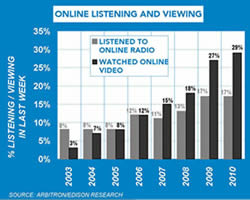 Online
listening and viewing - the weekly audience for online video
is substantially bigger than it is for online audio. The graph at
right charts this growth for the last eight years, indicating a
relative surge in online viewing in the last three years, from 18
to 29 percent, while during the same period the change in online
listening has been relatively flat, staying at 17 percent for the
last two years. Online
listening and viewing - the weekly audience for online video
is substantially bigger than it is for online audio. The graph at
right charts this growth for the last eight years, indicating a
relative surge in online viewing in the last three years, from 18
to 29 percent, while during the same period the change in online
listening has been relatively flat, staying at 17 percent for the
last two years.
Non-traditional
TV viewing now mainstream - a high percentage of persons are
consuming video in "non-traditional" ways as shown in the graph
to the lower left, with on-demand ordering of video from a cable
or satellite video service provider most prevalent of the non-traditional
methods
 Station
websites - consumers say that while radio station websites are
improving, TV and print sites are leading the local battle. Nearly
half of people age 12 and older give credit to radio for improvements
in their websites. Forty-eight percent say that radio station websites
have gotten more interesting compared to 17 percent believing them
to be worse or less interesting. However, monthly visitation to
radio station websites (16 percent) among persons 12+ lags visitation
to local TV and local newspaper websites. Station
websites - consumers say that while radio station websites are
improving, TV and print sites are leading the local battle. Nearly
half of people age 12 and older give credit to radio for improvements
in their websites. Forty-eight percent say that radio station websites
have gotten more interesting compared to 17 percent believing them
to be worse or less interesting. However, monthly visitation to
radio station websites (16 percent) among persons 12+ lags visitation
to local TV and local newspaper websites.
 Broadband
access has leveled - according to the study, the increase in
broadband access to the home has leveled off and growth has stabilized
for some digital platforms: Growth of residential broadband has
leveled off, with 84 percent of homes with Internet access having
broadband connections. The slower growth of residential broadband
is associated with little year over year change in weekly usage
of online radio (17 percent) and online video (29 percent). The
study suggests that expanded use of use of mobile devices and in-car
Internet may spark the next wave of growth. Broadband
access has leveled - according to the study, the increase in
broadband access to the home has leveled off and growth has stabilized
for some digital platforms: Growth of residential broadband has
leveled off, with 84 percent of homes with Internet access having
broadband connections. The slower growth of residential broadband
is associated with little year over year change in weekly usage
of online radio (17 percent) and online video (29 percent). The
study suggests that expanded use of use of mobile devices and in-car
Internet may spark the next wave of growth.
Wi-Fi
penetration - more than six in ten households with Internet
access have a Wi-Fi network at home: Sixty-two percent of homes
with Internet access have wireless network set-ups in their homes,
more easily enabling the consumption of digital media in any room
of their home.
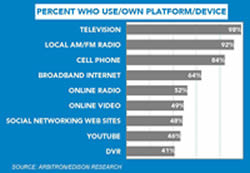
TV
has most widespread usage - when asked which platform or device
people use or own, TV ranked highest at 98 percent (see graph at
right), followed by local AM/FM radio (92 percent) and cell phones
(84 percent).
The
full version of the Arbitron/Edison Study is available online
from the Arbitron webpage at www.arbitron.com/study/digital_radio_study.asp.
|
|
TV
TechCheck
will not be published on July 5, but will return July
12, 2010.
|

The June 28, 2010 TV TechCheck is also available
in an Adobe Acrobat file.
Please click
here to read the Adobe Acrobat version of TV TechCheck
|