The ultimate goal of the broadcaster is to provide a quality
viewing experience for the viewer. A paper at the 2010 NAB Broadcast
Engineering Conference (BEC, April 10-15, 2010, Las Vegas, NV)
entitled "Broadcast Service Quality Monitoring Strategies" discusses
various approaches and strategies for monitoring service quality
throughout the broadcast system and for applying distributed monitoring
to broadcast architectures. This paper, excerpted here, was written
by Ralph Bachofen and Rich Chernock of Triveni Digital, Princeton
Junction, New Jersey.
DTV SYSTEM EFFECTS - DTV systems are very complex, with
numerous components that interact and need to be linked correctly.
Typical symptoms when things are not correct can include: receivers
having trouble tuning, no information in on-screen program guide,
programs missing, picture or sound breaking up, picture or sound
missing, noticeable "lip synch" errors and, most importantly,
upset viewers - resulting in complaint calls.
Symptoms of this sort can arise from numerous system issues:
equipment setup/configuration problems, equipment drift, equipment
failures, communication link failures, loss of synchronization
and human error (the "OOPs" factor). Finally, the actual problems
in the transport that can produce these symptoms include: PSI/PSIP
(Program Specific Information/Program and System Information Protocol)
tables missing, incorrectly formatted, incomplete and/or inconsistent;
excessive jitter in PCR (Program Clock Reference) values; audio
or video buffer underflow or overflow, audio or video program
element(s) missing (or effectively missing) or incorrect audio/video
synchronization.
STRATEGIC VIDEO MONITORING POINTS - from an engineer's
viewpoint, an ideal monitoring strategy might involve placing
monitors at all points that manipulate the digital signal, however
the costs of doing so might be too high. A more economical alternative
would be to the place permanent monitoring equipment at strategic
points and use portable equipment to uncover stream impairments
at tactical points as needed. In defining which points would be
considered strategic, there are basically two goals - to be able
to determine that an actionable impairment has taken place, and
to be able to localize the source of that impairment. The first
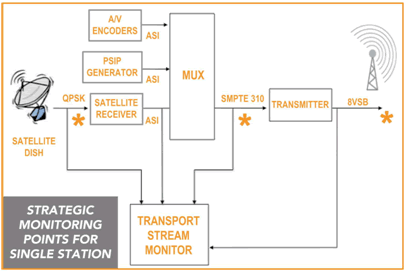
figure shows a single broadcast station and suggests strategic
points for monitoring (marked with "*"). These points have been
selected to have the highest impact for localizing impairments.
The rationale for these points is as follows:
8-VSB represents the final output transmission signal from the
station and is the one directly impacting the viewers. Monitoring
this point allows determination of the quality of the broadcast
reaching the consumers;
The mux output represents the output signal from the studio
to the transmitter;
The input from the satellite dish (if used) represents compressed
signals coming into the plant.
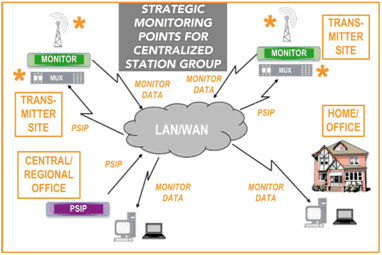
The second figure shows a more complex DTV broadcast distribution
system (typical for a small, centralized station group) and suggests
strategic points for monitoring. As above, "*" symbols are used
to indicate recommended strategic monitoring points. By appropriately
placing monitoring devices at each transmitter site, it is possible
to quickly isolate faults to a reasonable subset of systems to
troubleshoot.
For a centralized station group, there is often a distribution
of roles and expertise. Having the ability to remotely monitor
the transport at each of the stations in a region (both inside
the station and the RF emission output), it is possible for different
members of the organization to be aware of any impairments. Often,
there are regional "experts" who can react to and help with any
problems encountered at the stations. Distributed monitoring makes
this role possible without extra travel.
MONITORING INTERNAL AND EXTERNAL STREAMS - The internal
monitoring of transport streams by broadcasters ensures that over-the-air
viewers are receiving compliant digital television signals, but
effective monitoring of streams carried by a cable provider or
other downstream infrastructure also is critical to successful
carriage agreements and viewer satisfaction. Regardless of how
they receive a particular channel, audiences often associate video
and audio quality with the program, channel, or network they're
watching rather than with the service provider. The following
real-life example illustrates a situation where the ability to
monitor and compare internal and external streams on a continuing
basis would have been particularly effective in identifying and
resolving a problem quickly (conventional troubleshooting techniques
were used, which while solving the problem, were not as efficient).
Problem: cable viewers experienced visible or audible
glitches at approximately 7-minute intervals
Root cause of problem & resolution: it was determined
that an ASI/SMPTE-310 converter at the egress point of the station
(which fed both links) was dropping packets at approximately 7-minute
intervals (possibly a buffer mismatch issue). Updating software
on the converter solved the issue.
Suggested monitoring approach: by placing permanent monitoring
devices at both the broadcast output of the DTV station and the
ingest point of the cable head-end, existence of any impairments
could be quickly identified. Comparison of the transport stream
quality at both locations would quickly show whether the impairment
arose within the station or in the distribution link.
The full text of this paper is included in the Proceedings of
the 2010 NAB Broadcast Engineering Conference, which is available
for purchase online (book plus CD-ROM or CD-ROM only) from the
NAB Store at www.nabstore.com.
 Learn
how energy experts can help your station reduce expenses. Read
a case study (http://www.nab.org/xert/scitech/pdfs/WBOCcasestudyforNAB.PDF)
presented by NAB member benefit program APPI
Energy on how they saved member station WBOC money.
Learn
how energy experts can help your station reduce expenses. Read
a case study (http://www.nab.org/xert/scitech/pdfs/WBOCcasestudyforNAB.PDF)
presented by NAB member benefit program APPI
Energy on how they saved member station WBOC money.


