|
NAB 2010 is a Showcase for New Digital TV Technology
Last week's
2010 NAB Show (April 10-15, 2010, Las Vegas, NV, www.nabshow.com)
was a showcase for new digital TV technology both in the session
rooms and on the exhibit floor of the Las Vegas Convention Center
(LVCC). Below are some highlights from this annual industry event.

International Research Park - 2020 3D Media Research Project
– this was the first year for a new exhibit area, the International
Research Park, which featured advanced broadcast technologies
not yet commercially available. One of the exciting exhibits in
this area was from the European 2020 3D Media Research Project,
showing a highly advanced 3D production workflow. The system they
were demonstrating (see photo) utilizes three cameras working
together, one main and two satellite, to do “3D depth acquisition”
in a much more sophisticated fashion that the two-image stereoscopic
cameras being used commercially today. Looking closely at the
photograph, there are actually five cameras mounted on the rail
– a large main camera in the center, and two sets of satellite
cameras, which can be used alternately for experimentation.
The capture
of the three cameras' video streams is done within a new infrastructure
based on 10GigE and GigE-Vision. All uncompressed HD streams are
recorded on a single field recorder, the FlashPakII approach,
that can deal with up to seven cameras in parallel. The infrastructure
and the field recorder provides a net data bandwidth of 9 Gbit/s.
Members from this consortium exhibiting at NAB included JRS, Technicolor,
University of Hasselt and Barcelona Media. For more information
visit their Web site at www.20203dmedia.eu/.
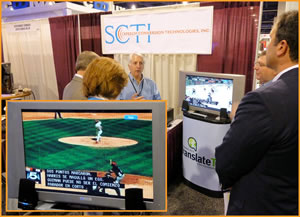 International
Research Park - Speech Conversion Technologies Inc. (SCTI) -
partly funded by the NAB FASTROAD program (www.nabfastroad.org),
SCTI was demonstrating a highly accurate automated speech recognition
and conversion technology called “AutoVOZ.” In the demonstration
(see photo), an English language audio program was being translated
into Spanish in real time, both into Spanish language captions
(shown on the screen) and to a natural-sounding Spanish voice.
Further, this tool synchronizes all of the captions (English and
Spanish) and voice (also English and Spanish) with the video.
For additional information, visit the SCTI Web site at www.speechtechno.com. International
Research Park - Speech Conversion Technologies Inc. (SCTI) -
partly funded by the NAB FASTROAD program (www.nabfastroad.org),
SCTI was demonstrating a highly accurate automated speech recognition
and conversion technology called “AutoVOZ.” In the demonstration
(see photo), an English language audio program was being translated
into Spanish in real time, both into Spanish language captions
(shown on the screen) and to a natural-sounding Spanish voice.
Further, this tool synchronizes all of the captions (English and
Spanish) and voice (also English and Spanish) with the video.
For additional information, visit the SCTI Web site at www.speechtechno.com.
Mobile DTV
Marketplace – a showcase of mobile DTV receiver technology,
the Mobile DTV Marketplace was located at the front of the LVCC
Grand Lobby. Sponsored by NAB, the ATSC, CEA and the Open Mobile
Video Coalition (OMVC), some of the mobile DTV receivers on display
included:
LG Electronics was showing the first consumer product to carry the
new ATSC Mobile DTV certification mark, the DP570MH 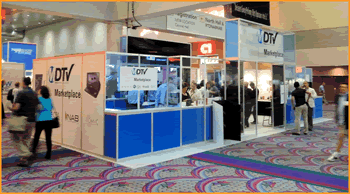 mobile
digital television with DVD playback. Also shown by LG was a prototype
GSM mobile phone with a built-in mobile DTV receiver; mobile
digital television with DVD playback. Also shown by LG was a prototype
GSM mobile phone with a built-in mobile DTV receiver;
Dell had on display an Inspiron Mini 10 with mobile DTV, WiFi
and embedded broadband capabilities along with mobile-DTV enabled
versions of its upcoming line of streak tablet computers;
The “Tivizen” model VTV-A10, a small, battery powered
mobile DTV receiver designed to receive mobile DTV signals then
stream them to WiFi-connected devices was also being shown. This
device, previously announced at the 2010 International CES as
the “Tivit,” is expected to be available in May for
a suggested retail price of $149;
USB receivers – among the first mobile DTV products to
reach consumers will be tiny USB receivers that will pick up mobile
DTV signals and allow a laptop or other mobile Internet device
with a USB connection to receive and display mobile DTV programs.
USB Receivers from DTV Interactive, iMovee, and Hauppauge were
featured.
ATSC Tech Zone -
Audio Loudness Management – in the ATSC Tech Zone
there was a demonstration of the tools necessary to address DTV
audio loudness concerns. As part of its ongoing loudness awareness
effort, the ATSC hosted NBC Universal and Dolby Laboratories in
the ATSC Tech Zone where they demonstrated methods to manage the
loudness of content during creation, distribution, and transmission,
then showing the results and the impact on the consumer experience.
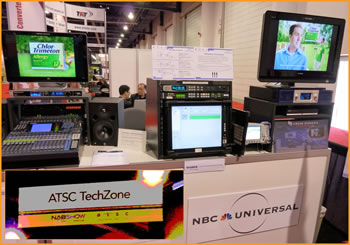 In
the demonstration, a booth “operator” could mix the
audio sources of NBC Nightly News with Brian Williams to the same
-24LKFS loudness as done in Studio 1A in Rockefeller Center. Once
the participant sets this level, the tools described in the ATSC
Recommended Practice make it simple to verify the loudness and
consistency of the signal as it passes through all points of the
signal chain, and ultimately to the consumer's set top box. In
the demonstration, a booth “operator” could mix the
audio sources of NBC Nightly News with Brian Williams to the same
-24LKFS loudness as done in Studio 1A in Rockefeller Center. Once
the participant sets this level, the tools described in the ATSC
Recommended Practice make it simple to verify the loudness and
consistency of the signal as it passes through all points of the
signal chain, and ultimately to the consumer's set top box.
As shown
in the photo, program audio flow is from left to right, beginning
with the mixing console through encoding and simulated transmission
to a consumer DTV receiver. The ATSC’s Recommended Practice
on loudness control, ATSC document number A/85, is titled “Techniques
for Establishing and Maintaining Audio Loudness for Digital Television.”
The RP provides guidance to broadcasters and creators of audio
for high-definition or standard-definition television content.
It recommends production, distribution, and transmission practices
needed to provide the highest quality audio soundtracks to the
digital television audience. The RP can be downloaded at no charge
from the ATSC Web site at www.atsc.org/cms/index.php/standards/recommended-practices.
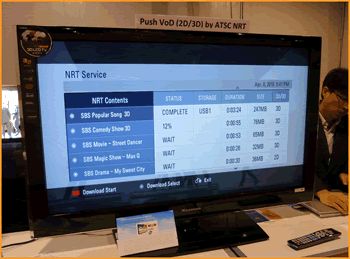 ATSC
Tech Zone – 3DTV using non real-time (NRT) services –
also in the TechZone was an exhibit conducted by a consortium
of Korean broadcasters, LG Electronics, and Kyung Hee University
of a non real-time (NRT) service using the ATSC digital TV system.
Their demonstration featured an end-to-end implementation of the
NRT technology which is one of the core elements of ATSC 2.0.
The content is encoded and delivered using ATSC NRT technology
and then stored at the local storage device attached to an NRT-capable
LG TV set through a USB connection ATSC
Tech Zone – 3DTV using non real-time (NRT) services –
also in the TechZone was an exhibit conducted by a consortium
of Korean broadcasters, LG Electronics, and Kyung Hee University
of a non real-time (NRT) service using the ATSC digital TV system.
Their demonstration featured an end-to-end implementation of the
NRT technology which is one of the core elements of ATSC 2.0.
The content is encoded and delivered using ATSC NRT technology
and then stored at the local storage device attached to an NRT-capable
LG TV set through a USB connection
In the demonstration,
a viewer could watch a live DTV transmission while at the same
time video files were being downloaded for later viewing. The
menu shown on the screen in the photo indicates content available
for NRT downloading (first column), the status of the download
(second column), etc. Much of the content being downloaded was
in 3D, representing one possible way that over-the-air DTV can
be used to support 3D video transmissions.
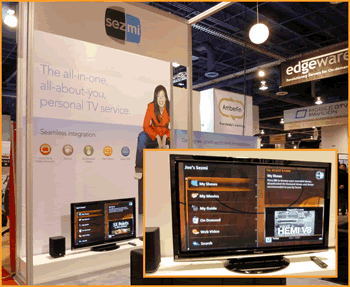 Sezmi
– Sezmi is a new video service that seamlessly integrates
live television, on-demand movies and television shows, and web
videos in an easily self-installed system that automatically records,
recommends and organizes the favorite shows of each individual
member of the family. In their exhibit at the NAB Show, Sezmi
was demonstrating this new service which is now available in the
Los Angeles, CA viewing area. Their booth is shown in the photo
at right, and in the inset is an example of the customizable user
interface which can be set up for each person in a viewing household. Sezmi
– Sezmi is a new video service that seamlessly integrates
live television, on-demand movies and television shows, and web
videos in an easily self-installed system that automatically records,
recommends and organizes the favorite shows of each individual
member of the family. In their exhibit at the NAB Show, Sezmi
was demonstrating this new service which is now available in the
Los Angeles, CA viewing area. Their booth is shown in the photo
at right, and in the inset is an example of the customizable user
interface which can be set up for each person in a viewing household.
The Sezmi
System can be purchased for $299 and includes an HD Media Recorder
that automatically organizes live, recorded, on-demand and online
content and can store up to 1,400 hours of programming. It also
includes an advanced indoor television reception system for receiving
local ATSC DTV broadcast channels and Sezmi’s programming
lineup of cable channels (which are included in the over-the-air
DTV transmission or downloaded from the Internet). Finally the
system includes a remote control featuring personal “mi”
buttons for each member of the family to quickly discover and
enjoy the programming they care about most. Sezmi expects to expand
their service beyond the LA area later this year. For additional
information, visit the Sezmi Web site at http://www.sezmi.com.
ADVERTISEMENT

|
The
April 19, 2010 TV TechCheck is also available
in an Adobe Acrobat file.
Please click
here to read the Adobe Acrobat version of TV TechCheck
|

