"Looking back over professional career that has
spanned almost 50 years, I now ask myself about why things turned
out the way that they did. Many engineers still use products that
I helped design from such companies as EMT, Lexicon, Orban, and
recently 25-Seven. I was president of the AES, started companies,
received patents, and provided expert witness services. Why was
I successful? These are the ingredients when I started my career
in the 1960s. I was blessed with native intelligence of a type
suitable for becoming an engineer. But I was certainly not the
smartest student at MIT. MIT provided me with a good education
with a faculty that was dedicated, brilliant, and on a mission.
My teachers were great. There were many who were better at mathematics,
circuit design, signal processing, and systems analysis. I was
good but not special. My concrete engineering knowledge and experience
were what I now call hard skills. They are the specialized knowledge
of your profession: measuring the radiation pattern of an antenna,
balancing the loudness of mixed program, repairing a defective
pre-amplifier. But the value of hard skill is not stable, changing
rapidly with shifts in supply and demand."
Dr. Blesser then acknowledged there was an element
of luck at the start of his career:
"My good luck, which I did not recognize at the
time, consisted of two unrelated factors. Firstly, advanced semiconductor
physics had just percolated down to undergraduate education in
electrical engineering. Previously it had been available only
for advanced graduate students. It was so new that there were
no textbooks. I was learning cutting edge technology. My generation
of students now had the ability to replace vacuum tubes with transistors,
with the corresponding increase in quality, dramatically reduced
size and power consumption. A few years before I became a student,
the Soviet Union shot Sputnik into outer space, and the US Government
dumped billions of dollars into engineering so that we could catch
up. There was so much money that engineers never lacked for resources."
He then discussed the need for other skills
than just technical knowledge:
�Like all professionals, I was constantly trying
to keep up, acquiring new hard skills as the previous ones became
obsolete. It was a never-ending battle, and eventually, I never
regained the stature of that initial period. But fortunately,
along the way, I discovered the Secret Sauce that would trump
the fragile nature of hard skills. I would like to share that
magic.
Soft skills are required to induce people to
work together for the mutual benefit all parties. Soft skills
allow you to make wise decisions that are consistent with your
enlightened self-interest. Soft skills reconcile different perspectives,
fusing together the collective wisdom of unique individuals. Soft
skills solve conflicts. Soft skills produce good communications.
Soft skills discover enlightened self-interest. I will try to
convince you of the value of soft-skills by first sharing personal
stories, and then giving you the general principles, which are
actually based on application of recent research from the cognitive
sciences."
He illustrated the need for soft skills with
an anecdote:
"While still an undergraduate I designed the
worlds first transistorized dynamic range compression product
for broadcasting. I sold the design to a boutique audio company
in Germany, EMT, and they invited me to spend a few months helping
them turn the design into a commercial product. Time passed, and
as a young professor at MIT I was in the forefront of the new
digital technologies. I realized that the time was right to design
a commercial digital delay device with high audio quality. I expected
that the executives at EMT would applaud the opportunity for them
to have a cutting edge product in their arsenal. The technical
implications were clear as day. It was obvious that I should offer
this product to EMT since I had a good working relationship and
a long history. I knew digital was the future; they would love
me even more because I was bringing them the keys to the future.
I told them about my new idea and how great it was, and implied
how great I was and how lucky they were to have me on their team.
And surprise, they said no thanks. I was crushed, hurt, angry,
and very disappointed. What happened? What had gone wrong? The
explanation: lack of soft skills! Lack of people skills! I had
the technology, but I didn�t know how to work with the people
making the decisions.
He set out some of the basic steps that can be
applied by an engineer when trying to get a proposal accepted,
perhaps by your general manager (GM):
(Step 1) Wait for the window to be open such
that the listener has the cognitive energy to actually pay attention
to what he might hear. If the GM is distracted with a crisis,
overscheduled meetings, hundreds of emails from headquarters,
he is unlikely to listen to any new ideas. No hearing is taking
place and you cannot compete with his other issues.
(Step 2) The window may be open to hear, but
there it is possible that a real response is not possible. The
GM may not be willing to hear more engineering-speak. Hook him
with a tease: "I had a great idea yesterday." Less is more.
(Step 3) Eventually the engineer will get an
invitation, and it will be on the GM�s terms when he has time
and mental energy to actually listen.
(Step 4) Make initial presentation in his language
so that he does not have to work hard at understanding. �I have
an idea that might enhance our profitability without requiring
a lot of risk."
(Step 5) Get him invested by showing that you
need his skills to make the idea work because there are issues
that he has more skills with. By his making a contribution, he
becomes emotional invested.
(Step 6) Use a language that reflects the self-image
that he wants to see. If he thinks of himself as a change agent,
emphasize how your idea supports that. If he is a bean counter,
emphasize the effect on the profit-loss statement for the next
quarter.
(Step 7) Plan joint tasks and meetings to emphasize
that you have just led the discussion to make the two of you a
team. Ask if he wants to add others to the team."
Dr, Blesser went on to explain some of the recent
research from cognitive science that supports and extends the
stories that he had shared and reasons that soft skills are so
important in a meeting or discussion. In particular, that emotions
are the key to soft skills and the answer to the question "Why
do I care?" He said how individuals broadcast their emotion from
more than 100 muscles in the face, from tone of voice, and body
language, etc. He indicated that while there are many ways to
learn to manage human system, one principle stands out among others:
time, saying:
"More specifically, the emotional brain piece
is extremely high speed, operating instantly, while you more rational
neo-cortex is extremely slow. If you slow time down, the rational
piece gets a change to catch up. If you respond instantly, you
are potentially functioning as if there were a lion in the environment.
There are other tools in the soft skills toolbox and I strongly
recommend that you find a way to those additional techniques.
Here is another exercise. When faced with a stimulus, slow time
down and create an explicit list of choices as to how you might
respond. Then analyze each response for its implications to your
long and short term well being. Only then pick your response.
It is good practice and eventually you can become proficient enough
to do it in real time."
Dr. Blesser finished his speech with some of
the characteristics of leaders:
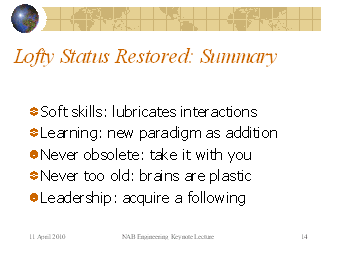
"Leaders are not born, but they do understand
how to make followers feel good by providing benefits in their
personal currency. They understand how to communicate in a multiplicity
of languages, being understood clearly. They understand the particular
cognitive strategies of their followers, be they all the same
or all unique. They recognize when a message is not being sent
accurately or received correctly. They can read the emotional
temperature and address the underlying source of a high temperature.
Anyone can become a leader once they acquire the necessary soft
skills. In my career, I never had authority, but I always acquired
leadership by how I treated people.
To answer the initial question:
"How to Restore the Lofty Status of Broadcast Engineers" the answer
is to increase the number and quality of your soft skills tools."
A recording of this speech, and all the sessions
of the NAB Broadcast Engineering Conference, are available for
purchase at the Online
Learning Center. The published papers are available in the
Proceedings, available from the NAB Store, at: http://www.nabstore.com/
.