One of the newest and most exciting DTV technologies is ATSC
Mobile DTV. A session at the upcoming NAB Broadcast Engineering
Conference (BEC, April 10-15, 2010, Las Vegas, Nev. - see below
for additional information) entitled "Mobile Television: Part
II" includes a paper, excerpted here, which discusses the
results of subjective evaluations of ATSC Mobile DTV video quality
as a function of bit rate.
INTRODUCTION - this paper presents the results of a subjective
assessment experiment that was conducted to examine the relation
between bit rate and perceived picture quality in the new ATSC
mobile digital TV standard. Using this new standard, broadcasting
services will be delivered using a portion of the 19.39 Mbps ATSC
8-VSB payload, leaving the rest available for normal HD/SD television
(and data) services. Since the bandwidth dedicated to mobile service
will be rather limited, every single bit allocated to mobile will
reduce the number of bits allocated to regular services by several
bits depending on the level of error protection chosen. Therefore,
it is important to determine the video quality performance of
the mobile system at different bit rates.
ASSESSMENT OVERVIEW - a group of non-expert viewers used
a single stimulus methodology to rate the perceived quality and
the degree of commercial acceptability of several short video
sequences. Thirty-two viewers, with a mean age of 28.6 years,
participated in this experiment. All viewers were screened for
normal visual acuity and color vision. They had no knowledge of
the purpose of the experiment. Video quality was rated using a
standard continuous scale. The sequences were displayed on a mobile
device. The video material was processed at eight different bit
rates using a current generation video encoder that supported
the ATSC Mobile DTV Standard (H.264 baseline profile; 416x240;
29.97 Hz).
VIDEO MATERIAL - the video material consisted of 14 video
sequences that had been selected to cover a wide range of picture
content. The duration of each sequence was eight seconds. Each
of the 14 original video sequences was processed at eight different
bit rates - 192, 288, 384, 480, 576, 672, 768 kbps and 2 Mbps.
The 2 Mbps bit rate is not formally part of the ATSC Mobile DTV
Standard; nonetheless, it was included in the study to provide
a high quality anchor. Viewing distance was not controlled; viewers
were allowed to hold the devices at any viewing distance they
deemed appropriate. Furthermore, the viewers were advised to hold
the devices as to maximize comfort and visibility, for example,
to avoid any possible reflections from ambient lights. Ambient
light varied between 12 and 15 lux, depending on seating position.
DESIGN AND ASSESSMENT PROCEDURE - the combination of
14 source sequences and eight bit rate conditions resulted in
112 test sequences to be evaluated. The viewers were asked to
rate the perceived video quality and the commercial acceptability
of each test sequence. Perceived video quality and commercial
acceptability were measured with a single-stimulus presentation
method. The method consists of a series of trials; in each trial
only one test sequence is presented and rated independently. Perceived
quality was rated using a standard continuous quality scale. The
scale consists of a continuous vertical line with five equal segments.
The descriptions: "Bad", "Poor", "Fair", "Good", and "Excellent"
are aligned with the five segments
RESULTS - the figure shows the relationship between bit
rate and perceived video quality for each of the 14 video sequences.
It can be noted that, as often observed, the effect of compression
on perceived video quality is highly dependent on the content
of the sequence (i.e., its spatiotemporal characteristics). At
low bit rates, there is a large difference between the perceived
video qualities of the different sequences; however, this difference
decreases with increasing bit rate.
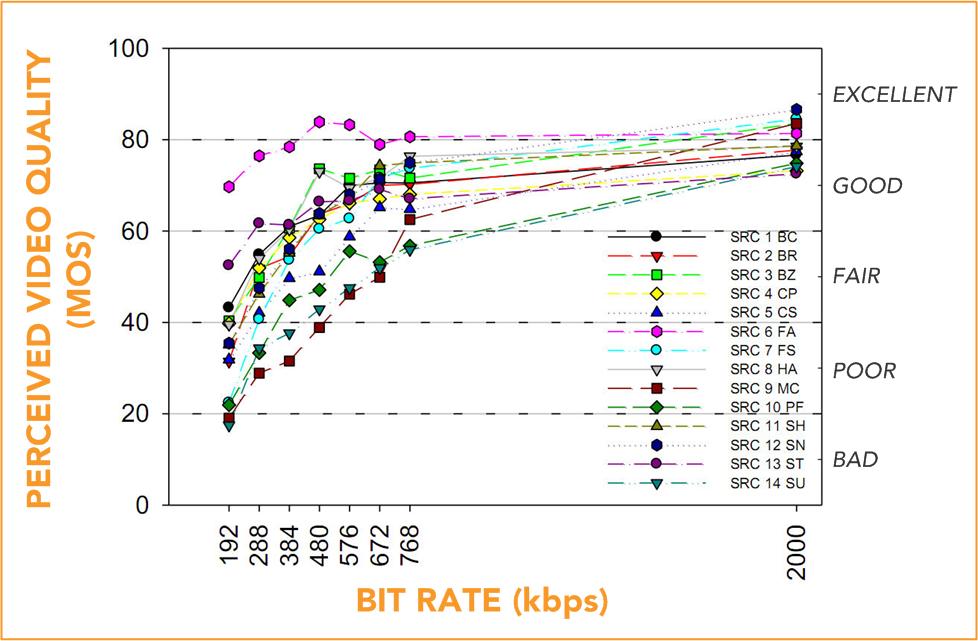
SUMMARY - the results suggest that bit rates around 300-400
kbps might be adequate for a mobile service, if high video quality
is not deemed necessary and/or the broadcasted content does not
have complex spatiotemporal characteristics. Higher bit rates
might be necessary if the broadcasted material must have a high
level of video quality and/or it consists of complex content.
This paper, entitled "Perceived Video Quality and Bit Rate in
the ATSC Mobile DTV Standard," will be presented by Filippo Speranza,
Research Scientist, Communications Research Centre Canada, on
Sunday, April 11, 2009 starting at 5:00 p.m. in room S219 of the
Las Vegas Convention Center. It will also be included in its entirety
in the 2010 NAB Broadcast Engineering Conference Proceedings,
on sale at the 2010 NAB Show Store and available on-line from
the NAB Store (www.nabstore.com)
after the convention. Other papers being presented during this
session include the following:
- ATSC A/153 Overview, Brett Jenkins, VP of Technology,
ION Media Networks
- Enhancing DTV Coverage: Implementing Vertical Polarization
for Existing Broadcast Antenna Systems, Kerry Cozad, Sr.
VP, Broadcast Engineering, Dielectric Communications
- Mobile DTV Service Guide and Data Services, Peter Mataga,
CT, Roundbox
- Practical Applications to the Installation of ATSC-M/H,
Don Tenhundfeld, Harris Corporation
- Audio Processing Requirements for Portable/Mobile Video
Applications, Ed Simeone, VP sales North America, Linear
Acoustic
For additional conference information visit the NAB Show Web
page at www.nabshow.com.



