NAB presents its Radio and Television Engineering Achievement
Awards each year at the NAB Show in Las Vegas. The awards, first
established in 1959, are given to individuals for their significant
contributions which have advanced the state of the art of broadcast
engineering. This year's winners, Mark Richer (Television and
Steve Church (Radio)) will be honored at the Technology Luncheon
on Wednesday, April 14.
Television Engineering Achievement Award Winner
Mark Richer
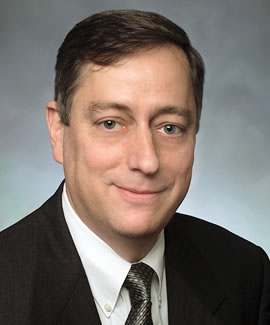 Mark
Richer is the President of the Advanced Television Systems Committee
(Washington, D.C., ATSC,
), the international, non-profit organization that develops voluntary
standards for digital television (DTV), as adopted for DTV broadcasting
in North America, South Korea, and several other countries. ATSC
member organizations represent the broadcast, broadcast equipment,
motion picture, consumer electronics, computer, cable, satellite
and semiconductor industries.
Mark
Richer is the President of the Advanced Television Systems Committee
(Washington, D.C., ATSC,
), the international, non-profit organization that develops voluntary
standards for digital television (DTV), as adopted for DTV broadcasting
in North America, South Korea, and several other countries. ATSC
member organizations represent the broadcast, broadcast equipment,
motion picture, consumer electronics, computer, cable, satellite
and semiconductor industries.
Mark has led the ATSC through the last decade, navigating a complex
and sometimes difficult period in the transition from analog to
digital television. Under his leadership, the organization has
responded to the needs of members and allied industries to produce
important standards for digital television. He has been instrumental
in maintaining the rapid pace of DTV standards development, keeping
the ATSC moving forward as an organization, relevant and the leader
in over-the-air DTV. Most recently the development of the ATSC
Mobile DTV standard is a major accomplishment and important opportunity
for the continuing success of broadcasting in the United States.
Previously, Mark was Vice President and General Manager at CDS,
a division of Thomcast Communications. While at Thomcast, he created
and managed Comark Digital Services, providing consulting, design
and turnkey services for broadcast television stations making
the conversion to digital technology.
Mark first joined the ATSC after 16 years with the Public Broadcasting
service (PBS) where, as Vice President of Engineering and Computer
Services, he was responsible for development of new technologies
for PBS and its member stations, design of audio/video systems
and management of computer operations. He was instrumental in
the development of technological innovations, including Line 21
closed captioning for the deaf, for which he was awarded an Emmy
for Engineering Development. He was also responsible for the selection
and implementation of digital video compression and transmission
technology and led PBS efforts in the area of digital and high
definition television. Prior to joining PBS in 1979, Mr. Richer
worked in various engineering positions in both commercial and
instructional television as well as for a major video/film production
facility.
Mark played a major role in the early planning for advanced television
in the United States, serving as Chair of the System Subcommittee
Working Party on Test and Evaluation for the FCC Advisory Committee
on Advanced Television Service. In this position, he was responsible
for testing proponent ATV systems, including that of the digital
HDTV Grand Alliance, which ultimately formed the basis for the
ATSC DTV standard.
Mark is a Fellow of the Society of Motion Picture and Television
Engineers (SMPTE) and a Senior Member of the Institute of Electrical
and Electronics Engineers (IEEE). He holds two patents and has
a Bachelor of Science degree from the Rochester Institute of Technology.
Radio Engineering Achievement Award Winner
Steve Church
 Steve
Church is the founder and Chief Executive Officer of Telos Systems
(Cleveland, Ohio, www.telos-systems.com),
a leading manufacturer of ISDN, coded audio and telephone interface
products for talk shows, teleconferencing, audio production, remote
broadcasts, and intercom applications. Among his many innovations,
Steve is perhaps most renowned for inventing in 1984 the world�s
first broadcast studio product using digital audio technology,
the famous Telos 10 telephone hybrid.
Steve
Church is the founder and Chief Executive Officer of Telos Systems
(Cleveland, Ohio, www.telos-systems.com),
a leading manufacturer of ISDN, coded audio and telephone interface
products for talk shows, teleconferencing, audio production, remote
broadcasts, and intercom applications. Among his many innovations,
Steve is perhaps most renowned for inventing in 1984 the world�s
first broadcast studio product using digital audio technology,
the famous Telos 10 telephone hybrid.
Prior to the Telos 10, the primary method used for putting callers
on the radio was with a speakerphone, a crude, one-way approach
at best due to the one-way audio path that resulted in the caller�s
audio disappearing when the radio announcer spoke. Steve was a
station chief engineer back then (he worked at WFBQ, Indianapolis,
and WMMS, Cleveland), and became determined to find a better way
to support call-in talk radio. His development of the Telos 10
digital signal processor (DSP)-based hybrid essentially turned
radio into a two-way medium and opened up the industry to numerous
new formats based on interactive talk.
The Telos 10 was to be but the first of many ground-breaking
broadcast technology innovations pioneered by Steve. In 1993 Steve
unveiled the Zephyr, the first single product to combine MP3 audio
and ISDN telephone technology, allowing for high-quality audio
to be transmitted without dedicated data circuits or satellite
paths. He was responsible for Zephyr NET, the first ISDN-based
program distribution network and the first low-cost alternative
�ad-hoc� audio distribution system in the world. For streaming
audio, Steve invented the hardware MP3 encoder with a built-in
audio server, the Audioactive Hardware Streaming Encoder, which
for the first time enabled streaming for radio stations as we
know it today.
Steve has made significant contributions in other areas, as well.
In 1997, Steve and his partner Frank Foti co-invented the Omnia.fm
audio processor. Steve and Frank perfected the DSP-based stereo
generator and composite limiter which made it possible to build
this fully-digital implementation. In 2003, Steve invented the
first standards-based audio-over-Ethernet transmission system
for broadcast, a protocol that became known as �Livewire.� The
use of standard Ethernet as a transmission backbone allowed the
use of inexpensive, off-the-shelf switching components from the
computer industry to create a real-time, uncompressed audio routing
system for broadcast at a fraction of the cost of equivalent systems.
Besides being an innovator, Steve is an author as well, having
written chapters in the past two NAB Engineering Handbooks on
broadcast telephony, and dozens of papers on different facets
of broadcast technology from audio coding to audio wiring.



