|  |  |

|
Video Transmission Demonstrated over Medium Wave DRM30
Called Diveemo, this new “…small-scale video service” was initiated as a joint effort between Fraunhofer IIS, Thomson Broadcast & Multimedia and Chengdu NewStar Electronics. According to a recent press release, “Diveemo delivers cost efficient large-area distribution of education and information video programs via DRM.” The launch of Diveemo at IBC featured a live video broadcast with BBC content displayed on a NewStar DRM receiver (shown in the photo). Some of the applications envisioned for Diveemo include usage as a distance learning system, news transmissions for offshore sites (such as oil drilling platforms), video information in alarm or emergency situations, video-based news services and advertising. Diveemo is designed to offer a convenient mobile small-scale video service experience, allowing users to quickly switch between channels and enjoy consistent audio and video even under bad reception conditions. A video stream can be accompanied by one or more audio streams, allowing for synchronous, multi-language support. Diveemo-enabled receivers also support all the features of the DRM Digital Radio standards, such as service selection by Unicode-compatible station labels, alternative frequency signaling and switching, announcement and warning/alert features. Diveemo is on track to be standardized by the European standards group ETSI (www.etsi.org) in the near future. 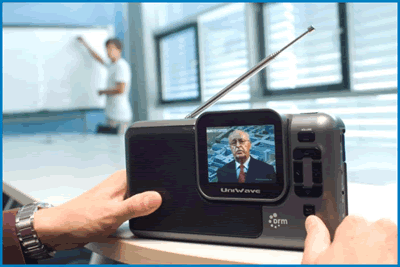
At IBC, the
live demonstration originated at the Orfordness, UK DRM transmission
site, approximately 200 miles from Amsterdam, on a frequency of
1296 kHz. For reception, a Diveemo-enabled NewStar prototype was
utilized (shown in photo). Some of the technical parameters for
Diveemo used in the demonstration include the following:
For DRM+, parameters
used for Diveemo are similar except the frame rate is increased
to 15 frames per second resulting in a net data rate of 185 kbps. |
 Digital Radio Mondiale (DRM,
 |
One
Week Left to Submit Proposals for the Deadline for submissions is October 22, 2010. There is only one week left to submit your proposal for the 65th NAB Broadcast Engineering Conference. This world-class conference addresses the most recent developments in broadcast technology and focuses on the opportunities and challenges that face broadcast engineering professionals. The topics of particular interested selected by the NAB Broadcast Engineering Conference Committee are listed on the Call for Proposal webpage. In order to be considered, proposals must explain what attendees can expect to learn from the paper, must not be a sales pitch and should be no more than 200 words in length. Papers accepted for presentation at the 2011 NAB Broadcast Engineering Conference will be eligible for the NAB Best Paper Award. Established in 2010, the Best Paper Award honors the author(s) of a paper of exceptional merit published in the NAB Broadcast Engineering Conference Proceedings. The yearly proceedings, published as both a book and a CD-ROM is a compendium of these technical papers, and an important archive of the leading edge of broadcast engineering issues. Technical paper proposals submitted for the 65th annual Broadcast Engineering Conference will be accepted until the October 22 deadline. If you have any questions, contact John Marino, VP NAB Science and Technology at (202) 429-5346.
The October 18, 2010 Radio TechCheck is also available in an Adobe Acrobat file. Please click here to read the Adobe Acrobat version of Radio TechCheck |