|  |  |

|
2010 Radio Show Wrap-up Last week’s Radio Show produced by RAB and NAB in Washington, D.C. was an unqualified success. Standing-room only crowds, new technology announcements, fast-paced and fact-filled conference sessions and an unparalleled opportunity for networking with radio industry peers were the hallmarks of this year’s show. Some of the highlights are summarized below. 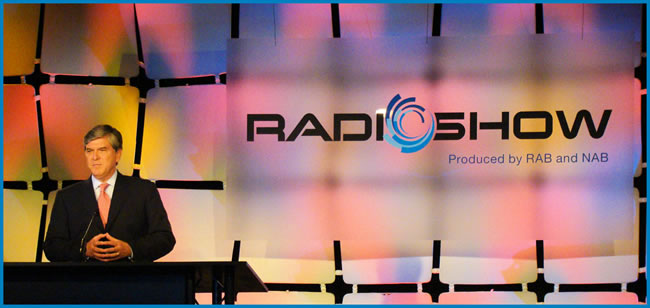
Gordon Smith Opening Remarks Expose Radio in Cell Phone Myths–one of the topics discussed by NAB President and CEO Gordon Smith (shown above) in his opening remarks was NAB’s ongoing efforts to get cellular carriers to make radio receivers a standard part of every cell phone. Smith noted in his remarks that “…there is a lot of misinformation out there regarding radio-enabled cell phones–myths about what we're trying to accomplish and what is technically feasible.” Senator Smith then went on to challenge those myths: "Myth #1: There is no consumer demand for radio–consumers tell us otherwise. Here's the reality: Americans would love to have free local radio on their cell phones. In a recent survey, 73 percent of cell phone owners said having free, local radio as an option on their phone is important to them; "Myth #2: Radio receivers would significantly impact the battery life of cell phones–this, too, is untrue. A typical cell phone with a radio receiver could provide the user with more than a full day's worth of radio listening on a single battery charge. Now, keep in mind most people charge their phones daily or every other day, which means a radio chip would have little to no effect on battery life; "Myth #3: Integrating radio into cell phones is a costly additional expense for manufacturers–the reality is the cost to the manufacturers would be very low. When mass produced, radio chips can be integrated into cell phones for pocket change. In fact, three out of four cell phone owners say they would consider paying the one time cost of enabling a phone with a radio receiver–that's how much they want local radio; "Myth #4: Critics argue that the size and weight of a chip would be too big and heavy for consumers–no one wants to bulk up their cell phone, even though we want more options and features. So luckily for cell phone users, a radio chip is smaller than the head of a nail and weighs less than a tic tac." Smith concluded this portion of his remarks by asking those assembled to help to correct the false information that they hear, stating that “…If cell phone service providers and handset manufacturers would look past the myths, they'd see that including radio in cell phones could open new revenue opportunities for all our industries.” The full text of Senator Smith’s keynote address is available online. 2nd Generation Insignia Portable HD Radio Receiver Unveiled–the Insignia NS-02 portable HD Radio receiver (see photos below) was on display at the HD Radio exhibit in the Radio Show “Marketplace.” This receiver is the successor to the NS-01 Insignia model with significant improvements including a new 2.4 inch LCD color touch screen interface and the introduction of three exciting new features: 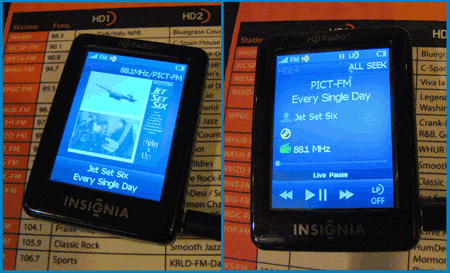
The Insignia NS-02 will be available later this year through Best Buy; suggested retail price has not yet been announced but it is expected to sell in the $70 price range. 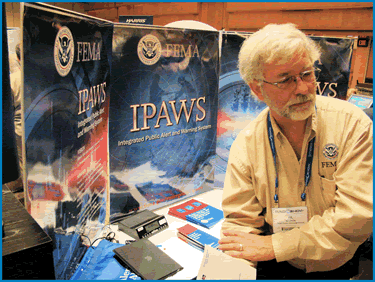
FEMA Announces Adoption of CAP–on Thursday, the Department of Homeland Security's Federal Emergency Management Agency (FEMA) announced the adoption of a new digital message format for the Integrated Public Alert and Warning System (IPAWS), the nation's next generation emergency alert and warning network. IPAWS incorporates and expands upon the traditional Emergency Alert System (EAS) supported by free over-the-air radio and TV broadcasters, and was being discussed by FEMA at their exhibit at the Radio Show (see photo–shown here is Alfred Kenyon, Project Manager, IPAWS Program Office, National Continuity Programs). The new digital message format adopted by FEMA is the Organization for the Advancement of Structured Information Standards (OASIS) Common Alerting Protocol (CAP) v1.2 Standard. This open standard will enable alert messages to be easily composed by emergency management officials for communication with citizens using a much broader set of devices to reach as many people as possible. In order to assist officials in evaluating new alert and warning systems, FEMA is conducting an assessment program to ensure products adhere to the IPAWS CAP profile. A list of pre-screened products that meet the profile will be published at the FEMA Responders Knowledge Base, to aide federal, state, territorial, tribal and local officials in purchasing emergency alert products that comply with IPAWS CAP. Vendors can apply for these assessments at www.nimssc.org/ipawsconform. The three documents defining the FEMA IPAWS technical standards and requirements for CAP and its implementation are: (1) OASIS CAP Standard v1.2; (2) IPAWS Specification to the CAP Standard (CAP v1.2 IPAWS USA Profile v1.0); and, (3) CAP to EAS Implementation Guide. Additional information and documentation on CAP technical standards can be found on the OASIS website. The CAP-EAS Implementation Guide can be found on the website of the EAS-CAP Industry Group (www.eas-cap.org/). The full FEMA press release is available online at www.fema.gov/news/newsrelease.fema?id=52880. 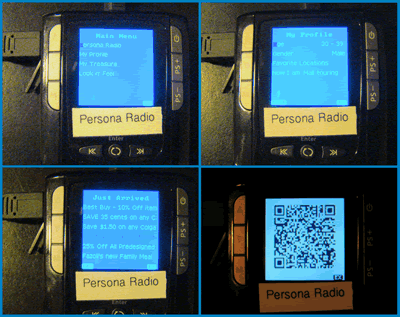
“Persona” Smart Radio Project–a proof-of-concept advanced receiver design was discussed by iBiquity in their exhibit on the show floor and shown to guests in the iBiquity hospitality suite. This project, funded in part by NAB’s technology advocacy program, FASTROAD, involves development of a “smart” receiver that allows users to create a customizable listening experience and allow behavioral targeted advertising. The Persona radio mock-up shown in the iBiquity hospitality suite was implemented on an Insignia NS-01 portable HD Radio receiver. Some pictures of the mock-up’s receiver display are shown here: NRSC Adopts NRSC-G202 Guideline–the latest National Radio Systems Committee (NRSC) Guideline, NRSC-G202, FM IBOC Total Digital Sideband Power for Various Configurations, was adopted by the NRSC’s Digital Radio Broadcasting (DRB) Subcommittee. This Guideline, which provides an easy-to-use, quick method for determining an FM IBOC station's authorized total digital sideband power level, was developed by the subcommittee's IBOC Standards Development Working Group (ISDWG), which is chaired by Dom Bordonaro, chief engineer, Cox Broadcasting–Connecticut. The DRB Subcommittee is co-chaired by Andy Laird, vice president and chief technology officer, Journal Broadcast Group, and Mike Bergman, vice president of new digital technologies, Kenwood USA. 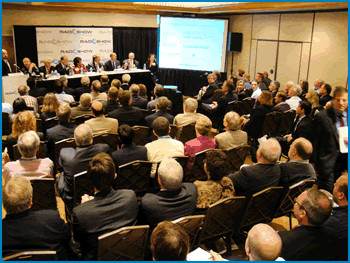
NRSC-G202 is intended as an aid to those who are responsible for or involved with FM IBOC facility design, operation and compliance monitoring. A companion, web-based total digital signal power calculator tool (shown to the right) has also been designed by the NRSC with assistance from broadcast engineering consulting firm of Cavell, Mertz and Associates. This new document is a companion to another NRSC Guideline, NRSC-G201-A, and expands upon information contained in Annex 1 of that document. The Guideline, and the web-based calculator, will be available on the NRSC website following a final procedural review which will take approximately two weeks. Additional information about the NRSC, including information on becoming a member, is also available on the website. Regulatory “Ask The Experts” Panel–one of the popular sessions at last week’s show was “Ask the Experts–Technical, Legal and Regulatory” which featured panelists from the FCC’s Audio Division, Media Bureau including Peter Doyle, Chief, and Jim Bradshaw, Deputy Division Chief, as well as Lisa Fowlkes, Deputy Chief, FCC Public Safety and Homeland Security Bureau. The standing-room crowd on hand to hear from these panelists is shown in the photo at the right. Topics discussed by the panel included “Franken FMs” (LPTV stations on TV channel 6 which are only transmitting an FM aural carrier, targeted for reception by FM receivers); FM translator processing issues; the Emergency Alert System (EAS), in particular the recent adoption by FEMA of the Common Alerting Protocol (CAP, discussed above); the authorization earlier this year of FM IBOC operation at elevated digital power levels and the updating of the FCC’s Consolidated Database System (CDBS). 
Experimental FM IBOC Asymmetric Sideband Transmission at WAMU–details on one of the first FM IBOC stations to go on-the-air with asymmetric sidebands were discussed for the first time last week, both at the Radio Show as well as at the Association of Public Radio Engineers (APRE) Public Radio Engineering Conference (PERC), also held last week in Washington. Public station WAMU (88.5 MHz, channel 203B) received an experimental authorization from the FCC to transmit an upper digital sideband at the maximum allowed power (equivalent to -10 dBc total digital power) and a lower sideband approximately 4 dB less than this, to protect 1st-adjacent station WHMM (88.3 MHz, channel 202A, Spotsylvania, Va.). Shown in the spectrum plot is the WAMU transmitted signal which clearly illustrates the asymmetric sidebands. WAMU is using a Nautel transmitter with software that is using a new peak to average reduction (PAR) algorithm designed to support asymmetric operation. WAMU worked with NPR Labs in developing the experimental application submitted to the FCC which included an engineering study by NPR Labs. |
|
Plan
to Attend Keynote speakers
for this year's symposium include James Martin, Director, ISR Programs
for the U.S. Department of Defense and James O'Neal, Technology
Editor, TV Technology, USA. Additional details on the technical
program and how to register
are availale on the IEEE Broadcast Technology Symposium website.
The advance registration deadline is October 1! Submit
Your Proposal Now In order to be considered, proposals must explain what attendees can expect to learn from the paper, must not be a sales pitch, and should be no more than 200 words in length. Papers accepted for presentation at the 2011 NAB Broadcast Engineering Conference will be eligible for the NAB Best Paper Award. Established in 2010, the Best Paper Award honors the author(s) of a paper of exceptional merit published in the NAB Broadcast Engineering Conference Proceedings. The yearly proceedings, published as both a book and a CD-ROM is a compendium of these technical papers, and an important archive of the leading edge of broadcast engineering issues. Technical paper proposals submitted for the 65th annual Broadcast Engineering Conference will be accepted until the October 22 deadline. If you have any questions, contact John Marino, VP NAB Science and Technology at (202) 429-5346. The October 4, 2010 Radio TechCheck is also available in an Adobe Acrobat file. Please click here to read the Adobe Acrobat version of Radio TechCheck |