|  |  |

|
Capitalizing
on the Future Started as an annual event in 1995, the NAB Futures Summit has become a unique opportunity to hear fresh ideas, many of which are based on technologies new to the broadcast industry. The Summit attracts visionary thinkers who are interested in networking with broadcasters and formulating win-win alliances and partnerships. The Summit offers the perfect venue to meet with peers from the broadcast industry and discuss new strategies for these critical times. The 16th annual NAB Futures Summit will be held November 7 - 9 at The Terranea Resort in Rancho Palos Verdes, Calif. The Summit will include forward-looking presentations, demos and panel discussions focused on innovative, bold ideas that help generate revenue, reduce expenses and enhance asset value. Whether it’s 3D, HD, the Internet or mobile devices, capitalizing on the next generation of technology is just smart business strategy in today’s highly-competitive marketplace. Here are some key Futures Summit speakers and topics: Wilfred
Martis, General Manager, Retail CE Products, Digital Home Group,
Intel Corporation Brian Cooley,
Editor at Large, CNET He is CNET’s senior analyst and commentator, frequently called upon by CNBC, CBS, CNN, ABC News and many other outlets for insights into consumer technology. Most recently he was behind CNET’s move to add in-car technology to its coverage. Prior to joining CNET in 1995 he enjoyed a 15-year stint as a radio host in Los Angeles and San Francisco. Cooley’s family has come from Silicon Valley long before it produced silicon. Topic: Show and Tell – Consumer Electronics Devices and Their Impact on Broadcasting. Jack Perry,
CEO, SyncBak Perry holds eight patents related to delivery of entertainment content over-the-air, over-satellite and over-the-Internet. He is a respected figure inside the beltway on issues related to digital entertainment, copyright and communications law and has testified before U.S. Congress twice. In 2005 he joined representatives of Microsoft, Verizon and Comcast to brief Congress on the impact of Internet protocol-enabled services in the communications industry. Perry was inducted into the Academy of Digital Television Pioneers in 2002 and nominated for an Academy Award (Best Industry Leadership) in 2005. He was also elected to National Academy of Television Arts and Sciences in 2003 and named one of the 40 most influential people in the consumer electronics industry the same year. Topic: Innovative Future Services for Television Broadcasters. Gary Arlen,
President, Arlen Communications For nearly 20 years, Gary has accurately analyzed the emergence of new media, forecasting the evolution of customer-controlled video and data services. Gary has published future-looking periodicals and consults for clients seeking strategic and business guidance to enter these new markets and is known for his insights into the development of applications, especially interactive content for Internet, two-way TV and other emerging systems. Among his specialties is what he calls "inter-species" breeding to integrate different types of services on new hybrid platforms. Gary's outlooks are published in industry journals, and his commentary is widely sought in the business and consumer press. Topic: Forget About Buttons! Gesture Control Is Coming for Consumer Devices. Mark Richer,
President, Advanced Television Systems Committee Mark first joined the ATSC after 16 years with the Public Broadcasting Service (PBS) where, as vice president of Engineering and Computer Services, he was responsible for development of new technologies for PBS and its member stations, design of audio/video systems and management of computer operations. Topic: How the ATSC Is Helping to Craft Television’s Future. David Wertheimer,
CEO and Executive Director, Entertainment Technology Center (ETC)
at USC Topic: The Outlook for 3D and Future Home Entertainment Technologies. Anthony
Wood, Founder and CEO, Roku Topic: Reinventing the Television Experience and Future Options for Consumers. Skip Pizzi,
Media Technology Consultant Skip has served as contributing editor at Radio World newspaper, where he wrote “The Big Picture” column that appeared in every issue. Skip was also editor-in-chief at Intertec Publishing Corporation, publisher of Broadcast Engineering and BE Radio (now Radio) magazines. Previously he spent 13 years at National Public Radio (NPR), as an audio engineer, engineering supervisor and technical director of numerous award-winning programs; he also founded the company’s technical training program. Topic: How Radio Broadcasters Can Benefit by Embracing New Technologies. The NAB Futures
Summit promises to equip you with the knowledge you need to understand
the opportunities and challenges being driven by technology. The
casual atmosphere surrounding the Summit program allows ample time
to network with our presenters and attendees. Additional information
on the Futures
Summit including registration
is available on NAB’s website. |
 Today more that ever, broadcasters should seek out the opportunities
of new technologies and think about how they could help their stations
by offering cost savings and revenue growth. New technologies will
continue to play a major role in defining future strategies for
moving organizations forward in the communications marketplace.
Today more that ever, broadcasters should seek out the opportunities
of new technologies and think about how they could help their stations
by offering cost savings and revenue growth. New technologies will
continue to play a major role in defining future strategies for
moving organizations forward in the communications marketplace. 
Ask the Experts at the Radio Show September 29–October 1, 2010 Grand Hyatt Washington • Washington, DC Ask the Experts is a series of sessions specifically designed by NAB Science and Technology for radio engineers and others interested in the future for radio broadcasting from a technology perspective. It will put you in front of people who are changing the rules, crafting new ones and enforcing compliance. Whether you handle technical operations at a small station, are in charge of a station group, or a consultant in the radio industry, Ask the Experts will offer a unique opportunity to join your colleagues and peers grilling our speakers for accurate answers to your most pressing questions. You may find the schedule for Ask the Experts and the other events plus information on registration and housing on the Radio Show website. Sign
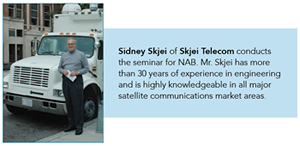
up for NAB's 2010 Satellite Uplink Operators In just four days, NAB will teach you the skills necessary for the proper operation of the satellite uplinks. Now certified by the Satellite Users Interference Reduction Group (SUIRG), this course offers expert training for you and your staff. Interference is an industry-wide problem. One solution is well-trained operators. The seminar includes: in-depth information about the theory of satellite communications, a satellite newsgathering truck demonstration and a half-day field trip to SES Americom Operations Center. Space is limited so register now. There is additional information on NAB's website or contact Cheryl Coleridge at 202 429 5346. Plan
to Attend Keynote speakers
for this year's symposium include James Martin, Director, ISR Programs
for the U.S. Department of Defense and James O'Neal, Technology
Editor, TV Technology, USA. Additional details on the technical
program and how to register
are availale on the IEEE Broadcast Technology Symposium website.
The advance registration deadline is October 1! Submit
Your Proposal Now In order to be considered, proposals must explain what attendees can expect to learn from the paper, must not be a sales pitch, and should be no more than 200 words in length. Papers accepted for presentation at the 2011 NAB Broadcast Engineering Conference will be eligible for the NAB Best Paper Award. Established in 2010, the Best Paper Award honors the author(s) of a paper of exceptional merit published in the NAB Broadcast Engineering Conference Proceedings. The yearly proceedings, published as both a book and a CD-ROM is a compendium of these technical papers, and an important archive of the leading edge of broadcast engineering issues. Technical paper
proposals submitted for the 65th annual Broadcast
Engineering Conference will be accepted until the October 22
deadline. If you have any questions, contact John
Marino, VP NAB Science and Technology at (202) 429-5346.
The September
20, 2010 Radio TechCheck is also available in
an Adobe Acrobat file. |
Advertisements
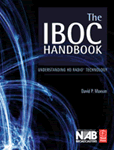 25% off The IBOC Handbook through October 2010 Enter coupon code IBOC25 |