|
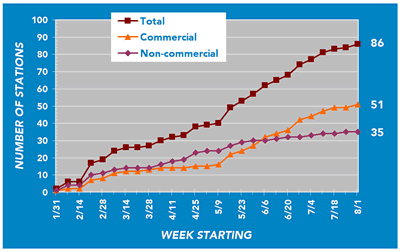
Update on Digital Power Increase for FM IBOC Stations It’s been six months since the FCC issued an Order authorizing FM in-band/on-channel (IBOC) digital radio stations to voluntarily increase digital power levels up to ten percent of analog power levels, and establishing interference mitigation and remediation procedures to promptly resolve complaints of interference to analog stations (see the February 1, 2010 issue of Radio TechCheck for additional information on the authorization Order). As of last week, 86 stations are currently operating with digital power levels in excess of 1 % (-20 dBc) of the analog signal power level, according to the Media Bureau’s Consolidated Database System (CDBS) Electronic Filing System (www.fcc.gov/mb/elecfile.html).
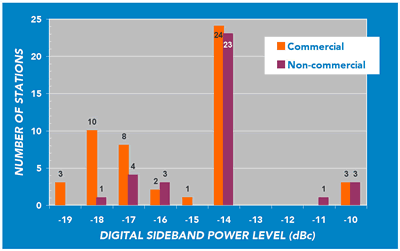
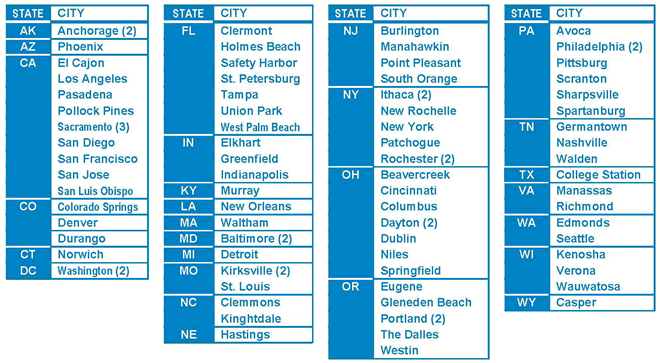
The two graphs illustrate when stations have increased digital power (upper graph), and what increased power levels they are operating at (lower graph), for both commercial and non-commercial stations. Since the authorization, 51 commercial and 35 non-commercial stations have elected to operate at increased digital power. The table below lists the cities where these stations are located. Not surprisingly, over half of these station (55 percent) are now operating at -14 dBc, which is the “blanket” authorized power level for most stations. All but “super-powered” stations (those operating in excess of their class limits) can increase to this power level simply by notifying the Commission (see below for details on notification). Seven stations are now operating in excess of -14 dBc, with six of these having increased to the maximum allowed -10 dBc. Requests for operation with digital power in excess of -14 dBc (or in excess of -20 dBc for super-powered stations) must be filed electronically in CDBS. Applicants should use the “Engineering STA” form for this purpose and should check the boxes marked “Licensed antenna” and “with other variance.” An explanation of the nature of the request should be included as a narrative attachment. The request must include an engineering showing in support of the request, as described in Paragraphs 15 – 20 of the Order. Thirty-seven percent of stations operating at elevated digital power levels are operating below the -14 dBc blanket authorization value, including three super-powered stations. It’s likely that many of these stations were able to increase their digital power without modifying their facilities, but not up to the -14 dBc level, and elected to implement a more modest increase as a result. For the super-powered stations, the maximum permissible increase is limited to the higher of either the original -20 dBc level or 10 dB below the maximum analog power that would be authorized for the class of the super-power FM station adjusted for the station’s antenna height above average terrain, predicted in accordance with Section 73.211(b) of the Rules. In order for a licensee to determine if its FM station is, by definition, a super-powered FM station, the Bureau has provided an FM Super-Powered Maximum Digital ERP Calculator on the Bureau’s Audio Division Web page (www.fcc.gov/mb/audio/digitalFMpower.html).
|
|
FM stations which are planning to increase their digital power should refer to a Public Notice released by the Media Bureau on May 17, 2010 which provides guidance regarding operations with increased digital power. Some of the points discussed in the Public Notice include the following:
The full text of the clarification Public Notice is available on the FCC’s web page at http://hraunfoss.fcc.gov/edocs_public/attachmatch/DA-10-866A1.pdf. On Thursday, September 30 from 3:30 - 5:00 p.m. at the Radio Show there will be a full team of experts from iBiquity to answer all your questions about HD Radio. This is a rare chance to ask about the future of this technology, what new implementations are in the works, and what receiver manufacturers are doing. Get the real story on where AM digital is headed, increased digital power, interference concerns and new concepts and products that are planned for the very near future. This is only one of the Ask the Experts technical sessions at the Radio Show which will be held September 29 through October 1 in Washington, D.C. Additional information on registration and housing for the Radio Show is available on radioshowweb.com. Proposals
Now Being Accepted for Las Vegas Convention
Center, Las Vegas, Nevada Conferences
April 9 - 14, 2011 Exhibits April 14 - 11
In order to be considered, proposals must explain what attendees can expect to learn from the paper, must not be a sales pitch, and should be no more than 200 words in length. We will consider
topics related to broadcast engineering, such as:
The NAB Broadcast Engineering Conference is a highly-technical conference where presenters deliver technical papers ranging over a variety of topics relevant to the broadcast and allied industries. Presentations are limited to thirty minutes in length, including five or ten minutes for questions from the audience. The conference rooms are equipped with audio visual equipment that will accommodate standard computer presentations. Papers accepted for presentation at the 2011 NAB Broadcast Engineering Conference will be eligible for the NAB Best Paper Award. Established in 2010, the Best Paper Award honors the author(s) of a paper of exceptional merit published in the NAB Broadcast Engineering Conference Proceedings. The yearly proceedings, published as both a book and a CD-ROM is a compendium of these technical papers, and an important archive of the leading edge of broadcast engineering issues. Technical paper
proposals submitted for the 65th annual Broadcast
Engineering Conference will be accepted until the October 22
deadline. If you have any questions, contact John Marino, VP NAB
Science and Technology at (202) 429-5346.
The August
9, 2010 Radio TechCheck is also available in an
Adobe Acrobat file. |
Advertisements