|
FCC
Seeks Comment on Collection, Use and Dissemination of Data
The FCC collects
a lot of data from broadcasters, and broadcasters spend a lot
of time and money preparing and submitting this data. Last month,
the Commission initiated an examination of its data practices
“…to improve the way the Commission collects, uses and
disseminates data,” and broadcasters now have an opportunity
to comment on these practices. An important goal of this effort,
according to the FCC, is to “…eliminate unnecessary
data collection while ensuring that the FCC has the information
needed for sound analysis and policy making.”
Three Public
Notices were released simultaneously last month by the FCC’s
Wireline Competition, Wireless Telecommunications and Media Bureaus
announcing this initiative. Included in each Public Notice is
an Internet link to a “working inventory of data items to
help facilitate comments” in the form of a downloadable Microsoft
Excel spreadsheet. The Media Bureau’s spreadsheet lists 140
separate forms and rule provisions which involve data collection,
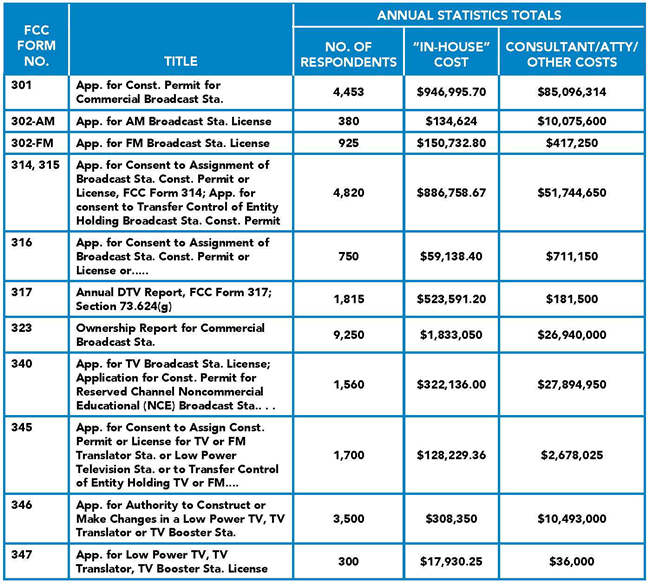
an excerpt from which is shown in the table below. Of particular
interest in this spreadsheet are Internet links to what are called
“Recent Supporting Statements” for the vast majority
of these items.
Included
in these Supporting Statements is a plethora of information regarding
the item in question, including the justification for the data
collection effort (for example, under which FCC rule part it is
required), and annual statistics on the number of respondents
as well as estimated “in-house” costs (incurred by the
broadcaster’s employees) and other costs incurred by the
broadcaster in submitting the data, for example, fees paid to
consulting engineers and outside counsel. As can be seen from
the figures in the table (which are taken from the Supporting
Statements), broadcasters are collectively spending a lot of money
on data collection efforts required by the FCC.
In
the Public Notice, the Media Bureau asks for comments and recommendations
on the following:
The utility
and rationale for each of its existing data collections. Specifically,
which data collections it should continue collecting; what alterations
should be made to specific data items collected; and, which data
collections the Bureau can eliminate without reducing the effectiveness
of its decision making;
Additional
data that commenters believe the Bureau needs to inform Commission
policymaking activities. The Bureau requests that commenters focus
their efforts on identifying data that the Commission has not
previously recognized it must obtain, rather than reiterating
the need for collections that already are under consideration.
Commenters should identify and explain in detail the rationale
for:
- additional data that should be collected;
- the method(s) through which the Bureau should collect the data
(for example, via purchase from third parties, primary research,
new forms, etc.);
- expected costs and burdens to the Bureau, industry and the public;
and
- any confidentiality or other issues that would impact the Bureau’s
collection or reporting of the data;
How the
FCC may improve collection and analysis processes for existing
collections. In particular, the Bureau seeks recommendations on
how it can reduce production burdens by use of technology or improved
practices. Commenters should identify and explain in detail the
rationale for:
- data collections that could be improved (including OMB PRA number,
if applicable);
- proposed improvements and how they could be implemented;
- expected reduction in burdens or cost savings to the Bureau,
industry or the public;
- data analysis and practices that the Bureau should undertake,
the capabilities required to do so and the anticipated benefits
each proposed improvement provides to the Bureau's data collection,
use and analysis; and
- any confidentiality or other issues that would impact the Bureau’s
implementation of the proposed improvements;
How it may
improve dissemination of reports and analyses it produces. In
this regard, the Bureau also seeks comment on how it should implement
the National Broadband Plan recommendations that (1) the Commission
have a “general policy of making the data it collects available
to the public, including via the Internet in a broadband data
depository, except in certain circumstances such as when the data
are competitively sensitive or protected by copyright,” and
(2) “the FCC should implement a process to make additional
data that is not accessible by the public available to academic
researchers and others, subject to appropriate restrictions to
protect confidentiality of competitively sensitive materials.”
Commenters should identify and explain in detail the rationale
for:
- Bureau reports or data for which access or dissemination could
be improved;
- proposals for improving access or dissemination, (for example,
how to handle data which is claimed to be proprietary);
- expected burdens, costs, or cost savings to the Bureau, industry
or the public;
- any confidentiality or other issues that would impact the Bureau’s
implementation of the improvements.
Interested
parties may file comments on or before August 13, 2010, and reply
comments on or before September 13, 2010. Filings in this proceeding
should be captioned “MB Data Review,” and filed in MB
Docket No. 10-103. The full text of the Media Bureau Public Notice
(including instructions for filing comments) is available on the
FCC’s Web site at http://hraunfoss.fcc.gov/edocs_public/attachmatch/DA-10-1195A1.pdf.
Links to all three Public Notices and data collection spreadsheets
are available at http://reboot.fcc.gov/data/review/.
|

 The
60th Annual IEEE Broadcast Symposium will feature a full and varied
technical program with a day of tutorials dealing with ATSC Mobile
and IBOC issues along with presentations from around the world
on important and significant new developments in radio engineering,
ATSC Systems and DTV Transmission issues. A panel on spectrum
issues related to the FCC’s Broadband Plan will feature experts
from the broadcast industry and government.
The
60th Annual IEEE Broadcast Symposium will feature a full and varied
technical program with a day of tutorials dealing with ATSC Mobile
and IBOC issues along with presentations from around the world
on important and significant new developments in radio engineering,
ATSC Systems and DTV Transmission issues. A panel on spectrum
issues related to the FCC’s Broadband Plan will feature experts
from the broadcast industry and government.