|
Radio
Data System (RDS) Update
Many (if
not most) FM radio broadcasters in the U.S. transmit the Radio
Data System (RDS) digital subcarrier along with their audio signal
and by doing so, provide their listeners with a variety of information,
predominantly song title and artist,  and
traffic information to specialized navigation devices (see the
April
13, 2009 issue of Radio TechCheck for additional background
information on RDS). There are two industry-sponsored organizations
that focus on RDS – the National Radio Systems Committee
(NRSC, www.nrscstandards.org)
here in the U.S., and in Europe, the RDS Forum (www.rds.org.uk/rds98/rds98.htm).
Both organizations have been very active lately and given below
is a summary of some of these recent activities. and
traffic information to specialized navigation devices (see the
April
13, 2009 issue of Radio TechCheck for additional background
information on RDS). There are two industry-sponsored organizations
that focus on RDS – the National Radio Systems Committee
(NRSC, www.nrscstandards.org)
here in the U.S., and in Europe, the RDS Forum (www.rds.org.uk/rds98/rds98.htm).
Both organizations have been very active lately and given below
is a summary of some of these recent activities.
UECP
specification update published
– the RDS Forum has recently made available online an updated
version of their SPB 490 Universal Encoder Communication Protocol
(UECP) Specification (Version 7.05/February 2010). This document,
first published in 1994, helps manufacturers of RDS system components
(for example, RDS encoders and network servers) achieve interoperability
by harmonizing various RDS encoder communication protocols.
The UECP
specification describes a universal layered protocol, based on
ISO/OSI recommendations, which encompasses all current RDS features
described in the most recent version of the RDS Standard (IEC/EN
62106 Ed.2 :2009-07). The model and protocol provided by the UECP
specification provides a template upon which new RDS system components
may be based. An encoder or network server does not need to implement
all the features described, but any feature implemented should
be made in accordance with the UECP specification.
UECP messages
are categorized into various groups including: RDS message commands,
transparent data commands, paging commands, clock setting and
control, RDS adjustment and control, control and set-up commands,
bi-directional commands (i.e., remote configuration commands)
and specific message commands. In the latter category, manufacturer
specific commands are possible using a manufacturer ID, which
can be obtained from the RDS Forum. The UECP specification is
available free of charge on the RDS Forum Web page at www.rds.org.uk/rds98/ebuuecpspecification.htm.
RDS
Forum topics of interest
– the RDS
Forum held its most recent meeting on June 14-15, 2010, in Glion/Montreux,
Switzerland. This annual two-day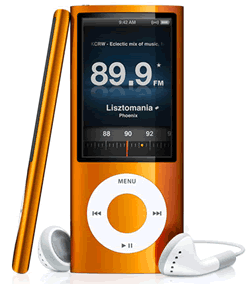 meeting provides members an opportunity to assess the current status
of RDS usage and implementation, and work to expand the capabilities
of the system, keeping it as relevant and useful for broadcasters
and listeners as possible. Two current topics being discussed within
the RDS Forum include:
meeting provides members an opportunity to assess the current status
of RDS usage and implementation, and work to expand the capabilities
of the system, keeping it as relevant and useful for broadcasters
and listeners as possible. Two current topics being discussed within
the RDS Forum include:
- RadioText+
: one of the most recent features to be added to RDS, RadioText+
makes it possible for receivers to parse and identify text information
sent over RDS using the RadioText feature. The recent implementation
of “RDS tagging” by such devices as the Apple iPod
Nano (see photo) utilizes RadioText+ features, and the RDS Forum
is encouraging application developers to make use of this powerful
new feature. An RDS Forum presentation entitled “Progress
on RT+ Implementation” is available for download at www.rds.org.uk/rds98/pdf/rdsForum_RTPlus%20progress_100427_8.pdf.
- Extending
AF to digital radio: a popular feature of RDS with government-sponsored
and public broadcasting radio network is Alternative Frequencies
(AF), whereby a station using RDS can transmit a list of radio
station frequencies (either AM or FM band) upon which the same
programming may be found. The RDS Forum recognizes that with
the worldwide implementation of digital radio systems now underway,
it would be desirable for the AF feature to support listing
of digital radio frequencies where the same programming may
be found, as well. This is an issue in particular for countries
that are using so-called “new band” digital radio
systems where the frequencies in use fall outside of the AM
and FM bands.
A presentation
on these and other topics currently of interest within the RDS
Forum is available from the RDS Forum website at www.rds.org.uk/rds98/pdf/rdsforum_study%20topics_100425_3.pdf.
Also, an article by the leaders of the RDS Forum, Dietmar Kopitz,
Johnny Beerling and Bev Marks, entitled “FM Radio with RDS
Will Have a Long Future,” was featured in the April 2010
International Edition of the newspaper Radio World, and is available
online at www.rwonline.com/article/98568.
NRSC
activities
– the Radio Broadcast Data System (RBDS) Subcommittee of
the NRSC is currently working on two RDS projects, an updating
of the NRSC version of the RDS Standard (called NRSC-4) and development
of an RDS usage guideline document. This Subcommittee was formed
in the early 1990’s to develop the U.S. version of the RDS
Standard, originally called the RBDS Standard so as to distinguish
it from its European counterpart. The RBDS Standard was first
adopted in 1993 and has been updated twice since then, in 1998
and most recently in 2005 when its designation was changed to
NRSC-4-A so as to conform to the NRSC Standards naming convention.
This latest
updating of the Standard, and the development of the RDS usage
guideline, are taking place within the Subcommittee’s RDS
Usage Working Group (RUWG), chaired by Steve Davis, Senior Vice
President, Engineering and Capital Management with Clear Channel
Broadcasting. The Subcommittee is currently under the leadership
of Barry Thomas, VP of Engineering, Radio with Lincoln Financial
Media. While the RUWG is doing the “nuts and bolts”
work on these documents, it will ultimately be up to the Subcommittee
to consider these documents for adoption.
The next
meeting of the RBDS Subcommittee will be held on Wednesday, September
29, 2010 in Washington, DC, in conjunction with The Radio Show
(September 29 – October 1, 2010, www.radioshowweb.com).
For additional information on the NRSC including a membership
application, visit the NRSC’s Web page at www.nrscstandards.org.
Mark
your Calendars!
The 60th Annual IEEE Broadcast Symposium
Westin Hotel • Alexandria, Va.
October 20-22, 2010
 The
60th Annual IEEE Broadcast Symposium will feature a full and varied
technical program with a day of tutorials dealing with ATSC Mobile
and IBOC issues along with presentations from around the world
on important and significant new developments in radio engineering,
ATSC Systems and DTV Transmission issues. A panel on spectrum
issues related to the FCC’s Broadband Plan will feature experts
from the broadcast industry and government. The
60th Annual IEEE Broadcast Symposium will feature a full and varied
technical program with a day of tutorials dealing with ATSC Mobile
and IBOC issues along with presentations from around the world
on important and significant new developments in radio engineering,
ATSC Systems and DTV Transmission issues. A panel on spectrum
issues related to the FCC’s Broadband Plan will feature experts
from the broadcast industry and government.
Luncheon
keynote speakers include Jim Martin, Director ISR Programs, Office
of the Deputy Under Secretary of Defense and James E. O'Neal,
broadcast historian and technology editor for New Bay Media's
TV Technology. The Welcome and Manufacturer's Receptions provide
an excellent opportunity for attendees to meet, mix, and discuss
contemporary broadcast engineering issues.
The symposium
will be attended by broadcast engineers, consultants, equipment
manufacturers, government regulators, and educators. The Broadcast
Symposium offers Continuing Education Units (CEU) for attending
technical sessions. Registration and Technical Program information
for the IEEE Broadcast Symposium can be found at: http://www.ieee.org/organizations/society/bt/.

July 12, 2010 Radio TechCheck is also available
in an Adobe Acrobat file.
Please click
here to read the Adobe Acrobat version of Radio TechCheck
|

