A paper at the 2010 NAB Broadcast Engineering Conference (BEC,
April 10-15, 2010, Las Vegas, NV) entitled "Extending Your HD
Radio Footprint" discusses the facility planning requirements
and technology choices involved in improving FM IBOC digital radio
coverage. Among other techniques, the paper discusses increasing
the digital power in an FM in-band/on-channel (IBOC) digital radio
signal (see the February
1, 2010 issue of Radio TechCheck for information on
FCC approval of the increase).
This paper, excerpted here, was written by Geoff Mendenhall,
Vice President - Transmission Research and Technology with Harris
Corporation, Mason, Ohio. For his effort, Geoff was awarded the
first ever NAB Best Paper Award for "...a paper of exceptional
merit published in the 2010 NAB BEC Proceedings, which was presented
to him at the NAB Technology Luncheon on April 14." NAB plans
to make the selection of a BEC "Best Paper" an annual tradition
at future BECs.
THE NEED FOR FULL HD RADIO COVERAGE - as HD Radio multicast
services become more important to the broadcaster's business model,
the need for an enhanced coverage footprint has become an imperative
for reliable digital reception on mobile and desktop devices.
The HD Radio multicast channels do not have the protection of
fall-back to analog when the edge of the digital signal coverage
is reached.
On January 29, 2010, the FCC's Media Bureau adopted an order
to modify the FM digital audio broadcasting rules to expand digital
coverage (available online at http://hraunfoss.fcc.gov/edocs_public/attachmatch/DA-10-208A1.pdf).
This change in the rules will allow virtually all stations to
increase their HD Radio digital power by +6 dB from the current
-20 dBc below the FM analog power level to -14 dBc, and some stations
up to -10 dBc. This amounts to a digital power increase of four
to ten times the current HD Radio power. The goals of increasing
HD Radio power are:
Reliable reception of multicast channels that do not have analog
fall back;
Better building penetration of HD Radio signal to portable and
desktop receivers;
Better mobile HD Radio digital reception in suburban areas;
Better digital reception on portable receivers with poor antennas.
SPACE COMBINING OR COMMON AMPLIFICATION - space combining
is often the most cost effective way to increase the HD Radio
power using the existing antennas and analog FM transmitter. If
the new transmission system isolation and power handling requirements
can be met, increasing the digital transmitter power is the only
equipment change. The shortcoming of space combining is the potential
for mis-tracking between the analog FM and digital HD Radio signal
levels in the far field. The causes of signal level tracking error
include the differences in the radiation center and the radiation
patterns of the two antennas. Even systems that use a single radiator
array with opposite circular polarizations for the FM and HD Radio
signals still suffer from mis-tracking at receive locations with
multipath signal reflections where the two different polarizations
add up differently.
LINEARITY CHALLENGE WITH HIGHER IBOC SIDEBANDS - the more
the amplitude of the IBOC carriers is increased, the more the
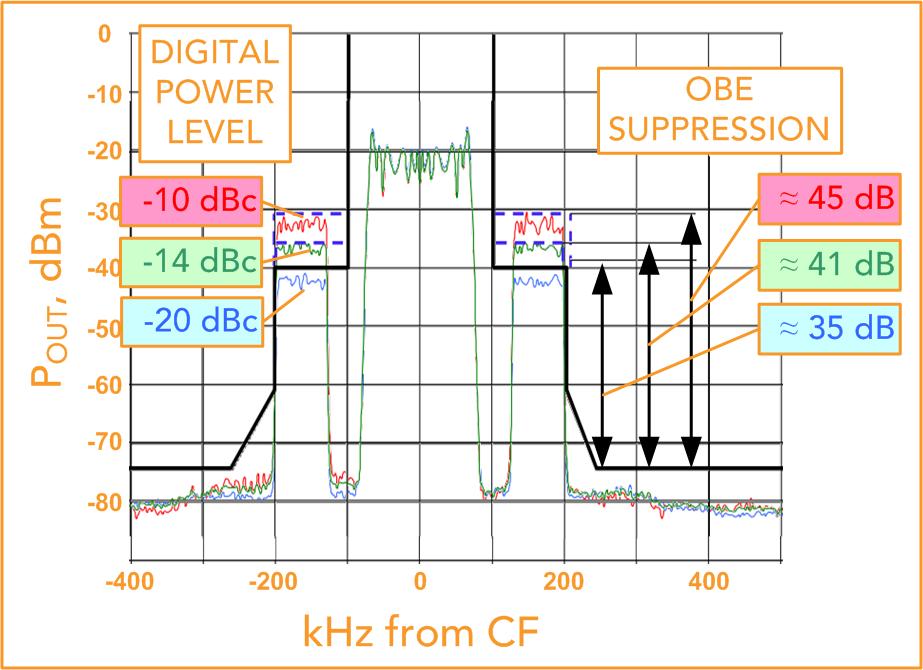
transmitter must be de-rated. At -10 dBc (10%) injection, the
RF intermodulation products need to be suppressed an additional
10 dB (see figure) at the same time the power output is increased
by 10 dB. This is a 20 dB net improvement (100x) in linearity
from that needed at -20 dBc (1%) to maintain the original RF mask
compliance. Due to the higher (3-5 dB) peak-to-average AM component
added to the constant envelope FM signal by the higher IBOC carriers,
the common amplification, FM + HD Radio transmitter must be further
de-rated from class "C" saturated FM operation. Common amplification
transmitters operating at -14 dBc will typically need an additional
back-off of about 1.4 dB or 72% of the -20 dBc rated power using
standard crest factor reduction.
ASYMMETRICAL HD RADIO SIDEBANDS - unequal HD Radio sidebands
can be used in both common amplification and separate amplification,
space combined systems to prevent interference to adjacent channels.
This will be a very important technique to maximize HD Radio coverage
for stations that cannot implement a full +10 dB increase for
both sidebands. Due to the redundancy of information transmitted
in both the upper and lower digital sidebands, HD Radio is still
receivable on standard receivers even if the upper and lower digital
sidebands are unequal. Operating with asymmetrical digital sidebands
can allow many stations to further increase in HD Radio digital
power above -14 dBc on one side of the station's channel while
still protecting adjacent channel stations with a closer spaced
protection contour on the other side.
ON-CHANNEL GAP FILLERS AND TRANSLATORS - single frequency,
on-channel gap fillers and two-frequency translators offer another
tool to improve HD Radio coverage without interference to others.
Both gap fillers and translators can be digital-only or analog
and digital both. In addition, asymmetrical sideband techniques
can be used with or without gap fillers and translators. HD Radio
gap fillers must be located with antenna patterns so that the
guard interval is met in those areas where the primary and secondary
(and/or tertiary) signals are all within 4 dB of each other. The
location of gap fillers that take advantage of terrain shielding
and directional antennas can expand the area over which HD Radio
digital reception is possible even outside of the guard interval.
The full text of this 10-page paper is included in the Proceedings
of the 2010 NAB Broadcast Engineering Conference, which is available
for purchase online (book plus CD-ROM or CD-ROM only) from the
NAB Store at www.nabstore.com.

Learn how energy experts can help your station reduce expenses.
Read a case study (http://www.nab.org/xert/scitech/pdfs/WBOCcasestudyforNAB.PDF)
presented by NAB member benefit program
APPI Energy on how they saved member station WBOC money.


