Last week's 2010 NAB Show (April 10-15, 2010, Las Vegas, NV,
www.nabshow.com) was a showcase
for new radio technology both in the session rooms and on the
exhibit floor of the Las Vegas Convention Center (LVCC). Below
are some highlights from this annual industry event.
RadioDNS – for the first time, the RadioDNS project
had a booth at the NAB Show, giving broadcasters in the U.S. an
 opportunity to learn about this exciting and innovative technology
which can link a radio broadcaster’s over-the-air signal
to its web page without sending any additional metadata. Shown
here in the exhibit are newly-elected RadioDNS chairman Nick Piggott
(on left) and secretary James Cridland.
opportunity to learn about this exciting and innovative technology
which can link a radio broadcaster’s over-the-air signal
to its web page without sending any additional metadata. Shown
here in the exhibit are newly-elected RadioDNS chairman Nick Piggott
(on left) and secretary James Cridland.
RadioDNS, a non-profit organization based in the U.K., allows
radio broadcasters to seamlessly enhance their existing analog
or digital broadcasts with IP delivered services. The project
uses a simple technology based upon the existing DNS (Domain Name
System) to allow IP-connected radios to automatically locate the
servers of the station the radio is tuned into. It's an open project,
with members and supporters from all over the world, including
Australia, Germany, the United Kingdom and the United States.
NAB recently became a member, and NAB Senior Director, Advanced
Engineering David Layer was recently elected to serve on the RadioDNS
Steering Board.
Shown in the RadioDNS booth was the PURE Sensia radio, which
is the first connected radio device to use the technology, enhancing
radio broadcasts with rich visual information acquired over IP.
The radio performs a simple lookup in DNS to translate a domain-name
based on the radio station's RDS or HD radio information, into
the broadcaster's own domain name. From then on, the radio can
find out what IP services the broadcaster supports, and provide
them to the listener. The same approach can be used by cellphones
with built-in FM or HD Radio functionality. Visit the RadioDNS
web page at www.radiodns.org
for additional information.
HD Radio Emergency Alerting – iBiquity
Digital Corporation, developers of HD Radio in-band/on-channel
digital radio technology, had two exhibits at the show. The first,
in the convention center grand lobby, consisted of a Ford truck
and Volvo SUV which come with HD Radio receivers as standard equipment.
In their main booth, located in the central hall, iBiquity was
showing a host of portable, automotive and home receivers as well
as a demonstration of a new datacasting technology iBiquity has
developed for emergency alerting.
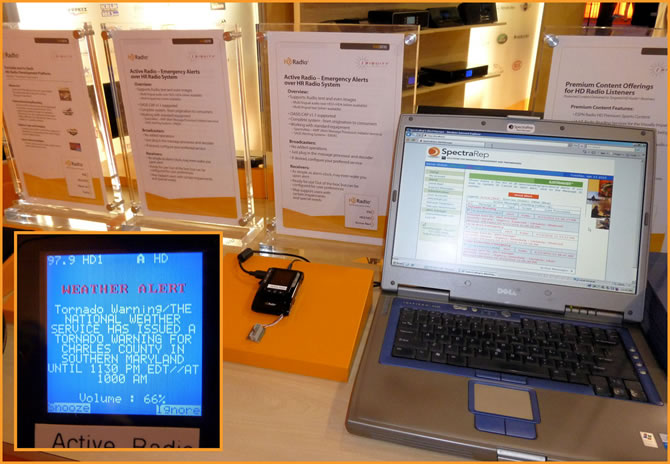
Called “Active Radio,” this new feature can “actively”
(that is, whether the listener’s radio is in use or not)
alert the public to life-threatening situations. This feature
may be supported by any FM or AM radio station broadcasting with
HD Radio technology and utilizes HD Radio system built-in capabilities.
An HD Radio receiver with Active Radio technology can detect Alert
information, even when turned “off” (but in a standby
mode) – an example of an alert sent using this technology
is shown in the inset in the figure above. This demo alert was
generated in the iBiquity booth using software developed by SpectraRep
(www.spectrarep.com),
seen on the laptop computer in the photo. Both audio and data
messages are supported.
New AM IBOC Configuration – in a radio technology
session on Sunday, iBiquity’s Director, Broadcast Business
Development Jeff Detweiler unveiled a new, optional AM IBOC configuration
which reduces the digital bandwidth and increases the analog bandwidth
of the AM IBOC hybrid signal. Shown in the figure are spectral
representations of the original configuration (“NORMAL MA1”)
and the new configuration (“MODIFIED MA1”). iBiquity
has created this new configuration to address concerns from some
AM broadcasters regarding so-called “host interference”
from the secondary and tertiary sidebands into the analog audio
signal.

This new configuration is made possible in part by advances in
audio coding technology which allow for good quality monaural
or “parametric stereo” audio in a 20 kbps audio stream.
While the normal MA1 configuration uses 36 kbps for audio, the
modified configuration uses these new 20 kbps streams, with the
choice of monaural or parametric stereo being decided by the broadcaster.
With this new configuration, iBiquity expects nearly all analog
radios to experience a signal-to-noise ratio (SNR) improvement
from 6 to 10 dB. Another benefit of the modified configuration
is elimination of the enhanced-to-core digital audio blending
which exists in the normal, 36 kbps multi-stream configuration.
Android-based Remote – in the Comrex booth, an Android
phone-based wideband audio “app” was being shown (see
photo). The ACCESS Reporter Codec, or  ARC, is a simple utility that allows select Android-based mobile
phones to make wideband audio calls to Comrex ACCESS and BRIC-Link
codecs. Once installed on an approved phone, the app displays
the familiar ACCESS interface and outgoing call listing. ARC makes
an IP call over the phone’s 3G or WiFi channel to your ACCESS
or BRIC-Link codec in the studio providing a full-duplex, wideband
high-quality audio channel between the two devices. Features include:
familiar Comrex ACCESS interface, simple touch screen functionality,
provides for full-duplex, wideband, voice quality audio, connects
to Comrex ACCESS or BRIC-Link via WiFi or 3G, works on Comrex-approved
Android phones. This app was being demonstrated in the booth on
a Google Nexus One phone.
ARC, is a simple utility that allows select Android-based mobile
phones to make wideband audio calls to Comrex ACCESS and BRIC-Link
codecs. Once installed on an approved phone, the app displays
the familiar ACCESS interface and outgoing call listing. ARC makes
an IP call over the phone’s 3G or WiFi channel to your ACCESS
or BRIC-Link codec in the studio providing a full-duplex, wideband
high-quality audio channel between the two devices. Features include:
familiar Comrex ACCESS interface, simple touch screen functionality,
provides for full-duplex, wideband, voice quality audio, connects
to Comrex ACCESS or BRIC-Link via WiFi or 3G, works on Comrex-approved
Android phones. This app was being demonstrated in the booth on
a Google Nexus One phone.


